Abstract
In previous investigations an ethanolic plant extract from Glycyrrhiza glabra (2.5% w/v) showed 100% efficacy against late blight (Phytophthora infestans) on detached tomato leaves. Based on these findings, the objective of this work was to investigate the effect of this extract against different important plant pathogenic fungi. Tests were carried out on potted plants. Against P. infestans, efficacies of 75% and 58% were achieved on tomato and potato plants with 5% extract concentration, respectively. Against another Oomycete, Pseudoperonospora cubensis, on cucumber, application of a 2.5% extract led to an efficacy of above 90%. The EC50-value was calculated to be 0.5% In a trial on beans against bean rust (Uromyces appendiculatus), G. glabra extract (5% concentration) showed 92% efficacy. In contrast, against powdery mildew on cucumber (Podosphaera xanthii), no disease reduction was found. Overall, the results indicate a high potential for the extract of G. glabra to control a number of important plant pathogens.
Abstract from the paper’s OpenAlex record, shown for indexing and research. Copyright remains with the authors or the publisher. Read at the source ↗
The text the model read, with the source record’s inline markup (italics, sub- and superscripts) rendered and its character entities decoded; quote offsets refer to the raw text.
Claims 6
Claim · model-written summary
A 5% extract gave 75% efficacy against P. infestans on tomato.
- Taxon
- tomato
 Solanum lycopersicume0
- Treatment
- 5% extract concentratione0
- Interactor
- P. infestans
 Phytophthora infestanse0pathogen
- Outcome
- efficaciese0
- Value
- 75%e0
Not reportedComparatorDirection
Organisms pictured · Representative pictures of the matched species, not figures from the paper.


Verbatim
e0“Against P. infestans, efficacies of 75% and 58% were achieved on tomato and potato plants with 5% extract concentration, respectively”
e1“Glycyrrhiza glabra extract”
Claim · model-written summary
A 5% extract gave 58% efficacy against P. infestans on potato.
- Taxon
- potato
 Solanum tuberosume0
- Treatment
- 5% extract concentratione0
- Interactor
- P. infestansPhytophthora infestanse0pathogen
- Outcome
- efficaciese0
- Value
- 58%e0
Not reportedComparatorDirection
Organisms pictured · Representative pictures of the matched species, not figures from the paper.

Verbatim
e0“Against P. infestans, efficacies of 75% and 58% were achieved on tomato and potato plants with 5% extract concentration, respectively”
Claim · model-written summary
A 2.5% extract gave above 90% efficacy against Pseudoperonospora cubensis on cucumber.
- Taxon
- cucumber
 Cucumis sativuse0
- Treatment
- 2.5% extracte0
- Interactor
- Pseudoperonospora cubensis
 Pseudoperonospora cubensise0pathogen
- Outcome
- efficacye0
- Value
- above 90%e0
Not reportedComparatorDirection
Organisms pictured · Representative pictures of the matched species, not figures from the paper.


Verbatim
e0“Pseudoperonospora cubensis, on cucumber, application of a 2.5% extract led to an efficacy of above 90%”
Claim · model-written summary
The extract EC50 was 0.5% in the cucumber trial.
- Taxon
- cucumberCucumis sativuse1
- Interactor
- Pseudoperonospora cubensisPseudoperonospora cubensise1pathogen
- Outcome
- EC50-valuee0
- Value
- 0.5%e0
Organisms pictured · Representative pictures of the matched species, not figures from the paper.
Verbatim
e0“The EC50-value was calculated to be 0.5%”
e1“Pseudoperonospora cubensis, on cucumber”
Claim · model-written summary
A 5% G. glabra extract gave 92% efficacy against bean rust.
- Taxon
- beanse0
- Treatment
- G. glabra extract (5% concentration)e0
- Interactor
- Uromyces appendiculatus
 Uromyces appendiculatuse0pathogen
- Outcome
- efficacye0
- Value
- 92%e0
Not reportedComparatorDirection
Organisms pictured · Representative pictures of the matched species, not figures from the paper.

Verbatim
e0“on beans against bean rust (Uromyces appendiculatus), G. glabra extract (5% concentration) showed 92% efficacy”
Claim · model-written summary
The extract did not reduce powdery mildew on cucumber.
- Taxon
- cucumberCucumis sativuse0
- Treatment
- G. glabra extracte1
- Interactor
- Podosphaera xanthii
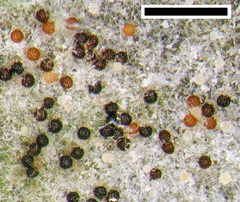 Podosphaera xanthiie0pathogen
- Outcome
- powdery mildewe0
- Direction
- no disease reductione0
Not reportedComparator
Organisms pictured · Representative pictures of the matched species, not figures from the paper.

Verbatim
e0“against powdery mildew on cucumber (Podosphaera xanthii), no disease reduction was found”
e1“G. glabra extract”
The same questions in other papers
botanical · Podosphaera xanthii · Cucumis sativus (cucumber)Positive and negative results
2 in the opposite direction
- positive
- positive
botanical · Phytophthora infestans · Solanum tuberosum (potato)Positive and negative results
15 papers in the same direction as this paper · 2 in the opposite direction
- positive
- negative
- no effect
14 papers more in this group
See all 18 papers →botanical · Phytophthora infestans · Solanum lycopersicum (tomato)Positive and negative results
23 papers in the same direction as this paper · 1 in the opposite direction
- no effect
- positive
- positive
21 papers more in this group
See all 25 papers →botanical · Uromyces appendiculatus · Phaseolus vulgaris (common bean)Results agree
2 papers in the same direction as this paper
- positive
- positive
botanical · Pseudoperonospora cubensis · Cucumis sativus (cucumber)Results agree
6 papers in the same direction as this paper
- positive
- positive
- positive
3 papers more in this group
See all 7 papers →Claims are grouped by organism, treatment and what was measured or targeted. A paper counts as positive when any of its claims in the group is positive.