Abstract
Wheat and barley plants that are severely infected with common root rot yield less than uninfected ones. Resistant cultivars usually have fewer diseased plants but some cultivars show tolerance as no yield loss occurs even though many plants display disease symptoms. This study assessed disease severity and yield loss due to common root rot in cultivars of wheat and barley by two techniques: i) sowing infested seed in soils with low inoculum levels of Bipolaris sorokiniana (Sacc. in Sorok.) Shoem., and ii) planting healthy seed in soil treated with the fumigants, metam and basamid. Infested seed exhibited reduced emergence, increased disease severity, but plot yield was not significantly affected compared with uninfested seed. The average yield loss or gain from seed treatment amongst all selections of wheat and barley was not significantly different. Losses were of the same magnitude (11.1% in barley, 6.2% in wheat) as reported in other studies. Soil fumigation reduced levels of B. sorokiniana in soil and disease severity. It also led to increased nutrient levels in soil and plant tissues, plant height, and plot yields by 16–29% compared with untreated areas. Tolerance to common root rot was exhibited by BW632, Virden, and Melvin. These losses are higher than reported in other studies which suggests yield loss may be underestimated or that common root rot is only one component of a root problem complex being affected by fumigants. Key words: Common root rot, loss, tolerance, seed inoculation, fumigation
Abstract from the paper’s OpenAlex record, shown for indexing and research. Copyright remains with the authors or the publisher. Read at the source ↗
The text the model read, with the source record’s inline markup (italics, sub- and superscripts) rendered and its character entities decoded; quote offsets refer to the raw text.
Claims 15
Claim · model-written summary
Infested seed reduced emergence relative to uninfested seed.
- Taxon
- wheat and barley
 Hordeum vulgare
 Triticum aestivumt0
- Treatment
- Infested seede0
- Interactor
- Bipolaris sorokiniana
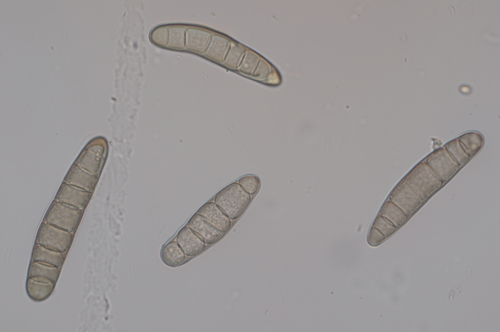
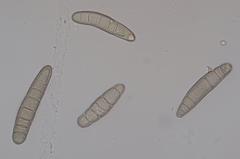 Bipolaris sorokinianat1pathogent0
- Outcome
- emergencee0
- Direction
- reducede0
- Comparator
- uninfested seede0
Organisms pictured · Representative pictures of the matched species, not figures from the paper.


Verbatim
e0“Infested seed exhibited reduced emergence, increased disease severity, but plot yield was not significantly affected compared with uninfested seed”
t0“wheat and barley tolerance and yield losses caused by common root rot”
t1“Bipolaris sorokiniana and soil fumigation methods”
Claim · model-written summary
Infested seed increased disease severity relative to uninfested seed.
- Taxon
- wheat and barleyHordeum vulgareTriticum aestivumt0
- Treatment
- Infested seede0
- Interactor
- Bipolaris sorokinianaBipolaris sorokinianat1pathogent0
- Outcome
- disease severitye0
- Direction
- increasede0
- Comparator
- uninfested seede0
Organisms pictured · Representative pictures of the matched species, not figures from the paper.
Verbatim
e0“Infested seed exhibited reduced emergence, increased disease severity, but plot yield was not significantly affected compared with uninfested seed”
t0“wheat and barley tolerance and yield losses caused by common root rot”
t1“Bipolaris sorokiniana and soil fumigation methods”
Claim · model-written summary
Infested seed did not significantly affect plot yield relative to uninfested seed.
- Taxon
- wheat and barleyHordeum vulgareTriticum aestivumt0
- Treatment
- Infested seede0
- Interactor
- Bipolaris sorokinianaBipolaris sorokinianat1pathogent0
- Outcome
- plot yielde0
- Direction
- not significantly affectede0
- Comparator
- uninfested seede0
Organisms pictured · Representative pictures of the matched species, not figures from the paper.
Verbatim
e0“Infested seed exhibited reduced emergence, increased disease severity, but plot yield was not significantly affected compared with uninfested seed”
t0“wheat and barley tolerance and yield losses caused by common root rot”
t1“Bipolaris sorokiniana and soil fumigation methods”
Claim · model-written summary
Average yield loss or gain from seed treatment was not significantly different across wheat and barley selections.
- Taxon
- wheat and barleyHordeum vulgareTriticum aestivume0
- Treatment
- seed treatmente0
- Outcome
- yield loss or gaine0
- Direction
- not significantly differente0
- Comparator
- all selectionse0
Organisms pictured · Representative pictures of the matched species, not figures from the paper.
Verbatim
e0“The average yield loss or gain from seed treatment amongst all selections of wheat and barley was not significantly different”
Claim · model-written summary
Reported barley yield loss was 11.1%.
- Taxon
- barleyHordeum vulgaree0
- Outcome
- Lossese0
- Value
- 11.1%e0
- Comparator
- other studiese0
Organisms pictured · Representative pictures of the matched species, not figures from the paper.
Verbatim
e0“Losses were of the same magnitude (11.1% in barley, 6.2% in wheat) as reported in other studies”
Claim · model-written summary
Reported wheat yield loss was 6.2%.
- Taxon
- wheatTriticum aestivume0
- Outcome
- Lossese0
- Value
- 6.2%e0
- Comparator
- other studiese0
Organisms pictured · Representative pictures of the matched species, not figures from the paper.
Verbatim
e0“Losses were of the same magnitude (11.1% in barley, 6.2% in wheat) as reported in other studies”
Claim · model-written summary
Soil fumigation reduced soil B. sorokiniana levels.
- Treatment
- Soil fumigatione0
- Interactor
- B. sorokinianaBipolaris sorokinianae0pathogen
- Outcome
- levels of B. sorokiniana in soile0
- Direction
- reducede0
Not reportedTaxonComparator
Organisms pictured · Representative pictures of the matched species, not figures from the paper.
Verbatim
e0“Soil fumigation reduced levels of B. sorokiniana in soil and disease severity”
Claim · model-written summary
Soil fumigation reduced disease severity.
- Taxon
- wheat and barleyHordeum vulgareTriticum aestivumt0
- Treatment
- Soil fumigatione0
- Interactor
- B. sorokinianaBipolaris sorokinianae0pathogen
- Outcome
- disease severitye0
- Direction
- reducede0
Not reportedComparator
Organisms pictured · Representative pictures of the matched species, not figures from the paper.
Verbatim
e0“Soil fumigation reduced levels of B. sorokiniana in soil and disease severity”
t0“wheat and barley tolerance and yield losses caused by common root rot”
t1“Bipolaris sorokiniana and soil fumigation methods”
Claim · model-written summary
Soil fumigation increased soil nutrient levels.
- Treatment
- Soil fumigationt0
- Outcome
- nutrient levels in soile0
- Direction
- increasede0
- Comparator
- untreated arease0
Not reportedTaxon
Verbatim
e0“It also led to increased nutrient levels in soil and plant tissues, plant height, and plot yields by 16–29% compared with untreated areas”
t0“soil fumigation methods”
Claim · model-written summary
Soil fumigation increased nutrient levels in plant tissues.
- Taxon
- wheat and barleyHordeum vulgareTriticum aestivumt0
- Treatment
- Soil fumigationt1
- Outcome
- nutrient levels in soil and plant tissuese0
- Direction
- increasede0
- Comparator
- untreated arease0
Organisms pictured · Representative pictures of the matched species, not figures from the paper.
Verbatim
e0“It also led to increased nutrient levels in soil and plant tissues, plant height, and plot yields by 16–29% compared with untreated areas”
t0“wheat and barley tolerance and yield losses caused by common root rot”
t1“Bipolaris sorokiniana and soil fumigation methods”
Claim · model-written summary
Soil fumigation increased plant height relative to untreated areas.
- Taxon
- wheat and barleyHordeum vulgareTriticum aestivumt0
- Treatment
- Soil fumigationt1
- Outcome
- plant heighte0
- Direction
- increasede0
- Comparator
- untreated arease0
Organisms pictured · Representative pictures of the matched species, not figures from the paper.
Verbatim
e0“It also led to increased nutrient levels in soil and plant tissues, plant height, and plot yields by 16–29% compared with untreated areas”
t0“wheat and barley tolerance and yield losses caused by common root rot”
t1“Bipolaris sorokiniana and soil fumigation methods”
Claim · model-written summary
Soil fumigation increased plot yields by 16–29% relative to untreated areas.
- Taxon
- wheat and barleyHordeum vulgareTriticum aestivumt0
- Treatment
- Soil fumigationt1
- Outcome
- plot yieldse0
- Direction
- increasede0
- Value
- 16–29%e0
- Comparator
- untreated arease0
Organisms pictured · Representative pictures of the matched species, not figures from the paper.
Verbatim
e0“It also led to increased nutrient levels in soil and plant tissues, plant height, and plot yields by 16–29% compared with untreated areas”
t0“wheat and barley tolerance and yield losses caused by common root rot”
t1“Bipolaris sorokiniana and soil fumigation methods”
Claim · model-written summary
BW632 exhibited tolerance to common root rot.
- Taxon
- wheat and barleyHordeum vulgareTriticum aestivumt0
- Material
- BW632e0
- Outcome
- Tolerance to common root rote0
Organisms pictured · Representative pictures of the matched species, not figures from the paper.
Verbatim
e0“Tolerance to common root rot was exhibited by BW632, Virden, and Melvin”
t0“wheat and barley tolerance and yield losses caused by common root rot”
t1“Bipolaris sorokiniana and soil fumigation methods”
Claim · model-written summary
Virden exhibited tolerance to common root rot.
- Taxon
- wheat and barleyHordeum vulgareTriticum aestivumt0
- Material
- Virdene0
- Outcome
- Tolerance to common root rote0
Organisms pictured · Representative pictures of the matched species, not figures from the paper.
Verbatim
e0“Tolerance to common root rot was exhibited by BW632, Virden, and Melvin”
t0“wheat and barley tolerance and yield losses caused by common root rot”
t1“Bipolaris sorokiniana and soil fumigation methods”
Claim · model-written summary
Melvin exhibited tolerance to common root rot.
- Taxon
- wheat and barleyHordeum vulgareTriticum aestivumt0
- Material
- Melvine0
- Outcome
- Tolerance to common root rote0
Organisms pictured · Representative pictures of the matched species, not figures from the paper.
Verbatim
e0“Tolerance to common root rot was exhibited by BW632, Virden, and Melvin”
t0“wheat and barley tolerance and yield losses caused by common root rot”
t1“Bipolaris sorokiniana and soil fumigation methods”
The same questions in other papers
solarization · nutrient: content · Hordeum vulgare (barley)Positive and negative results
1 in the opposite direction
- no effect
solarization · growth · Hordeum vulgare (barley)Positive and negative results
1 paper in the same direction as this paper · 2 in the opposite direction
- no effect
- no effect
- positive
infection · Bipolaris sorokiniana · Hordeum vulgare (barley)Positive and negative results
1 paper in the same direction as this paper · 2 in the opposite direction
- positive
- positive
- negative
solarization · yield · Triticum aestivum (wheat)Positive and negative results
12 papers in the same direction as this paper · 5 in the opposite direction
- negative
- negative
- negative
14 papers more in this group
See all 18 papers →solarization · growth · Triticum aestivum (wheat)Positive and negative results
17 papers in the same direction as this paper · 6 in the opposite direction
- negative
- no effect
- no effect
20 papers more in this group
See all 24 papers →seed treatment · yield · Hordeum vulgare (barley)Positive and negative results
5 papers in the same direction as this paper · 43 in the opposite direction
- positive
- positive
- positive
45 papers more in this group
See all 49 papers →seed treatment · yield · Triticum aestivum (wheat)Positive and negative results
30 papers in the same direction as this paper · 270 in the opposite direction
- positive
- positive
- positive
297 papers more in this group
See all 301 papers →solarization · Bipolaris sorokiniana · Triticum aestivum (wheat)Results agree
2 papers in the same direction as this paper
- positive
- positive
8 of 9 groups shown: named compounds and organisms first, then groups whose results differ (checked claim by claim), then those with positive and negative results, then the smaller groups.
Claims are grouped by organism, treatment and what was measured or targeted. A paper counts as positive when any of its claims in the group is positive.