Abstract
Plants are able to interact with their environment by emitting volatile organic compounds. We investigated the volatile interactions that take place below ground between barley roots and two pathogenic fungi, Cochliobolus sativus and Fusarium culmorum. The volatile molecules emitted by each fungus, by non-infected barley roots and by barley roots infected with one of the fungi or the two of them were extracted by head-space solid phase micro extraction and analyzed by gas chromatography mass spectrometry. The effect of fungal volatiles on barley growth and the effect of barley root volatiles on fungal growth were assessed by cultivating both organisms in a shared atmosphere without any physical contact. The results show that volatile organic compounds, especially terpenes, are newly emitted during the interaction between fungi and barley roots. The volatile molecules released by non-infected barley roots did not significantly affect fungal growth, whereas the volatile molecules released by pathogenic fungi decreased the length of barley roots by 19 to 21.5% and the surface of aerial parts by 15%. The spectrum of the volatiles released by infected barley roots had no significant effect on F. culmorum growth, but decreased C. sativus growth by 13 to 17%. This paper identifies the volatile organic compounds emitted by two pathogenic fungi and shows that pathogenic fungi can modify volatile emission by infected plants. Our results open promising perspectives concerning the biological control of edaphic diseases.
Abstract from the paper’s OpenAlex record; open copy licensed cc-by. Read at the source ↗
The text the model read, with the source record’s inline markup (italics, sub- and superscripts) rendered and its character entities decoded; quote offsets refer to the raw text.
Claims 7
Claim · model-written summary
Volatile organic compounds, especially terpenes, were newly emitted during the interaction between fungi and barley roots.
- Taxon
- barley
 Hordeum vulgaree1
- Organ / stage
- rootse1
- Interactor
- Cochliobolus sativus
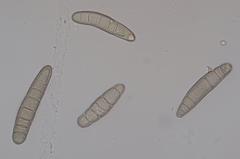 Bipolaris sorokinianae0pathogen
- Second interactor
- Fusarium culmorum
 Fusarium culmorume0pathogen
- Outcome
- volatile organic compounds, especially terpenese1
- Direction
- newly emittede1
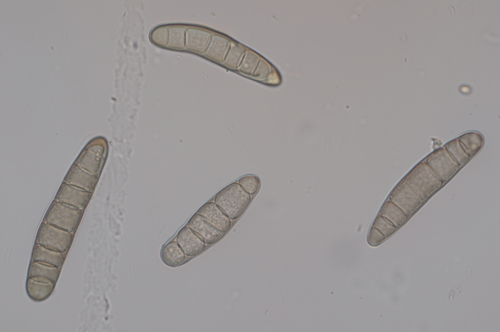
Organisms pictured · Representative pictures of the matched species, not figures from the paper.


Verbatim
e0“investigated the volatile interactions that take place below ground between barley roots and two pathogenic fungi, Cochliobolus sativus and Fusarium culmorum”
e1“volatile organic compounds, especially terpenes, are newly emitted during the interaction between fungi and barley roots”
Claim · model-written summary
Volatiles released by non-infected barley roots did not significantly affect fungal growth.
- Taxon
- barleyHordeum vulgaree2
- Treatment
- volatile molecules released by non-infected barley rootse2
- Interactor
- pathogenic fungie0pathogen
- Outcome
- fungal growthe2
- Direction
- did not significantly affecte2
Organisms pictured · Representative pictures of the matched species, not figures from the paper.
Verbatim
e0“investigated the volatile interactions that take place below ground between barley roots and two pathogenic fungi, Cochliobolus sativus and Fusarium culmorum”
e2“The volatile molecules released by non-infected barley roots did not significantly affect fungal growth”
Claim · model-written summary
Volatiles released by pathogenic fungi decreased barley root length by 19 to 21.5%.
- Taxon
- barleyHordeum vulgaree3
- Treatment
- volatile molecules released by pathogenic fungie3
- Interactor
- pathogenic fungie3pathogen
- Outcome
- length of barley rootse3
- Direction
- decreasede3
- Value
- 19 to 21.5%e3
Not reportedComparator
Organisms pictured · Representative pictures of the matched species, not figures from the paper.
Verbatim
e3“the volatile molecules released by pathogenic fungi decreased the length of barley roots by 19 to 21.5% and the surface of aerial parts by 15%”
Claim · model-written summary
Volatiles released by pathogenic fungi decreased the surface of barley aerial parts by 15%.
- Taxon
- barleyHordeum vulgaree3
- Treatment
- volatile molecules released by pathogenic fungie3
- Interactor
- pathogenic fungie3pathogen
- Outcome
- surface of aerial partse3
- Direction
- decreasede3
- Value
- 15%e3
Not reportedComparator
Organisms pictured · Representative pictures of the matched species, not figures from the paper.
Verbatim
e3“the volatile molecules released by pathogenic fungi decreased the length of barley roots by 19 to 21.5% and the surface of aerial parts by 15%”
Claim · model-written summary
Volatiles released by infected barley roots had no significant effect on F. culmorum growth.
- Taxon
- barleyHordeum vulgaree4
- Treatment
- volatiles released by infected barley rootse4
- Interactor
- F. culmorumFusarium culmorume4pathogen
- Outcome
- F. culmorum growthe4
- Direction
- had no significant effecte4
Organisms pictured · Representative pictures of the matched species, not figures from the paper.
Verbatim
e4“The spectrum of the volatiles released by infected barley roots had no significant effect on F. culmorum growth”
Claim · model-written summary
Volatiles released by infected barley roots decreased C. sativus growth by 13 to 17%.
- Taxon
- barleyHordeum vulgaree4
- Treatment
- volatiles released by infected barley rootse4
- Interactor
- C. sativusBipolaris sorokinianae5pathogen
- Outcome
- C. sativus growthe5
- Direction
- decreasede5
- Value
- 13 to 17%e5
Not reportedComparator
Organisms pictured · Representative pictures of the matched species, not figures from the paper.
Verbatim
e4“The spectrum of the volatiles released by infected barley roots had no significant effect on F. culmorum growth”
e5“but decreased C. sativus growth by 13 to 17%”
Claim · model-written summary
Pathogenic fungi emitted volatile organic compounds that were identified.
- Taxon
- barleyHordeum vulgaree0
- Interactor
- pathogenic fungie6pathogen
- Outcome
- volatile organic compounds emitted by two pathogenic fungie6
Organisms pictured · Representative pictures of the matched species, not figures from the paper.
Verbatim
e0“investigated the volatile interactions that take place below ground between barley roots and two pathogenic fungi, Cochliobolus sativus and Fusarium culmorum”
e6“This paper identifies the volatile organic compounds emitted by two pathogenic fungi”
The same questions in other papers
infection · Bipolaris sorokiniana · Hordeum vulgare (barley)Positive and negative results
1 paper in the same direction as this paper · 2 in the opposite direction
- negative
- negative
- positive
Claims are grouped by organism, treatment and what was measured or targeted. A paper counts as positive when any of its claims in the group is positive.