Abstract
The ability of representatives of Pantoea agglomerans (Erwinia herbicola (Lohnis) Dye [21]), Bacillus subtilis and some species of Pseudomonas genus to inhibit the growth of phytopathogenic bacteria and micromycetes and to regulate the growth of plants has been comparatively studied. The ability to inhibit the growth of mycellium of phytopathogenic Fusarium avenaceum, F. gibbosum, F. oxysporum was found out in all of 13 investigated strains of P. agglomerans, while the growth of F. culmorum is inhibited by 2 strains and Bipolaris sorokiniana is inhibited by 7 strains. The strains of P. agglomerans and Bacillus subtilis inhibit the growth of mycellium of these mycromycetes to the greater extent than the representatives of Pseudomonas genus. The mycellium growth of B. sorokiniana is better inhibited by B. subtilis and representatives of Pseudomonas genus. Besides the antifungal action 8 strains of P. agglomerans manifested the antagonistic activity in respect to phytopathogenic Agrobacterium tumefaciens and representatives of genera Clavibacter, Erwinia, Pseudomonas, Xanthomonas and also in respect to the microflora which is present in the cabbage and wheat seeds. The strains have been revealed which, parallel with high antagonistic activity in respect to phytopathogenic micromycetes and bacteria, stimulate the seed germination and increase the weight of the cabbage and wheat sprouts.
Abstract from the paper’s OpenAlex record, shown for indexing and research. Copyright remains with the authors or the publisher. Read at the source ↗
The text the model read, with the source record’s inline markup (italics, sub- and superscripts) rendered and its character entities decoded; quote offsets refer to the raw text.
Claims 15
Claim · model-written summary
P. agglomerans strains inhibit the growth of mycelium of Fusarium avenaceum.
- Taxon
- cabbage and wheat
 Brassica oleracea var. capitata
 Triticum aestivume5
- Interactor
- Fusarium avenaceum
 Fusarium avenaceume0pathogen
- Second interactor
- P. agglomerans
 Pantoea agglomeranse0biocontrol_agent
- Outcome
- growth of mycelliume0
- Direction
- inhibite0
Organisms pictured · Representative pictures of the matched species, not figures from the paper.


Verbatim
e0“The ability to inhibit the growth of mycellium of phytopathogenic Fusarium avenaceum, F. gibbosum, F. oxysporum was found out in all of 13 investigated strains of P. agglomerans”
e5“in respect to the microflora which is present in the cabbage and wheat seeds”
Claim · model-written summary
P. agglomerans strains inhibit the growth of mycelium of F. gibbosum.
- Taxon
- cabbage and wheatBrassica oleracea var. capitataTriticum aestivume5
- Interactor
- F. gibbosumFusarium gibbosume0pathogen
- Second interactor
- P. agglomeransPantoea agglomeranse0biocontrol_agent
- Outcome
- growth of mycelliume0
- Direction
- inhibite0
Organisms pictured · Representative pictures of the matched species, not figures from the paper.
Verbatim
e0“The ability to inhibit the growth of mycellium of phytopathogenic Fusarium avenaceum, F. gibbosum, F. oxysporum was found out in all of 13 investigated strains of P. agglomerans”
e5“in respect to the microflora which is present in the cabbage and wheat seeds”
Claim · model-written summary
P. agglomerans strains inhibit the growth of mycelium of F. oxysporum.
- Taxon
- cabbage and wheatBrassica oleracea var. capitataTriticum aestivume5
- Interactor
- F. oxysporum
 Fusarium oxysporume0pathogen
- Second interactor
- P. agglomeransPantoea agglomeranse0biocontrol_agent
- Outcome
- growth of mycelliume0
- Direction
- inhibite0
Organisms pictured · Representative pictures of the matched species, not figures from the paper.

Verbatim
e0“The ability to inhibit the growth of mycellium of phytopathogenic Fusarium avenaceum, F. gibbosum, F. oxysporum was found out in all of 13 investigated strains of P. agglomerans”
e5“in respect to the microflora which is present in the cabbage and wheat seeds”
Claim · model-written summary
F. culmorum growth is inhibited by 2 strains.
- Taxon
- cabbage and wheatBrassica oleracea var. capitataTriticum aestivume5
- Interactor
- F. culmorum
 Fusarium culmorume1pathogen
- Outcome
- growthe1
- Direction
- inhibitede1
- Value
- 2 strainse1
Organisms pictured · Representative pictures of the matched species, not figures from the paper.

Verbatim
e1“while the growth of F. culmorum is inhibited by 2 strains and Bipolaris sorokiniana is inhibited by 7 strains”
e5“in respect to the microflora which is present in the cabbage and wheat seeds”
Claim · model-written summary
Bipolaris sorokiniana growth is inhibited by 7 strains.
- Taxon
- cabbage and wheatBrassica oleracea var. capitataTriticum aestivume5
- Interactor
- Bipolaris sorokiniana
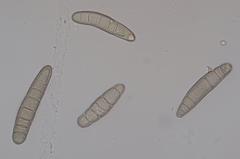 Bipolaris sorokinianae1pathogen
- Outcome
- growthe1
- Direction
- inhibitede1
- Value
- 7 strainse1
Organisms pictured · Representative pictures of the matched species, not figures from the paper.
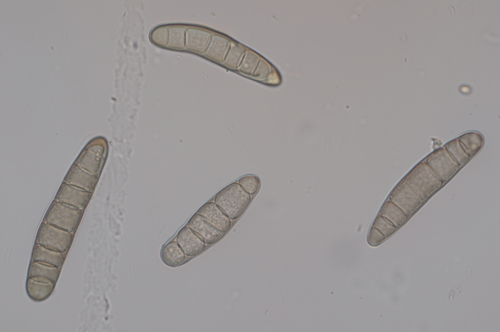
Verbatim
e1“while the growth of F. culmorum is inhibited by 2 strains and Bipolaris sorokiniana is inhibited by 7 strains”
e5“in respect to the microflora which is present in the cabbage and wheat seeds”
Claim · model-written summary
P. agglomerans strains inhibit mycelium growth of the tested micromycetes to a greater extent than Pseudomonas representatives.
- Taxon
- cabbage and wheatBrassica oleracea var. capitataTriticum aestivume5
- Treatment
- strains of P. agglomeranse2
- Outcome
- growth of mycelliume2
- Direction
- to the greater extente2
- Comparator
- representatives of Pseudomonas genuse2
Organisms pictured · Representative pictures of the matched species, not figures from the paper.
Verbatim
e2“The strains of P. agglomerans and Bacillus subtilis inhibit the growth of mycellium of these mycromycetes to the greater extent than the representatives of Pseudomonas genus”
e5“in respect to the microflora which is present in the cabbage and wheat seeds”
Claim · model-written summary
Bacillus subtilis inhibits mycelium growth of the tested micromycetes to a greater extent than Pseudomonas representatives.
- Taxon
- cabbage and wheatBrassica oleracea var. capitataTriticum aestivume5
- Treatment
- Bacillus subtilise2
- Outcome
- growth of mycelliume2
- Direction
- to the greater extente2
- Comparator
- representatives of Pseudomonas genuse2
Organisms pictured · Representative pictures of the matched species, not figures from the paper.
Verbatim
e2“The strains of P. agglomerans and Bacillus subtilis inhibit the growth of mycellium of these mycromycetes to the greater extent than the representatives of Pseudomonas genus”
e5“in respect to the microflora which is present in the cabbage and wheat seeds”
Claim · model-written summary
Bacillus subtilis better inhibits B. sorokiniana mycelium growth.
- Taxon
- cabbage and wheatBrassica oleracea var. capitataTriticum aestivume5
- Interactor
- B. sorokinianaBipolaris sorokinianae3pathogen
- Second interactor
- B. subtilis
 Bacillus subtilise3biocontrol_agent
- Outcome
- mycellium growthe3
- Direction
- better inhibitede3
Organisms pictured · Representative pictures of the matched species, not figures from the paper.

Verbatim
e3“The mycellium growth of B. sorokiniana is better inhibited by B. subtilis and representatives of Pseudomonas genus”
e5“in respect to the microflora which is present in the cabbage and wheat seeds”
Claim · model-written summary
Pseudomonas representatives better inhibit B. sorokiniana mycelium growth.
- Taxon
- cabbage and wheatBrassica oleracea var. capitataTriticum aestivume5
- Interactor
- B. sorokinianaBipolaris sorokinianae3pathogen
- Second interactor
- representatives of Pseudomonas genuse3biocontrol_agent
- Outcome
- mycellium growthe3
- Direction
- better inhibitede3
Organisms pictured · Representative pictures of the matched species, not figures from the paper.
Verbatim
e3“The mycellium growth of B. sorokiniana is better inhibited by B. subtilis and representatives of Pseudomonas genus”
e5“in respect to the microflora which is present in the cabbage and wheat seeds”
Claim · model-written summary
Eight P. agglomerans strains show antagonistic activity against Agrobacterium tumefaciens.
- Taxon
- cabbage and wheatBrassica oleracea var. capitataTriticum aestivume5
- Interactor
- Agrobacterium tumefaciens
 Agrobacterium tumefaciense4pathogen
- Second interactor
- P. agglomeransPantoea agglomeranse4biocontrol_agent
- Outcome
- antagonistic activitye4
- Value
- 8 strainse4
Organisms pictured · Representative pictures of the matched species, not figures from the paper.

Verbatim
e4“8 strains of P. agglomerans manifested the antagonistic activity in respect to phytopathogenic Agrobacterium tumefaciens and representatives of genera Clavibacter, Erwinia, Pseudomonas, Xanthomonas”
e5“in respect to the microflora which is present in the cabbage and wheat seeds”
Claim · model-written summary
Eight P. agglomerans strains show antagonistic activity against Clavibacter and Erwinia.
- Taxon
- cabbage and wheatBrassica oleracea var. capitataTriticum aestivume5
- Interactor
- Clavibacter, Erwinia
 Erwinia
 Clavibactere4pathogen
- Second interactor
- P. agglomeransPantoea agglomeranse4biocontrol_agent
- Outcome
- antagonistic activitye4
- Value
- 8 strainse4
Organisms pictured · Representative pictures of the matched species, not figures from the paper.


Verbatim
e4“8 strains of P. agglomerans manifested the antagonistic activity in respect to phytopathogenic Agrobacterium tumefaciens and representatives of genera Clavibacter, Erwinia, Pseudomonas, Xanthomonas”
e5“in respect to the microflora which is present in the cabbage and wheat seeds”
Claim · model-written summary
Eight P. agglomerans strains show antagonistic activity against Pseudomonas and Xanthomonas.
- Taxon
- cabbage and wheatBrassica oleracea var. capitataTriticum aestivume5
- Interactor
- Pseudomonas, Xanthomonas
 Pseudomonas
 Xanthomonase4pathogen
- Second interactor
- P. agglomeransPantoea agglomeranse4biocontrol_agent
- Outcome
- antagonistic activitye4
- Value
- 8 strainse4
Organisms pictured · Representative pictures of the matched species, not figures from the paper.


Verbatim
e4“8 strains of P. agglomerans manifested the antagonistic activity in respect to phytopathogenic Agrobacterium tumefaciens and representatives of genera Clavibacter, Erwinia, Pseudomonas, Xanthomonas”
e5“in respect to the microflora which is present in the cabbage and wheat seeds”
Claim · model-written summary
Selected strains show antagonistic activity against the microflora of cabbage and wheat seeds.
- Taxon
- cabbage and wheatBrassica oleracea var. capitataTriticum aestivume5
- Interactor
- microflorae5other
- Outcome
- antagonistic activitye4
Organisms pictured · Representative pictures of the matched species, not figures from the paper.
Verbatim
e4“8 strains of P. agglomerans manifested the antagonistic activity in respect to phytopathogenic Agrobacterium tumefaciens and representatives of genera Clavibacter, Erwinia, Pseudomonas, Xanthomonas”
e5“in respect to the microflora which is present in the cabbage and wheat seeds”
Claim · model-written summary
Selected strains stimulate seed germination of cabbage and wheat.
- Taxon
- cabbage and wheatBrassica oleracea var. capitataTriticum aestivume6
- Treatment
- strainse6
- Outcome
- seed germinatione6
- Direction
- stimulatee6
Not reportedComparator
Organisms pictured · Representative pictures of the matched species, not figures from the paper.
Verbatim
e6“The strains have been revealed which, parallel with high antagonistic activity in respect to phytopathogenic micromycetes and bacteria, stimulate the seed germination and increase the weight of the cabbage and wheat sprouts”
Claim · model-written summary
Selected strains increase the weight of cabbage and wheat sprouts.
- Taxon
- cabbage and wheatBrassica oleracea var. capitataTriticum aestivume6
- Treatment
- strainse6
- Outcome
- weight of the cabbage and wheat sproutse6
- Direction
- increasee6
Not reportedComparator
Organisms pictured · Representative pictures of the matched species, not figures from the paper.
Verbatim
e6“The strains have been revealed which, parallel with high antagonistic activity in respect to phytopathogenic micromycetes and bacteria, stimulate the seed germination and increase the weight of the cabbage and wheat sprouts”
The same questions in other papers
Pantoea agglomerans · growth · Brassica oleracea (wild cabbage)Results agree
1 paper in the same direction as this paper
- positive
Pantoea agglomerans · growth · Triticum aestivum (wheat)Results agree
2 papers in the same direction as this paper
- positive
- positive
Bacillus subtilis · growth · Brassica oleracea (wild cabbage)Results agree
3 papers in the same direction as this paper
- positive
- positive
- positive
Bacillus subtilis · growth · Triticum aestivum (wheat)Results agree
38 papers in the same direction as this paper
- positive
- positive
- positive
35 papers more in this group
See all 39 papers →Claims are grouped by organism, treatment and what was measured or targeted. A paper counts as positive when any of its claims in the group is positive.