Abstract
Summary Enhancement of the resistance level in plants by rhizobacteria has been proven in several pathosystems. This study investigated the ability of four rhizobacteria strains ( Pseudomonas putida BTP1 and Bacillus subtilis Bs2500, Bs2504 and Bs2508) to promote the growth in three barley genotypes and protect them against Cochliobolus sativus . Our results demonstrated that all tested rhizobacteria strains had a protective effect on barley genotypes Arabi Abiad, Banteng and WI2291. However, P. putida BTP1 and B. subtilis Bs2508 strains were the most effective as they reduced disease incidence by 53 and 38% (mean effect), respectively. On the other hand, there were significant differences among the rhizobacteria-treated genotypes on plant growth parameters, such as wet weight, dry weight, plant height and number of leaves. Pseudomonas putida BTP1 strain was the most effective as it significantly increased plant growth by 15-32%. In addition, the susceptible genotypes Arabi Abiad and WI2291 were the most responsive to rhizobacteria. This means that these genotypes have a high potential for increase of their resistance against the pathogen and enhancement of plant growth after the application of rhizobacteria. Consequently, barley seed treatment with the tested rhizobacteria could be considered as an effective biocontrol method against C. sativus .
Abstract from the paper’s OpenAlex record; open copy licensed cc-by-nc-nd. Read at the source ↗
The text the model read, with the source record’s inline markup (italics, sub- and superscripts) rendered and its character entities decoded; quote offsets refer to the raw text.
Claims 10
Claim · model-written summary
All tested rhizobacteria strains had a protective effect on barley genotype Arabi Abiad against Cochliobolus sativus.
- Taxon
- barley
 Hordeum vulgaree0
- Material
- Arabi Abiade0
- Treatment
- rhizobacteria strainse0
- Interactor
- Cochliobolus sativus
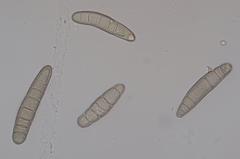 Bipolaris sorokinianat0pathogen
- Second interactor
- rhizobacteria strainsHyphomicrobialese0biocontrol_agent
- Outcome
- protective effecte0
Not reportedComparatorDirection
Organisms pictured · Representative pictures of the matched species, not figures from the paper.

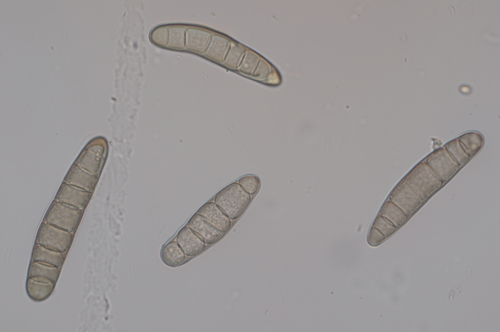
Verbatim
t0“Cochliobolus sativus”
e0“all tested rhizobacteria strains had a protective effect on barley genotypes Arabi Abiad, Banteng and WI2291”
Claim · model-written summary
All tested rhizobacteria strains had a protective effect on barley genotype Banteng against Cochliobolus sativus.
- Taxon
- barleyHordeum vulgaree0
- Material
- Bantenge0
- Treatment
- rhizobacteria strainse0
- Interactor
- Cochliobolus sativusBipolaris sorokinianat0pathogen
- Second interactor
- rhizobacteria strainsHyphomicrobialese0biocontrol_agent
- Outcome
- protective effecte0
Not reportedComparatorDirection
Organisms pictured · Representative pictures of the matched species, not figures from the paper.
Verbatim
t0“Cochliobolus sativus”
e0“all tested rhizobacteria strains had a protective effect on barley genotypes Arabi Abiad, Banteng and WI2291”
Claim · model-written summary
All tested rhizobacteria strains had a protective effect on barley genotype WI2291 against Cochliobolus sativus.
- Taxon
- barleyHordeum vulgaree0
- Material
- WI2291e0
- Treatment
- rhizobacteria strainse0
- Interactor
- Cochliobolus sativusBipolaris sorokinianat0pathogen
- Second interactor
- rhizobacteria strainsHyphomicrobialese0biocontrol_agent
- Outcome
- protective effecte0
Not reportedComparatorDirection
Organisms pictured · Representative pictures of the matched species, not figures from the paper.
Verbatim
t0“Cochliobolus sativus”
e0“all tested rhizobacteria strains had a protective effect on barley genotypes Arabi Abiad, Banteng and WI2291”
Claim · model-written summary
P. putida BTP1 reduced disease incidence on barley by 53% (mean effect).
- Taxon
- barleyHordeum vulgaret0
- Treatment
- P. putida BTP1e0
- Interactor
- P. putida BTP1
 Pseudomonas putidae0biocontrol_agent
- Outcome
- disease incidencee0
- Direction
- reducede0
- Value
- 53e0
- Qualifier
- mean effecte0
Not reportedComparator
Organisms pictured · Representative pictures of the matched species, not figures from the paper.

Verbatim
t0“barley”
e0“P. putida BTP1 and B. subtilis Bs2508 strains were the most effective as they reduced disease incidence by 53 and 38% (mean effect), respectively”
Claim · model-written summary
B. subtilis Bs2508 reduced disease incidence on barley by 38% (mean effect).
- Taxon
- barleyHordeum vulgaret0
- Treatment
- B. subtilis Bs2508e0
- Interactor
- B. subtilis Bs2508
 Bacillus subtilise0biocontrol_agent
- Outcome
- disease incidencee0
- Direction
- reducede0
- Value
- 38%e0
- Qualifier
- mean effecte0
Not reportedComparator
Organisms pictured · Representative pictures of the matched species, not figures from the paper.

Verbatim
t0“barley”
e0“P. putida BTP1 and B. subtilis Bs2508 strains were the most effective as they reduced disease incidence by 53 and 38% (mean effect), respectively”
Claim · model-written summary
There were significant differences among rhizobacteria-treated barley genotypes in plant growth parameters such as wet weight, dry weight, plant height and number of leaves.
- Taxon
- barleyHordeum vulgaret0
- Material
- genotypese0
- Treatment
- rhizobacteriae0
- Outcome
- plant growth parameterse0
Not reportedDirection
Organisms pictured · Representative pictures of the matched species, not figures from the paper.
Verbatim
t0“barley”
e0“there were significant differences among the rhizobacteria-treated genotypes on plant growth parameters, such as wet weight, dry weight, plant height and number of leaves”
Claim · model-written summary
Pseudomonas putida BTP1 significantly increased barley plant growth by 15-32%.
- Taxon
- barleyHordeum vulgaret0
- Treatment
- Pseudomonas putida BTP1 straine0
- Outcome
- plant growthe0
- Direction
- increasede0
- Value
- 15-32%e0
Not reportedComparator
Organisms pictured · Representative pictures of the matched species, not figures from the paper.
Verbatim
t0“barley”
e0“Pseudomonas putida BTP1 strain was the most effective as it significantly increased plant growth by 15-32%”
Claim · model-written summary
The susceptible barley genotype Arabi Abiad was among the most responsive to rhizobacteria.
- Taxon
- barleyHordeum vulgaret0
- Material
- Arabi Abiade0
- Treatment
- rhizobacteriae0
- Outcome
- most responsivee0
- Direction
- most responsivee0
Not reportedComparator
Organisms pictured · Representative pictures of the matched species, not figures from the paper.
Verbatim
t0“barley”
e0“the susceptible genotypes Arabi Abiad and WI2291 were the most responsive to rhizobacteria”
Claim · model-written summary
The susceptible barley genotype WI2291 was among the most responsive to rhizobacteria.
- Taxon
- barleyHordeum vulgaret0
- Material
- WI2291e0
- Treatment
- rhizobacteriae0
- Outcome
- most responsivee0
- Direction
- most responsivee0
Not reportedComparator
Organisms pictured · Representative pictures of the matched species, not figures from the paper.
Verbatim
t0“barley”
e0“the susceptible genotypes Arabi Abiad and WI2291 were the most responsive to rhizobacteria”
Claim · model-written summary
Barley seed treatment with the tested rhizobacteria could be considered an effective biocontrol method against C. sativus.
- Taxon
- barleyHordeum vulgaree0
- Treatment
- barley seed treatment with the tested rhizobacteriae0
- Outcome
- effective biocontrol method against C. sativuse0
Organisms pictured · Representative pictures of the matched species, not figures from the paper.
Verbatim
e0“barley seed treatment with the tested rhizobacteria could be considered as an effective biocontrol method against C. sativus”
The same questions in other papers
Bacillus subtilis · disease · Hordeum vulgare (barley)Positive and negative results
1 paper in the same direction as this paper · 1 in the opposite direction
- no effect
- positive
Pseudomonas putida · growth · Hordeum vulgare (barley)Results agree
1 paper in the same direction as this paper
- positive
Pseudomonas putida · disease · Hordeum vulgare (barley)Results agree
2 papers in the same direction as this paper
- positive
- positive
inoculation · Bipolaris sorokiniana · Hordeum vulgare (barley)Positive and negative results
1 paper in the same direction as this paper · 4 in the opposite direction
- negative
- negative
- no effect
2 papers more in this group
See all 6 papers →Claims are grouped by organism, treatment and what was measured or targeted. A paper counts as positive when any of its claims in the group is positive.