Abstract
Field experiments were conducted to characterize the relationship between severity of spot blotch epidemics in barley ( Hordeum vulgare L.) and loss in grain yield and malt quality. The effect of spot blotch on yield and quality must be known to evaluate the economic benefit of specific disease control strategies such as the use of resistant cultivars or fungicide. Spot blotch epidemics of different intensities were established by inoculating field plots at specific barley growth stages and by using two cultivars, ‘Larker’ and ‘Dickson’, that differ in disease reaction to spot blotch. Inoculations with Cochliobolus sativus reduced yield, yield components, and malt quality of Larker more than Dickson. Yield and quality factors were more adversely affected if inoculation was just prior to flag leaf emergence or at anthesis than at early milk development. Reduction in yield in response to spot blotch epidemics was largely a function of reduction in kernel weight. In 1983, field plots of Larker, Dickson, ‘Glenn’, ‘Bumper’, ‘Robust’, and ‘Hazen’ were either inoculated with C. sativus spores or sprayed with fungicide to evaluate changes in cultivar resistance to spot blotch since the release of Larker in 1961. Based on percentage yield loss [(yield of inoculated plots)/(yield of fungicide‐treated plots)], a significant improvement in disease resistance was achieved with the release of Dickson in 1964. Percentage yield losses observed for Dickson (released in 1964), Glenn (released in 1978), Bumper (released in 1980), and Robust (released in 1983) were not statistically different from each other, indicating no further improvement in disease resistance over Dickson. However, a significant improvement in disease resistance was again achieved with the release of Hazen in 1984.
Abstract from the paper’s OpenAlex record, shown for indexing and research. Copyright remains with the authors or the publisher. Read at the source ↗
The text the model read, with the source record’s inline markup (italics, sub- and superscripts) rendered and its character entities decoded; quote offsets refer to the raw text.
Claims 6
Claim · model-written summary
Inoculation reduced Larker yield and malt quality more than Dickson.
- Taxon
- barley
 Hordeum vulgaret0
- Material
- Larkere0
- Treatment
- Inoculations with Cochliobolus sativuse0
- Interactor
- Cochliobolus sativus
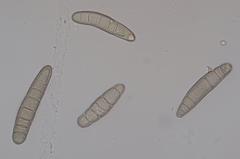 Bipolaris sorokinianae0pathogen
- Outcome
- yield, yield components, and malt qualitye0
- Direction
- reducede0
- Comparator
- Dicksone0
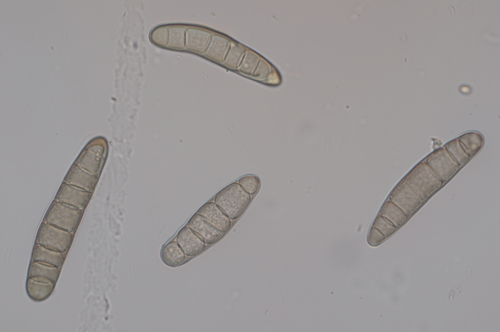
Organisms pictured · Representative pictures of the matched species, not figures from the paper.

Verbatim
e0“Inoculations with Cochliobolus sativus reduced yield, yield components, and malt quality of Larker more than Dickson”
t0“barley”
Claim · model-written summary
Inoculation before flag leaf emergence or at anthesis caused more adverse yield and quality effects than at early milk stage.
- Taxon
- BarleyHordeum vulgaret0
- Organ / stage
- flag leaf emergence or at anthesise0
- Treatment
- inoculatione0
- Interactor
- Cochliobolus sativusBipolaris sorokinianat0pathogen
- Outcome
- Yield and quality factorse0
- Direction
- more adversely affectede0
- Comparator
- early milk developmente0
Organisms pictured · Representative pictures of the matched species, not figures from the paper.
Verbatim
e0“Yield and quality factors were more adversely affected if inoculation was just prior to flag leaf emergence or at anthesis than at early milk development”
t0“Inoculations with Cochliobolus sativus at Specific Growth Stages on Grain Yield and Quality of Malting Barley”
Claim · model-written summary
Yield reduction was largely attributed to reduced kernel weight.
- Taxon
- BarleyHordeum vulgaret0
- Interactor
- Cochliobolus sativusBipolaris sorokinianat0pathogen
- Outcome
- Reduction in yielde0
- Qualifier
- reduction in kernel weighte0
Not reportedDirection
Organisms pictured · Representative pictures of the matched species, not figures from the paper.
Verbatim
e0“Reduction in yield in response to spot blotch epidemics was largely a function of reduction in kernel weight”
t0“Inoculations with Cochliobolus sativus at Specific Growth Stages on Grain Yield and Quality of Malting Barley”
Claim · model-written summary
Dickson release significantly improved disease resistance over Larker.
- Taxon
- BarleyHordeum vulgaret0
- Material
- Dicksone0
- Interactor
- Cochliobolus sativusBipolaris sorokinianat0pathogen
- Outcome
- disease resistancee0
- Direction
- improvemente0
- Comparator
- Larkere1
Organisms pictured · Representative pictures of the matched species, not figures from the paper.
Verbatim
e0“a significant improvement in disease resistance was achieved with the release of Dickson in 1964”
t0“Inoculations with Cochliobolus sativus at Specific Growth Stages on Grain Yield and Quality of Malting Barley”
e1“Inoculations with Cochliobolus sativus reduced yield, yield components, and malt quality of Larker more than Dickson”
Claim · model-written summary
Dickson, Glenn, Bumper, and Robust did not differ significantly in yield loss.
- Taxon
- BarleyHordeum vulgaret0
- Material
- Dicksone0
- Interactor
- Cochliobolus sativusBipolaris sorokinianat0pathogen
- Outcome
- Percentage yield lossese0
- Comparator
- Glenne0
Not reportedDirection
Organisms pictured · Representative pictures of the matched species, not figures from the paper.
Verbatim
e0“Percentage yield losses observed for Dickson (released in 1964), Glenn (released in 1978), Bumper (released in 1980), and Robust (released in 1983) were not statistically different from each other”
t0“Inoculations with Cochliobolus sativus at Specific Growth Stages on Grain Yield and Quality of Malting Barley”
Claim · model-written summary
Hazen release significantly improved disease resistance over Dickson.
- Taxon
- BarleyHordeum vulgaret0
- Material
- Hazene0
- Interactor
- Cochliobolus sativusBipolaris sorokinianat0pathogen
- Outcome
- disease resistancee0
- Direction
- improvemente0
- Comparator
- Dicksone1
Organisms pictured · Representative pictures of the matched species, not figures from the paper.
Verbatim
e0“a significant improvement in disease resistance was again achieved with the release of Hazen in 1984”
t0“Inoculations with Cochliobolus sativus at Specific Growth Stages on Grain Yield and Quality of Malting Barley”
e1“Inoculations with Cochliobolus sativus reduced yield, yield components, and malt quality of Larker more than Dickson”
The same questions in other papers
inoculation · Bipolaris sorokiniana · Hordeum vulgare (barley)Positive and negative results
3 papers in the same direction as this paper · 2 in the opposite direction
- positive
- positive
- no effect
2 papers more in this group
See all 6 papers →inoculation · quality: general · Hordeum vulgare (barley)Positive and negative results
1 paper in the same direction as this paper · 6 in the opposite direction
- positive
- positive
- positive
4 papers more in this group
See all 8 papers →Claims are grouped by organism, treatment and what was measured or targeted. A paper counts as positive when any of its claims in the group is positive.