Abstract
The effects of common root rot (CRR), caused primarily by Cochliobolus sativus, on yield components in 16 barley cultivars representative of three groups—two-row (Hannchen and Smyrna types), Coast, and Manchuria—were studied at Bozeman and Glasgow, Mont, in 1980. At Bozeman, autoclaved oat kernels colonized by Cochliobolus sativus added with seed, effected a mean disease rating (DR) among the cultivars of 42.8, compared to 30.3, when autoclaved uncolonized oat kernels were added. In spite of the mean increase in disease severity of the inoculated plots, there was no significant difference in yield between inoculated and noninoculated plots. Later developed yield components, i.e. kernels per spike and kernel weight, compensated for the initial reduction in fertile tillers caused by CRR. Therefore, in population of plants under disease pressure from CRR, compensating effects on yield components may allow for little or no overall yield reduction, particularly in cultivars that are not highly susceptible to CRR. The two-row, Hannchen-type cultivars were all intermediate in DR at both locations. The two-row, Smyrna-type cultivars were high in susceptibility at Glasgow but intermediate in reaction to CRR at Bozeman. The six-row, Manchuria-Coast groups of cultivars were more diverse in their reaction to CRR at both locations. It appears that genetic relationships have more influence on a cultivar’s disease rating to CRR than has grouping based upon physiological characteristics.Key words: Barley groups, Cochliobolus sativus, yield components
Abstract from the paper’s OpenAlex record, shown for indexing and research. Copyright remains with the authors or the publisher. Read at the source ↗
The text the model read, with the source record’s inline markup (italics, sub- and superscripts) rendered and its character entities decoded; quote offsets refer to the raw text.
Claims 8
Claim · model-written summary
Inoculation with Cochliobolus sativus colonized kernels increased barley disease rating to 42.8 compared with 30.3 for uncolonized kernels at Bozeman.
- Taxon
- barley
 Hordeum vulgaree0
- Treatment
- autoclaved oat kernels colonized by Cochliobolus sativus added with seede1
- Interactor
- Cochliobolus sativus
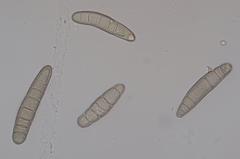 Bipolaris sorokinianae1pathogen
- Outcome
- disease ratinge1
- Direction
- increasee2
- Value
- 42.8e1
- Qualifier
- compared to 30.3e1
- Comparator
- autoclaved uncolonized oat kernelse1
- Setting
- Bozemane1
Organisms pictured · Representative pictures of the matched species, not figures from the paper.

Verbatim
e0“The effects of common root rot (CRR), caused primarily by Cochliobolus sativus, on yield components in 16 barley cultivars representative of three groups—two-row (Hannchen and Smyrna types), Coast, and Manchuria—were studied at Bozeman and Glasgow, Mont, in 1980.”
e1“At Bozeman, autoclaved oat kernels colonized by Cochliobolus sativus added with seed, effected a mean disease rating (DR) among the cultivars of 42.8, compared to 30.3, when autoclaved uncolonized oat kernels were added.”
e2“In spite of the mean increase in disease severity of the inoculated plots, there was no significant difference in yield between inoculated and noninoculated plots.”
Claim · model-written summary
Inoculation with Cochliobolus sativus did not significantly change barley yield compared with noninoculated plots.
- Taxon
- barleyHordeum vulgaree0
- Treatment
- inoculated plotse2
- Interactor
- Cochliobolus sativusBipolaris sorokinianae0pathogen
- Outcome
- yielde2
- Direction
- no significant differencee2
- Comparator
- noninoculated plotse2
Organisms pictured · Representative pictures of the matched species, not figures from the paper.
Verbatim
e0“The effects of common root rot (CRR), caused primarily by Cochliobolus sativus, on yield components in 16 barley cultivars representative of three groups—two-row (Hannchen and Smyrna types), Coast, and Manchuria—were studied at Bozeman and Glasgow, Mont, in 1980.”
e2“In spite of the mean increase in disease severity of the inoculated plots, there was no significant difference in yield between inoculated and noninoculated plots.”
Claim · model-written summary
Later developed kernels per spike and kernel weight compensated for the initial reduction in fertile tillers caused by common root rot.
- Taxon
- barleyHordeum vulgaree0
- Interactor
- Cochliobolus sativusBipolaris sorokinianae0pathogen
- Outcome
- kernels per spike and kernel weighte3
- Direction
- compensatede3
- Qualifier
- Later developed yield componentse3
Organisms pictured · Representative pictures of the matched species, not figures from the paper.
Verbatim
e0“The effects of common root rot (CRR), caused primarily by Cochliobolus sativus, on yield components in 16 barley cultivars representative of three groups—two-row (Hannchen and Smyrna types), Coast, and Manchuria—were studied at Bozeman and Glasgow, Mont, in 1980.”
e3“Later developed yield components, i.e. kernels per spike and kernel weight, compensated for the initial reduction in fertile tillers caused by CRR.”
Claim · model-written summary
The two-row Hannchen-type barley cultivars were intermediate in disease rating at both locations.
- Taxon
- barleyHordeum vulgaree0
- Material
- two-row, Hannchen-type cultivarse4
- Outcome
- DRe4
- Direction
- intermediatee4
- Setting
- both locationse4
Organisms pictured · Representative pictures of the matched species, not figures from the paper.
Verbatim
e0“The effects of common root rot (CRR), caused primarily by Cochliobolus sativus, on yield components in 16 barley cultivars representative of three groups—two-row (Hannchen and Smyrna types), Coast, and Manchuria—were studied at Bozeman and Glasgow, Mont, in 1980.”
e4“The two-row, Hannchen-type cultivars were all intermediate in DR at both locations.”
Claim · model-written summary
The two-row Smyrna-type barley cultivars were highly susceptible at Glasgow.
- Taxon
- barleyHordeum vulgaree0
- Material
- two-row, Smyrna-type cultivarse5
- Outcome
- susceptibilitye5
- Direction
- highe5
- Setting
- Glasgowe5
Organisms pictured · Representative pictures of the matched species, not figures from the paper.
Verbatim
e0“The effects of common root rot (CRR), caused primarily by Cochliobolus sativus, on yield components in 16 barley cultivars representative of three groups—two-row (Hannchen and Smyrna types), Coast, and Manchuria—were studied at Bozeman and Glasgow, Mont, in 1980.”
e5“The two-row, Smyrna-type cultivars were high in susceptibility at Glasgow but intermediate in reaction to CRR at Bozeman.”
Claim · model-written summary
The two-row Smyrna-type barley cultivars were intermediate in reaction to common root rot at Bozeman.
- Taxon
- barleyHordeum vulgaree0
- Material
- two-row, Smyrna-type cultivarse5
- Outcome
- reaction to CRRe5
- Direction
- intermediatee5
- Setting
- Bozemane5
Organisms pictured · Representative pictures of the matched species, not figures from the paper.
Verbatim
e0“The effects of common root rot (CRR), caused primarily by Cochliobolus sativus, on yield components in 16 barley cultivars representative of three groups—two-row (Hannchen and Smyrna types), Coast, and Manchuria—were studied at Bozeman and Glasgow, Mont, in 1980.”
e5“The two-row, Smyrna-type cultivars were high in susceptibility at Glasgow but intermediate in reaction to CRR at Bozeman.”
Claim · model-written summary
The six-row Manchuria-Coast barley groups were more diverse in reaction to common root rot at both locations.
- Taxon
- barleyHordeum vulgaree0
- Material
- six-row, Manchuria-Coast groups of cultivarse6
- Outcome
- reaction to CRRe6
- Direction
- more diversee6
- Setting
- both locationse6
Organisms pictured · Representative pictures of the matched species, not figures from the paper.
Verbatim
e0“The effects of common root rot (CRR), caused primarily by Cochliobolus sativus, on yield components in 16 barley cultivars representative of three groups—two-row (Hannchen and Smyrna types), Coast, and Manchuria—were studied at Bozeman and Glasgow, Mont, in 1980.”
e6“The six-row, Manchuria-Coast groups of cultivars were more diverse in their reaction to CRR at both locations.”
Claim · model-written summary
Genetic relationships appear to influence barley disease rating to common root rot more than grouping by physiological characteristics.
- Taxon
- barleyHordeum vulgaree0
- Outcome
- cultivar’s disease rating to CRRe7
- Direction
- more influencee7
- Comparator
- grouping based upon physiological characteristicse7
Organisms pictured · Representative pictures of the matched species, not figures from the paper.
Verbatim
e0“The effects of common root rot (CRR), caused primarily by Cochliobolus sativus, on yield components in 16 barley cultivars representative of three groups—two-row (Hannchen and Smyrna types), Coast, and Manchuria—were studied at Bozeman and Glasgow, Mont, in 1980.”
e7“It appears that genetic relationships have more influence on a cultivar’s disease rating to CRR than has grouping based upon physiological characteristics.”
The same questions in other papers
Bipolaris sorokiniana · disease · Hordeum vulgare (barley)Positive and negative results
2 papers in the same direction as this paper · 1 in the opposite direction
- negative
- positive
- negative
inoculation · Bipolaris sorokiniana · Hordeum vulgare (barley)Positive and negative results
3 papers in the same direction as this paper · 2 in the opposite direction
- negative
- no effect
- positive
2 papers more in this group
See all 6 papers →Claims are grouped by organism, treatment and what was measured or targeted. A paper counts as positive when any of its claims in the group is positive.