Abstract
Antagonistic effect of different fungicides, antagonists and herbicides was tested by poisoned food technique, dual culture test and in pot culture against Sclerotium oryzae. Hexaconazole @ 200 ppm and propiconazole @ 100 ppm and butachlor @ 400 ppm were found effective in inhibiting S. oryzae under in vitro conditions. Among antagonists, Trichoderma viride (strain T1) and Pseudomonas fluorescens (strain BI-1) were found to have most potential antagonistic activity inhibiting growth of test pathogen by 75.3 and 77.2 per cent, respectively. Integrated management against stem rot of rice was attempted under pot culture. Of the twelve treatments, combined soil application of butachlor (400 ppm) 8–10 days after pathogen inoculation followed by application of T. viride @ 10 g kg−1 and P. fluorescens @10 ml kg−1 just at the appearance of the disease followed by spraying of propiconazole (100 ppm) were found superior to other treatments in reducing the disease and promoting the plant growth parameters like root length, shoot height, dry shoot and root weight of rice plants.
Abstract from the paper’s OpenAlex record, shown for indexing and research. Copyright remains with the authors or the publisher. Read at the source ↗
The text the model read, with the source record’s inline markup (italics, sub- and superscripts) rendered and its character entities decoded; quote offsets refer to the raw text.
Claims 7
Claim · model-written summary
Hexaconazole at 200 ppm inhibited S. oryzae in vitro.
- Taxon
- Rice
 Oryza sativat0
- Treatment
- Hexaconazole @ 200 ppme0
- Interactor
- S. oryzae
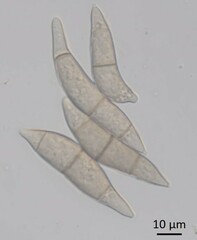 Nakataea oryzaee0pathogent0
- Outcome
- inhibiting S. oryzaee0
- Setting
- in vitro conditionse0
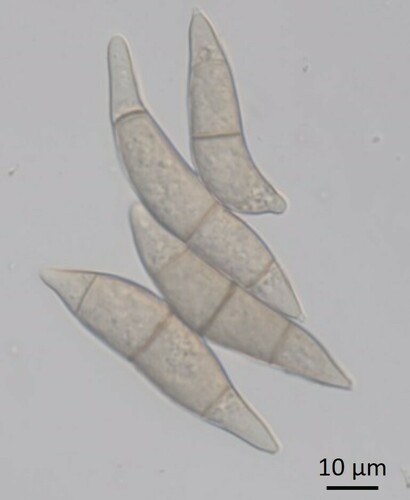
Organisms pictured · Representative pictures of the matched species, not figures from the paper.

Verbatim
e0“Hexaconazole @ 200 ppm and propiconazole @ 100 ppm and butachlor @ 400 ppm were found effective in inhibiting S. oryzae under in vitro conditions.”
t0“Rice”
Claim · model-written summary
Propiconazole at 100 ppm inhibited S. oryzae in vitro.
- Taxon
- RiceOryza sativat0
- Treatment
- propiconazole @ 100 ppme0
- Interactor
- S. oryzaeNakataea oryzaee0pathogent0
- Outcome
- inhibiting S. oryzaee0
- Setting
- in vitro conditionse0
Organisms pictured · Representative pictures of the matched species, not figures from the paper.
Verbatim
e0“Hexaconazole @ 200 ppm and propiconazole @ 100 ppm and butachlor @ 400 ppm were found effective in inhibiting S. oryzae under in vitro conditions.”
t0“Rice”
Claim · model-written summary
Butachlor at 400 ppm inhibited S. oryzae in vitro.
- Taxon
- RiceOryza sativat0
- Treatment
- butachlor @ 400 ppme0
- Interactor
- S. oryzaeNakataea oryzaee0pathogent0
- Outcome
- inhibiting S. oryzaee0
- Setting
- in vitro conditionse0
Organisms pictured · Representative pictures of the matched species, not figures from the paper.
Verbatim
e0“Hexaconazole @ 200 ppm and propiconazole @ 100 ppm and butachlor @ 400 ppm were found effective in inhibiting S. oryzae under in vitro conditions.”
t0“Rice”
Claim · model-written summary
T. viride inhibited pathogen growth by 75.3 percent.
- Taxon
- RiceOryza sativat0
- Second interactor
- Trichoderma viride
 Trichoderma viridee0biocontrol_agentt0
- Outcome
- growth of test pathogene0
- Direction
- inhibitinge0
- Value
- 75.3e0
Organisms pictured · Representative pictures of the matched species, not figures from the paper.

Verbatim
e0“Trichoderma viride (strain T1) and Pseudomonas fluorescens (strain BI-1) were found to have most potential antagonistic activity inhibiting growth of test pathogen by 75.3 and 77.2 per cent, respectively.”
t0“Rice”
Claim · model-written summary
P. fluorescens inhibited pathogen growth by 77.2 percent.
- Taxon
- RiceOryza sativat0
- Second interactor
- Pseudomonas fluorescens
 Pseudomonas fluorescense0biocontrol_agentt0
- Outcome
- growth of test pathogene0
- Direction
- inhibitinge0
- Value
- 77.2 per cente0
Organisms pictured · Representative pictures of the matched species, not figures from the paper.

Verbatim
e0“Trichoderma viride (strain T1) and Pseudomonas fluorescens (strain BI-1) were found to have most potential antagonistic activity inhibiting growth of test pathogen by 75.3 and 77.2 per cent, respectively.”
t0“Rice”
Claim · model-written summary
The integrated treatment reduced rice stem rot relative to other treatments.
- Taxon
- riceOryza sativae0
- Treatment
- combined soil application of butachlor (400 ppm) 8–10 days after pathogen inoculation followed by application of T. viride @ 10 g kg−1 and P. fluorescens @10 ml kg−1 just at the appearance of the disease followed by spraying of propiconazole (100 ppm)e0
- Outcome
- the diseasee0
- Direction
- reducinge0
- Comparator
- other treatmentse0
Organisms pictured · Representative pictures of the matched species, not figures from the paper.
Verbatim
e0“combined soil application of butachlor (400 ppm) 8–10 days after pathogen inoculation followed by application of T. viride @ 10 g kg−1 and P. fluorescens @10 ml kg−1 just at the appearance of the disease followed by spraying of propiconazole (100 ppm) were found superior to other treatments in reducing the disease and promoting the plant growth parameters like root length, shoot height, dry shoot and root weight of rice plants.”
t0“Sclerotium oryzae”
Claim · model-written summary
The integrated treatment promoted rice root and shoot growth measures relative to other treatments.
- Taxon
- riceOryza sativae0
- Treatment
- combined soil application of butachlor (400 ppm) 8–10 days after pathogen inoculation followed by application of T. viride @ 10 g kg−1 and P. fluorescens @10 ml kg−1 just at the appearance of the disease followed by spraying of propiconazole (100 ppm)e0
- Outcome
- root length, shoot height, dry shoot and root weighte0
- Direction
- promotinge0
- Comparator
- other treatmentse0
Organisms pictured · Representative pictures of the matched species, not figures from the paper.
Verbatim
e0“combined soil application of butachlor (400 ppm) 8–10 days after pathogen inoculation followed by application of T. viride @ 10 g kg−1 and P. fluorescens @10 ml kg−1 just at the appearance of the disease followed by spraying of propiconazole (100 ppm) were found superior to other treatments in reducing the disease and promoting the plant growth parameters like root length, shoot height, dry shoot and root weight of rice plants.”
The same questions in other papers
butachlor · disease · Oryza sativa (rice)Positive and negative results
1 in the opposite direction
- negative
propiconazole · growth · Oryza sativa (rice)Positive and negative results
1 paper in the same direction as this paper · 3 in the opposite direction
- no effect
- negative
- negative
1 paper more in this group
See all 5 papers →butachlor · growth · Oryza sativa (rice)Positive and negative results
4 papers in the same direction as this paper · 6 in the opposite direction
- negative
- negative
- negative
7 papers more in this group
See all 11 papers →Pseudomonas fluorescens · disease · Oryza sativa (rice)Positive and negative results
24 papers in the same direction as this paper · 1 in the opposite direction
- negative
- positive
- positive
22 papers more in this group
See all 26 papers →Trichoderma viride · disease · Oryza sativa (rice)Results agree
8 papers in the same direction as this paper
- positive
- positive
- positive
5 papers more in this group
See all 9 papers →Trichoderma viride · growth · Oryza sativa (rice)Results agree
9 papers in the same direction as this paper
- positive
- positive
- positive
6 papers more in this group
See all 10 papers →Pseudomonas fluorescens · growth · Oryza sativa (rice)Results agree
22 papers in the same direction as this paper
- positive
- positive
- positive
19 papers more in this group
See all 23 papers →propiconazole · disease · Oryza sativa (rice)Results agree
30 papers in the same direction as this paper
- positive
- positive
- positive
27 papers more in this group
See all 31 papers →8 of 12 groups shown: named compounds and organisms first, then groups whose results differ (checked claim by claim), then those with positive and negative results, then the smaller groups.
Claims are grouped by organism, treatment and what was measured or targeted. A paper counts as positive when any of its claims in the group is positive.