Abstract
Field experiments conducted during the years 2003-2005 showed that the rate of photosynthesis and transpiration decreased as a result of pea infection by Peronospora viciae. Foliar application of effective microorganisms (EM) combined with chemical control increased the rate of photosynthesis in pea, while other methods of EM application reduced net photosynthesis values (An). Chemical control and seed dressing with the tested biological agent caused a significant decrease in molar transpiration (E) values, compared to the control treatment. Soil application of EM contributed to inhibiting fungal pathogen infestation on pea plants.
Abstract from the paper’s OpenAlex record; open copy licensed cc-by. Read at the source ↗
The text the model read, with the source record’s inline markup (italics, sub- and superscripts) rendered and its character entities decoded; quote offsets refer to the raw text.
Claims 6
Claim · model-written summary
Peronospora viciae infection decreased pea photosynthesis and transpiration.
- Taxon
- pea
 Lathyrus oleraceuse0
- Treatment
- pea infection by Peronospora viciaee0
- Interactor
- Peronospora viciae
 Peronospora viciaee0pathogen
- Outcome
- rate of photosynthesis and transpiratione0
- Direction
- decreasede0
- Comparator
- control treatmente1
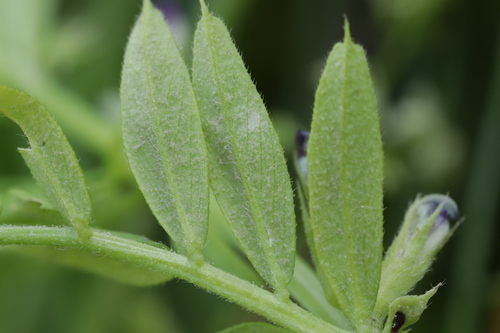
Organisms pictured · Representative pictures of the matched species, not figures from the paper.

Verbatim
e0“the rate of photosynthesis and transpiration decreased as a result of pea infection by Peronospora viciae”
e1“control treatment”
Claim · model-written summary
Foliar EM combined with chemical control increased pea photosynthesis.
- Taxon
- peaLathyrus oleraceuse0
- Treatment
- Foliar application of effective microorganisms (EM) combined with chemical controle0
- Interactor
- effective microorganisms (EM)e0biocontrol_agent
- Outcome
- rate of photosynthesise0
- Direction
- increasede0
- Comparator
- control treatmente1
Organisms pictured · Representative pictures of the matched species, not figures from the paper.
Verbatim
e0“Foliar application of effective microorganisms (EM) combined with chemical control increased the rate of photosynthesis in pea”
e1“control treatment”
Claim · model-written summary
Other EM application methods reduced pea net photosynthesis.
- Taxon
- peaLathyrus oleraceuse1
- Treatment
- other methods of EM applicatione0
- Interactor
- EMe0biocontrol_agent
- Outcome
- net photosynthesis values (An)e0
- Direction
- reducede0
- Comparator
- control treatmente2
Organisms pictured · Representative pictures of the matched species, not figures from the paper.
Verbatim
e0“other methods of EM application reduced net photosynthesis values (An)”
e1“pea infection by Peronospora viciae”
e2“control treatment”
Claim · model-written summary
Chemical control significantly reduced molar transpiration relative to the control.
- Taxon
- peaLathyrus oleraceuse1
- Treatment
- Chemical controle0
- Outcome
- molar transpiration (E) valuese0
- Direction
- decreasee0
- Comparator
- control treatmente0
Organisms pictured · Representative pictures of the matched species, not figures from the paper.
Verbatim
e0“Chemical control and seed dressing with the tested biological agent caused a significant decrease in molar transpiration (E) values, compared to the control treatment”
e1“pea infection by Peronospora viciae”
Claim · model-written summary
Seed dressing with the biological agent significantly reduced molar transpiration relative to the control.
- Taxon
- peaLathyrus oleraceuse1
- Treatment
- seed dressing with the tested biological agente0
- Outcome
- molar transpiration (E) valuese0
- Direction
- decreasee0
- Comparator
- control treatmente0
Organisms pictured · Representative pictures of the matched species, not figures from the paper.
Verbatim
e0“seed dressing with the tested biological agent caused a significant decrease in molar transpiration (E) values, compared to the control treatment”
e1“pea infection by Peronospora viciae”
Claim · model-written summary
Soil EM application inhibited fungal pathogen infestation on pea.
- Taxon
- peaLathyrus oleraceuse0
- Treatment
- Soil application of EMe0
- Interactor
- fungal pathogene0pathogen
- Second interactor
- EMe0biocontrol_agent
- Outcome
- fungal pathogen infestatione0
- Direction
- inhibitinge0
- Comparator
- control treatmente1
Organisms pictured · Representative pictures of the matched species, not figures from the paper.
Verbatim
e0“Soil application of EM contributed to inhibiting fungal pathogen infestation on pea plants”
e1“control treatment”
The same questions in other papers
inoculation · pest · Lathyrus oleraceus (pea)Positive and negative results
4 papers in the same direction as this paper · 1 in the opposite direction
- negative
- positive
- positive
2 papers more in this group
See all 6 papers →application · physiology: photosynthesis · Lathyrus oleraceus (pea)Positive and negative results
4 papers in the same direction as this paper · 1 in the opposite direction
- no effect
- positive
- positive
2 papers more in this group
See all 6 papers →inoculation · physiology: photosynthesis · Lathyrus oleraceus (pea)Positive and negative results
7 papers in the same direction as this paper · 2 in the opposite direction
- no effect
- no effect
- positive
6 papers more in this group
See all 10 papers →application · pest · Lathyrus oleraceus (pea)Positive and negative results
8 papers in the same direction as this paper · 3 in the opposite direction
- no effect
- negative
- negative
8 papers more in this group
See all 12 papers →Claims are grouped by organism, treatment and what was measured or targeted. A paper counts as positive when any of its claims in the group is positive.