Abstract
The incidence of the corn stunt pathogen transmitted to maize by the corn leafhopper, Dalbulus maidis (Delong and Wolcott), was reduced in high-density plantings of maize ( Zea mays mays L.) in Nicaragua. Density was manipulated by modifying the distance between rows or between plants within a row. Although leafhopper populations were not strongly influenced by planting density in this study, the planting arrangement significantly affected leafhopper abundance. At equivalent planting densities, leafhoppers were more abundant in treatments with reduced between-row spacing. This difference was not reflected in the incidence of corn stunt, which tended to be lower in treatments with reduced row spacing. This result can be explained by the effects of planting arrangement on leafhopper movement. In contrast to a previous study, nitrogen fertilization affected maize growth early in the season, but did not significantly influence vector abundance or disease incidence.
Abstract from the paper’s OpenAlex record, shown for indexing and research. Copyright remains with the authors or the publisher. Read at the source ↗
The text the model read, with the source record’s inline markup (italics, sub- and superscripts) rendered and its character entities decoded; quote offsets refer to the raw text.
Claims 9
Claim · model-written summary
High density maize planting reduced corn stunt incidence in Nicaragua.
- Treatment
- high-density plantingse0
- Interactor
- Dalbulus maidis
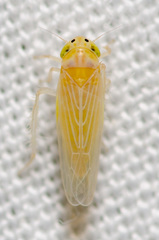 Dalbulus maidise0pest
- Outcome
- incidence of the corn stunt pathogene0
- Direction
- reducede0
- Setting
- Nicaraguae0
 Zea mays
Not reportedComparator
Organisms pictured · Representative pictures of the matched species, not figures from the paper.


Verbatim
e0“The incidence of the corn stunt pathogen transmitted to maize by the corn leafhopper, Dalbulus maidis (Delong and Wolcott), was reduced in high-density plantings of maize ( Zea mays mays L.) in Nicaragua”
Claim · model-written summary
Planting density did not strongly influence leafhopper populations.
Not reportedComparator
Organisms pictured · Representative pictures of the matched species, not figures from the paper.
Verbatim
e0“leafhopper populations were not strongly influenced by planting density”
t0“Maize”
Claim · model-written summary
Planting arrangement significantly affected leafhopper abundance.
Not reportedComparatorDirection
Organisms pictured · Representative pictures of the matched species, not figures from the paper.
Verbatim
e0“the planting arrangement significantly affected leafhopper abundance”
t0“Maize”
Claim · model-written summary
At equal density, reduced between-row spacing increased leafhopper abundance.
Not reportedComparator
Organisms pictured · Representative pictures of the matched species, not figures from the paper.
Verbatim
e0“At equivalent planting densities, leafhoppers were more abundant in treatments with reduced between-row spacing”
t0“Maize”
Claim · model-written summary
Reduced between-row spacing tended to lower corn stunt incidence.
Not reportedComparator
Organisms pictured · Representative pictures of the matched species, not figures from the paper.
Verbatim
e0“corn stunt, which tended to be lower in treatments with reduced row spacing”
t0“Maize”
Claim · model-written summary
The authors attributed the pattern to planting arrangement effects on leafhopper movement.
Organisms pictured · Representative pictures of the matched species, not figures from the paper.
Verbatim
e0“This result can be explained by the effects of planting arrangement on leafhopper movement”
t0“Maize”
Claim · model-written summary
Nitrogen fertilization affected early maize growth.
Not reportedComparatorDirection
Organisms pictured · Representative pictures of the matched species, not figures from the paper.
Verbatim
e0“nitrogen fertilization affected maize growth early in the season”
Claim · model-written summary
Nitrogen fertilization did not significantly affect vector abundance.
- Treatment
- nitrogen fertilizatione0
- Outcome
- vector abundancee0
- Direction
- did not significantly influencee0
Not reportedComparator
Organisms pictured · Representative pictures of the matched species, not figures from the paper.
Verbatim
e0“nitrogen fertilization affected maize growth early in the season, but did not significantly influence vector abundance or disease incidence”
t0“Maize”
Claim · model-written summary
Nitrogen fertilization did not significantly affect disease incidence.
- Treatment
- nitrogen fertilizatione0
- Outcome
- disease incidencee0
- Direction
- did not significantly influencee0
Not reportedComparator
Organisms pictured · Representative pictures of the matched species, not figures from the paper.
Verbatim
e0“nitrogen fertilization affected maize growth early in the season, but did not significantly influence vector abundance or disease incidence”
t0“Maize”
The same questions in other papers
fertilization · disease · Zea mays (maize)Results differ
27 papers in the same direction as this paper · 56 in the opposite direction
- no effect
- positive
- positive
80 papers more in this group
See all 84 papers →density · pest · Zea mays (maize)Positive and negative results
2 papers in the same direction as this paper · 13 in the opposite direction
- positive
- positive
- positive
12 papers more in this group
See all 16 papers →density · organism · Zea mays (maize)Positive and negative results
13 papers in the same direction as this paper · 4 in the opposite direction
- no effect
- no effect
- negative
14 papers more in this group
See all 18 papers →fertilization · pest · Zea mays (maize)Positive and negative results
21 papers in the same direction as this paper · 42 in the opposite direction
- no effect
- positive
- positive
60 papers more in this group
See all 64 papers →fertilization · growth · Zea mays (maize)Positive and negative results
1,195 papers in the same direction as this paper · 149 in the opposite direction · 20 reporting no difference from an alternative
- no effect
- no effect
- negative
1,361 papers more in this group
See all 1,365 papers →Claims are grouped by organism, treatment and what was measured or targeted. A paper counts as positive when any of its claims in the group is positive.