Abstract
The effect of seed-borne pathogens of wheat and barley on crown and root rot diseases of seven barley cultivars (Jimah-6, Jimah-51, Jimah-54, Jimah-58, Omani, Beecher and Duraqi) and three wheat cultivars (Cooley, Maissani and Shawarir) was investigated. Bipolaris sorokiniana and Alternaria alternata were detected in seeds of at least eight cultivars, but Fusarium species in seeds of only two barley cultivars (Jimah-54 and Jimah-58). Crown rot and root rot symptoms developed on barley and wheat cultivars following germination of infected seeds in sterilized growing media. Bipolaris sorokiniana was the only pathogen consistently isolated from crowns and roots of the emerging seedlings. In addition, crown rot and root rot diseases of non-inoculated barley cultivars correlated significantly with B. sorokiniana inoculum in seeds (P = 0.0019), but not with Fusarium or Alternaria (P > 0.05). These results indicate the role of seed-borne inoculum of B. sorokiniana in development of crown rot and root rot diseases. Pathogenicity tests of B. sorokiniana isolates confirmed its role in inducing crown rot and root rot, with two wheat cultivars being more resistant to crown and root rots than most barley cultivars (P < 0.05). Barley cultivars also exhibited significant differences in resistance to crown rot (P < 0.05). In addition, black point disease symptoms were observed on seeds of three barley cultivars and were found to significantly affect seed germination and growth of some of these cultivars. This study confirms the role of seed-borne inoculum of B. sorokiniana in crown and root rots of wheat and barley and is the first report in Oman of the association of B. sorokiniana with black point disease of barley.
Abstract from the paper’s OpenAlex record, shown for indexing and research. Copyright remains with the authors or the publisher. Read at the source ↗
The text the model read, with the source record’s inline markup (italics, sub- and superscripts) rendered and its character entities decoded; quote offsets refer to the raw text.
Claims 12
Claim · model-written summary
Bipolaris sorokiniana and Alternaria alternata occurred in seeds of at least eight cultivars.
- Taxon
- barley and wheat
 Hordeum vulgare
 Triticum aestivumt0
- Interactor
- Bipolaris sorokiniana
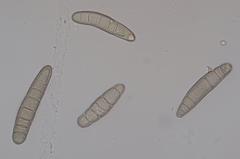 Bipolaris sorokinianae0pathogen
- Second interactor
- Alternaria alternata
 Alternaria alternatae0pathogen
- Outcome
- detected in seeds of at least eight cultivarse0
Organisms pictured · Representative pictures of the matched species, not figures from the paper.


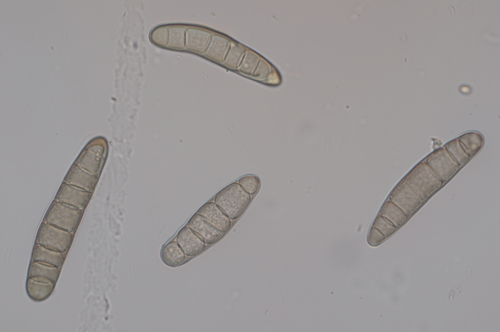

Verbatim
e0“Bipolaris sorokiniana and Alternaria alternata were detected in seeds of at least eight cultivars”
t0“Barley and Wheat”
Claim · model-written summary
Fusarium occurred in seeds of only two barley cultivars.
- Taxon
- barleyHordeum vulgaree0
- Material
- Jimah-54 and Jimah-58e0
- Outcome
- Fusarium species in seedse0
- Value
- twoe0
 Fusarium
Organisms pictured · Representative pictures of the matched species, not figures from the paper.

Verbatim
e0“Fusarium species in seeds of only two barley cultivars (Jimah-54 and Jimah-58)”
Claim · model-written summary
Infected barley and wheat seeds produced crown and root rot symptoms after germination.
- Taxon
- barley and wheatHordeum vulgareTriticum aestivume0
- Organ / stage
- infected seedse0
- Outcome
- Crown rot and root rot symptomse0
- Setting
- sterilized growing mediae0
Organisms pictured · Representative pictures of the matched species, not figures from the paper.
Verbatim
e0“Crown rot and root rot symptoms developed on barley and wheat cultivars following germination of infected seeds in sterilized growing media”
Claim · model-written summary
Bipolaris sorokiniana was the only pathogen consistently isolated from emerging crowns and roots.
- Taxon
- barley and wheatHordeum vulgareTriticum aestivumt0
- Interactor
- Bipolaris sorokinianaBipolaris sorokinianae0pathogen
- Outcome
- only pathogen consistently isolated from crowns and rootse0
Organisms pictured · Representative pictures of the matched species, not figures from the paper.
Verbatim
e0“Bipolaris sorokiniana was the only pathogen consistently isolated from crowns and roots of the emerging seedlings”
t0“Barley and Wheat”
Claim · model-written summary
Barley crown and root rot correlated significantly with seed B. sorokiniana inoculum.
- Taxon
- barleyHordeum vulgaree0
- Interactor
- B. sorokinianaBipolaris sorokinianae0pathogen
- Outcome
- crown rot and root rot diseasese0
Not reportedDirection
Organisms pictured · Representative pictures of the matched species, not figures from the paper.
Verbatim
e0“crown rot and root rot diseases of non-inoculated barley cultivars correlated significantly with B. sorokiniana inoculum in seeds (P = 0.0019)”
Claim · model-written summary
Barley rots did not significantly correlate with Fusarium or Alternaria seed inoculum.
- Taxon
- barleyHordeum vulgaret0
- Second interactor
- Alternaria
 Alternariae0pathogen
- Outcome
- crown rot and root rot diseasese1
Not reportedDirection
Organisms pictured · Representative pictures of the matched species, not figures from the paper.

Verbatim
e0“but not with Fusarium or Alternaria (P > 0.05)”
e1“crown rot and root rot diseases of non-inoculated barley cultivars correlated significantly with B. sorokiniana inoculum in seeds (P = 0.0019), but not with Fusarium or Alternaria (P > 0.05)”
t0“Barley”
Claim · model-written summary
B. sorokiniana pathogenicity tests confirmed induction of crown and root rot.
- Taxon
- barley and wheatHordeum vulgareTriticum aestivumt0
- Treatment
- B. sorokiniana isolatese0
- Interactor
- B. sorokinianaBipolaris sorokinianae0pathogen
- Outcome
- crown rot and root rote0
Not reportedComparatorDirection
Organisms pictured · Representative pictures of the matched species, not figures from the paper.
Verbatim
e0“Pathogenicity tests of B. sorokiniana isolates confirmed its role in inducing crown rot and root rot”
t0“Barley and Wheat”
Claim · model-written summary
Two wheat cultivars resisted crown and root rot more than most barley cultivars.
- Taxon
- wheatTriticum aestivume0
- Material
- two wheat cultivarse0
- Outcome
- resistant to crown and root rotse0
- Direction
- moree0
- Comparator
- most barley cultivarse0
Organisms pictured · Representative pictures of the matched species, not figures from the paper.
Verbatim
e0“two wheat cultivars being more resistant to crown and root rots than most barley cultivars (P < 0.05)”
Claim · model-written summary
Barley cultivars differed significantly in crown rot resistance.
- Taxon
- BarleyHordeum vulgaree0
- Outcome
- resistance to crown rote0
- Direction
- differencese0
Organisms pictured · Representative pictures of the matched species, not figures from the paper.
Verbatim
e0“Barley cultivars also exhibited significant differences in resistance to crown rot (P < 0.05)”
Claim · model-written summary
Black point symptoms occurred on seeds of three barley cultivars.
- Taxon
- barleyHordeum vulgaree0
- Organ / stage
- seedse0
- Outcome
- black point disease symptomse0
- Value
- threee0
Organisms pictured · Representative pictures of the matched species, not figures from the paper.
Verbatim
e0“black point disease symptoms were observed on seeds of three barley cultivars”
Claim · model-written summary
Black point significantly affected germination and growth in some barley cultivars.
- Taxon
- barleyHordeum vulgaret0
- Organ / stage
- seede0
- Outcome
- seed germination and growthe0
Not reportedDirection
Organisms pictured · Representative pictures of the matched species, not figures from the paper.
Verbatim
e0“were found to significantly affect seed germination and growth of some of these cultivars”
t0“Barley”
Claim · model-written summary
The authors report the first Oman association of B. sorokiniana with barley black point.
- Taxon
- barleyHordeum vulgaree0
- Interactor
- B. sorokinianaBipolaris sorokinianae0pathogen
- Outcome
- association of B. sorokiniana with black point diseasee0
- Setting
- Omane0
Organisms pictured · Representative pictures of the matched species, not figures from the paper.
Verbatim
e0“first report in Oman of the association of B. sorokiniana with black point disease of barley”
The same questions in other papers
Bipolaris sorokiniana · disease · Triticum aestivum (wheat)Positive and negative results
1 paper in the same direction as this paper · 2 in the opposite direction
- positive
- positive
- negative
Bipolaris sorokiniana · disease · Hordeum vulgare (barley)Positive and negative results
2 papers in the same direction as this paper · 1 in the opposite direction
- positive
- negative
- negative
Claims are grouped by organism, treatment and what was measured or targeted. A paper counts as positive when any of its claims in the group is positive.