Abstract
The forage grass factory could break through the restrictions of land resources, region and climate to achieve efficient production throughout the year by accurate and intelligent management. However, due to its closed environment, mold outbreaks in the forage grass factory were severe, significantly affecting barley production. In this study, 9 contaminated barley tissues were collected and 45 strains were isolated in forage grass factory. After ITS sequencing, 45 strains were all identified as Rhizopus oryzae . Through stress factor assays, R. oryzae growth was seriously hindered by low concentration of sodium nitrate, high pH value and ozone water treatment. High pH and ozone water affected growth mainly by altering membrane integrity of R. oryzae . Sodium nitrate inhibited the growth of R. oryzae mainly by affecting the amount of sporulation. Low concentration of sodium nitrate and ozone water did not affect the growth of barley. High concentrations of sodium nitrate (100 mM) and pH values (8–8.5) inhibited barley growth. Among them, ozone water had the most obvious inhibition effect on R. oryzae . Large-scale ozone water treatment in the forage grass factory had also played a role in restoring barley production. Taken together, the green techonology to control mold disease and maintain the safety of forage through different physicochemical methods was selected, which was of considerable application value in animal husbandry.
Abstract from the paper’s OpenAlex record; open copy licensed cc-by. Read at the source ↗
The text the model read, with the source record’s inline markup (italics, sub- and superscripts) rendered and its character entities decoded; quote offsets refer to the raw text.
Claims 13
Claim · model-written summary
All 45 isolates from contaminated barley tissues were identified as Rhizopus oryzae by ITS sequencing.
- Taxon
- barley
 Hordeum vulgaree0
- Interactor
- Rhizopus oryzae
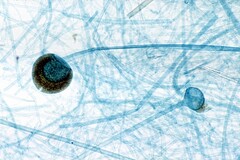 Rhizopus arrhizuse1pathogen
- Outcome
- strains were all identifiede1
- Value
- 45 strainse1
Organisms pictured · Representative pictures of the matched species, not figures from the paper.


Verbatim
e0“significantly affecting barley production”
e1“After ITS sequencing, 45 strains were all identified as Rhizopus oryzae”
Claim · model-written summary
Low concentration of sodium nitrate seriously hindered R. oryzae growth.
- Taxon
- barleyHordeum vulgaree0
- Treatment
- low concentration of sodium nitratee1
- Interactor
- R. oryzaeRhizopus arrhizuse1pathogen
- Outcome
- R. oryzae growthe1
- Direction
- seriously hinderede1
Not reportedComparator
Organisms pictured · Representative pictures of the matched species, not figures from the paper.
Verbatim
e0“significantly affecting barley production”
e1“Through stress factor assays, R. oryzae growth was seriously hindered by low concentration of sodium nitrate, high pH value and ozone water treatment”
Claim · model-written summary
High pH value seriously hindered R. oryzae growth.
- Taxon
- barleyHordeum vulgaree0
- Treatment
- high pH valuee1
- Interactor
- R. oryzaeRhizopus arrhizuse1pathogen
- Outcome
- R. oryzae growthe1
- Direction
- seriously hinderede1
Not reportedComparator
Organisms pictured · Representative pictures of the matched species, not figures from the paper.
Verbatim
e0“significantly affecting barley production”
e1“Through stress factor assays, R. oryzae growth was seriously hindered by low concentration of sodium nitrate, high pH value and ozone water treatment”
Claim · model-written summary
Ozone water treatment seriously hindered R. oryzae growth.
- Taxon
- barleyHordeum vulgaree0
- Treatment
- ozone water treatmente1
- Interactor
- R. oryzaeRhizopus arrhizuse1pathogen
- Outcome
- R. oryzae growthe1
- Direction
- seriously hinderede1
Not reportedComparator
Organisms pictured · Representative pictures of the matched species, not figures from the paper.
Verbatim
e0“significantly affecting barley production”
e1“Through stress factor assays, R. oryzae growth was seriously hindered by low concentration of sodium nitrate, high pH value and ozone water treatment”
Claim · model-written summary
High pH affected R. oryzae growth mainly by altering its membrane integrity.
- Taxon
- barleyHordeum vulgaree0
- Treatment
- High pHe1
- Interactor
- R. oryzaeRhizopus arrhizuse1pathogen
- Outcome
- growthe1
- Qualifier
- altering membrane integritye1
Organisms pictured · Representative pictures of the matched species, not figures from the paper.
Verbatim
e0“significantly affecting barley production”
e1“High pH and ozone water affected growth mainly by altering membrane integrity of R. oryzae”
Claim · model-written summary
Ozone water affected R. oryzae growth mainly by altering its membrane integrity.
- Taxon
- barleyHordeum vulgaree0
- Treatment
- ozone watere1
- Interactor
- R. oryzaeRhizopus arrhizuse1pathogen
- Outcome
- growthe1
- Qualifier
- altering membrane integritye1
Organisms pictured · Representative pictures of the matched species, not figures from the paper.
Verbatim
e0“significantly affecting barley production”
e1“High pH and ozone water affected growth mainly by altering membrane integrity of R. oryzae”
Claim · model-written summary
Sodium nitrate inhibited R. oryzae growth mainly by affecting the amount of sporulation.
- Taxon
- barleyHordeum vulgaree0
- Treatment
- Sodium nitratee1
- Interactor
- R. oryzaeRhizopus arrhizuse1pathogen
- Outcome
- growthe1
- Qualifier
- by affecting the amount of sporulatione1
Organisms pictured · Representative pictures of the matched species, not figures from the paper.
Verbatim
e0“significantly affecting barley production”
e1“Sodium nitrate inhibited the growth of R. oryzae mainly by affecting the amount of sporulation”
Claim · model-written summary
Low concentration of sodium nitrate did not affect barley growth.
- Taxon
- barleyHordeum vulgaree0
- Treatment
- Low concentration of sodium nitratee1
- Outcome
- growth of barleye1
- Direction
- did not affecte1
Not reportedComparator
Organisms pictured · Representative pictures of the matched species, not figures from the paper.
Verbatim
e0“significantly affecting barley production”
e1“Low concentration of sodium nitrate and ozone water did not affect the growth of barley”
Claim · model-written summary
Ozone water did not affect barley growth.
- Taxon
- barleyHordeum vulgaree0
- Treatment
- ozone watere1
- Outcome
- growth of barleye1
- Direction
- did not affecte1
Not reportedComparator
Organisms pictured · Representative pictures of the matched species, not figures from the paper.
Verbatim
e0“significantly affecting barley production”
e1“Low concentration of sodium nitrate and ozone water did not affect the growth of barley”
Claim · model-written summary
High sodium nitrate (100 mM) inhibited barley growth.
- Taxon
- barleyHordeum vulgaree0
- Treatment
- High concentrations of sodium nitrate (100 mM)e1
- Outcome
- barley growthe1
- Direction
- inhibitede1
- Value
- 100 mMe1
Not reportedComparator
Organisms pictured · Representative pictures of the matched species, not figures from the paper.
Verbatim
e0“significantly affecting barley production”
e1“High concentrations of sodium nitrate (100 mM) and pH values (8–8.5) inhibited barley growth”
Claim · model-written summary
pH values of 8–8.5 inhibited barley growth.
- Taxon
- barleyHordeum vulgaree0
- Treatment
- pH values (8–8.5)e1
- Outcome
- barley growthe1
- Direction
- inhibitede1
- Value
- 8–8.5e1
Not reportedComparator
Organisms pictured · Representative pictures of the matched species, not figures from the paper.
Verbatim
e0“significantly affecting barley production”
e1“High concentrations of sodium nitrate (100 mM) and pH values (8–8.5) inhibited barley growth”
Claim · model-written summary
Among the treatments, ozone water had the most obvious inhibition effect on R. oryzae.
- Taxon
- barleyHordeum vulgaree0
- Treatment
- ozone watere1
- Interactor
- R. oryzaeRhizopus arrhizuse1pathogen
- Outcome
- inhibition effecte1
- Direction
- most obviouse1
Not reportedComparator
Organisms pictured · Representative pictures of the matched species, not figures from the paper.
Verbatim
e0“significantly affecting barley production”
e1“Among them, ozone water had the most obvious inhibition effect on R. oryzae”
Claim · model-written summary
Large-scale ozone water treatment in the forage grass factory helped restore barley production.
- Taxon
- barleyHordeum vulgaree0
- Treatment
- Large-scale ozone water treatmente1
- Outcome
- barley productione1
- Direction
- restoringe1
- Setting
- forage grass factorye1
Not reportedComparator
Organisms pictured · Representative pictures of the matched species, not figures from the paper.
Verbatim
e0“significantly affecting barley production”
e1“Large-scale ozone water treatment in the forage grass factory had also played a role in restoring barley production”
The same questions in other papers
irrigation · yield · Hordeum vulgare (barley)Results differ
82 papers in the same direction as this paper · 26 in the opposite direction
- no effect
- negative
- negative
105 papers more in this group
See all 109 papers →ozone · yield · Hordeum vulgare (barley)Positive and negative results
2 in the opposite direction
- negative
- negative
ozone · growth · Hordeum vulgare (barley)Positive and negative results
3 papers in the same direction as this paper · 3 in the opposite direction
- positive
- positive
- positive
3 papers more in this group
See all 7 papers →ph · growth · Hordeum vulgare (barley)Positive and negative results
4 papers in the same direction as this paper · 4 in the opposite direction
- positive
- positive
- positive
5 papers more in this group
See all 9 papers →Claims are grouped by organism, treatment and what was measured or targeted. A paper counts as positive when any of its claims in the group is positive.