Abstract
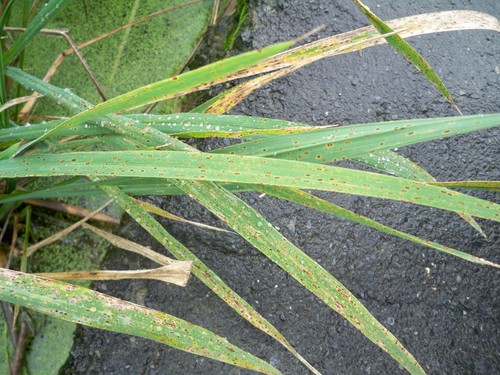
HomePlant DiseaseVol. 103, No. 5Bipolaris oryzae Causing Brown Leaf Spot on Echinochloa crus-galli in Southern Brazil PreviousNext DISEASE NOTES OPENOpen Access licenseBipolaris oryzae Causing Brown Leaf Spot on Echinochloa crus-galli in Southern BrazilT. E. Kaspary, C. Bellé, C. A. G. Rigon, L. Cutti, G. Casarotto, M. Gallon, and A. Merotto JuniorT. E. KasparyInstituto Nacional de Investigación Agropecuaria, La Estanzuela, 70000, Colonia, Uruguay; , C. Bellé†Corresponding author: C. Bellé; E-mail Address: crbelle@gmail.comhttp://orcid.org/0000-0003-2247-3207Departamento de Solos, Centro de Ciências Rurais, Universidade Federal de Santa Maria, 97105-900, Santa Maria, RS, Brazil; and , C. A. G. RigonDepartamento de Fitotecnia, Universidade Federal do Rio Grande do Sul, 91540-000, Porto Alegre, RS, Brazil, L. CuttiDepartamento de Fitotecnia, Universidade Federal do Rio Grande do Sul, 91540-000, Porto Alegre, RS, Brazil, G. CasarottoDepartamento de Fitotecnia, Universidade Federal do Rio Grande do Sul, 91540-000, Porto Alegre, RS, Brazil, M. GallonDepartamento de Fitotecnia, Universidade Federal do Rio Grande do Sul, 91540-000, Porto Alegre, RS, Brazil, and A. Merotto JuniorDepartamento de Fitotecnia, Universidade Federal do Rio Grande do Sul, 91540-000, Porto Alegre, RS, BrazilAffiliationsAuthors and Affiliations T. E. Kaspary1 C. Bellé2 † C. A. G. Rigon3 L. Cutti3 G. Casarotto3 M. Gallon3 A. Merotto Junior3 1Instituto Nacional de Investigación Agropecuaria, La Estanzuela, 70000, Colonia, Uruguay; 2Departamento de Solos, Centro de Ciências Rurais, Universidade Federal de Santa Maria, 97105-900, Santa Maria, RS, Brazil; and 3Departamento de Fitotecnia, Universidade Federal do Rio Grande do Sul, 91540-000, Porto Alegre, RS, Brazil Published Online:15 Mar 2019https://doi.org/10.1094/PDIS-11-18-2057-PDNAboutSections ToolsAdd to favoritesDownload CitationsTrack Citations ShareShare onFacebookTwitterLinked InRedditEmailWechat Barnyardgrass (Echinochloa crus-galli [L.] P. Beauv.), a member of the family Poaceae, is an important weed in rice production with widespread herbicide resistance (Heap 2018). In addition to yield loss from competition, barnyardgrass may be an alternative host of pests and diseases of rice. In January 2018, symptoms of leaf spots were observed on E. crus-galli in Porto Alegre, Rio Grande do Sul state, Brazil. Diseased plants exhibited leaves with brown, often small, elliptical, and necrotic spots. Lesions were surrounded by a diffuse chlorotic margin, and larger lesions had tan centers. The incidence of the disease was up to 85%, and the severity ranged from 50 to 75%. Leaf lesion samples were surface disinfested (70% ethanol for 45 s, 1% NaClO for 1.5 min, rinsed three times in sterile water, and dried on sterilized filter paper), placed on potato dextrose agar (PDA) medium, and incubated at 25°C. Colonies on PDA were initially gray, with unevenly distributed mycelium resulting in a fluffy appearance, and becoming dark gray with age. Conidiophores were brown, straight, cylindrical, and multiseptate. Conidia were brown, curved, ellipsoidal tapering to rounded ends, and measured 60.1 to 85.4 µm (length) × 20.2 to 31.0 µm (width), mean ± SD = 75.2 ± 3.5 × 23.5 ± 1.2 µm, length/width ratio = 3.2, with 4 to 10 septa (n = 100). To further confirm the identification, the internal transcribed spacer (ITS), glycerol-3-phosphate dehydrogenase (GPD), and translation elongation factor 1-alpha (EF1-α) genes were amplified with polymerase chain reaction, as described by Manamgoda et al. (2014). The obtained DNA sequences were submitted to GenBank (accession nos.: ITS, MH920540; GPD, MH921828; and EF1-α, MH921829). BLAST searches indicated 99 to 100% identity with sequences of Bipolaris oryzae (Breda de Haan) Shoemaker (ITS, MG448606, JF693908, and MH857291; GPD, MG458233, LT715776, and LT715776; and EF1-α, KT163402, MF431724, and MG458234). To confirm Koch's postulates of the B. oryzae isolate, six plants of E. crus-galli were inoculated with a suspension of 1 × 10⁶ conidial/ml. A set of six noninoculated plants was considered as controls, with only distilled water applied. All plants were enclosed in plastic bags and incubated in a growth chamber at 25 ± 2°C for 24 h with a 12-h photoperiod. At the end of the 24-h period, plastic bags were removed. At 5 to 6 days after the inoculation, leaves displayed symptoms similar to those observed in the field, whereas controls remained symptomless. A fungus was reisolated from inoculated leaves that had the same morphological and molecular traits as the initial isolates. Based on the morphological characteristics and sequence analysis, the fungus was identified as B. oryzae (Manamgoda et al. 2014). B. oryzae has previously been reported from other hosts in Brazil including Oryza sativa, Triticum aestivum, and Brachypodium distachyon (Kaspary et al. 2018; Manamgoda et al. 2014). Rice plants (cultivars BRS Querência and Puita Inta CL) were also inoculated with an isolate of B. oryzae from E. crus-galli using the same methods as described above. Brown leaf spot symptoms developed, indicating that this isolate is pathogenic on rice. The current report highlights the relevance of E. crus-galli as a host for B. oryzae that could be important for studies about the pathogen-host interaction in cereal crops. To our knowledge, this is the first report of B. oryzae causing leaf spot of E. crus-galli in Brazil.References:Heap, I. 2018. International Survey of Herbicide Resistant Weeds. Retrieved 15 September 2018 from http://www.weedscience.org/Summary/Species.aspx. Google ScholarKaspary, T. E., et al. 2018. Plant Dis. 102:1450. https://doi.org/10.1094/PDIS-11-17-1806-PDN Link, ISI, Google ScholarManamgoda, D. S., et al. 2014. Stud. Mycol. 79:221. https://doi.org/10.1016/j.simyco.2014.10.002 Crossref, ISI, Google ScholarT. E. Kaspary and C. Bellé contributed equally to this work.The author(s) declare no conflict of interest.DetailsFiguresLiterature CitedRelated Vol. 103, No. 5 May 2019SubscribeISSN:0191-2917e-ISSN:1943-7692 DownloadCaptionTomato leaves infected with Tomato chlorotic dwarf viroid (Olmedo-Velarde, Roy, Belanger, Watanabe, Hamasaki, Mavrodieva, Nakhla, and Melzer). Photo credit: M. J. Melzer. Spinach plants with downy mildew symptoms caused by Peronospora effusa (Kandel, Mou, Shishkoff, Shi, Subbarao, and Klosterman). Photo credit: S. L. Kandel. Metrics Article History Issue Date: 8 May 2019Published: 15 Mar 2019First Look: 7 Jan 2019Accepted: 31 Dec 2018 Page: 1038 Information© 2019 The American Phytopathological SocietyCited byA polyphasic approach to delineate species in Bipolaris25 May 2020 | Fungal Diversity, Vol. 102, No. 1
Abstract from the paper’s OpenAlex record, shown for indexing and research. Copyright remains with the authors or the publisher. Read at the source ↗
The text the model read, with the source record’s inline markup (italics, sub- and superscripts) rendered and its character entities decoded; quote offsets refer to the raw text.
Claims 6
Claim · model-written summary
Barnyardgrass leaf spot incidence reached 85% in Porto Alegre.
- Taxon
- E. crus-galli
 Echinochloa crus-gallie0
- Outcome
- incidence of the diseasee1
- Value
- 85%e1
- Setting
- Porto Alegre, Rio Grande do Sul state, Brazile0
Not reportedInteractor
Organisms pictured · Representative pictures of the matched species, not figures from the paper.

Verbatim
e0“In January 2018, symptoms of leaf spots were observed on E. crus-galli in Porto Alegre, Rio Grande do Sul state, Brazil.”
e1“The incidence of the disease was up to 85%”
Claim · model-written summary
Barnyardgrass leaf spot severity ranged from 50 to 75%.
- Taxon
- E. crus-galliEchinochloa crus-gallie0
- Outcome
- severitye1
- Value
- 50 to 75%e1
- Setting
- Porto Alegre, Rio Grande do Sul state, Brazile0
Organisms pictured · Representative pictures of the matched species, not figures from the paper.
Verbatim
e0“In January 2018, symptoms of leaf spots were observed on E. crus-galli in Porto Alegre, Rio Grande do Sul state, Brazil.”
e1“the severity ranged from 50 to 75%”
Claim · model-written summary
Inoculated barnyardgrass developed field-like symptoms while controls remained symptomless.
- Taxon
- E. crus-galliEchinochloa crus-gallie0
- Treatment
- inoculated with a suspension of 1 × 10⁶ conidial/mle0
- Interactor
- B. oryzae
 Bipolaris oryzaee0pathogen
- Outcome
- leaves displayed symptomse1
- Direction
- displayede1
- Comparator
- controlse1
Organisms pictured · Representative pictures of the matched species, not figures from the paper.
Verbatim
e0“To confirm Koch's postulates of the B. oryzae isolate, six plants of E. crus-galli were inoculated with a suspension of 1 × 10⁶ conidial/ml.”
e1“At 5 to 6 days after the inoculation, leaves displayed symptoms similar to those observed in the field, whereas controls remained symptomless.”
Claim · model-written summary
The fungus was reisolated from inoculated leaves with the same morphology and molecular traits.
- Taxon
- E. crus-galliEchinochloa crus-gallie1
- Outcome
- A fungus was reisolated from inoculated leavese0
Organisms pictured · Representative pictures of the matched species, not figures from the paper.
Verbatim
e0“A fungus was reisolated from inoculated leaves that had the same morphological and molecular traits as the initial isolates.”
e1“six plants of E. crus-galli were inoculated”
Claim · model-written summary
The barnyardgrass isolate caused brown leaf spot on rice.
- Taxon
- Rice
 Oryza sativae0
- Material
- BRS Querência and Puita Inta CLe0
- Treatment
- inoculated with an isolate of B. oryzaee0
- Interactor
- B. oryzaeBipolaris oryzaee0pathogen
- Outcome
- Brown leaf spot symptomse0
- Direction
- developede0
Not reportedComparator
Organisms pictured · Representative pictures of the matched species, not figures from the paper.

Verbatim
e0“Rice plants (cultivars BRS Querência and Puita Inta CL) were also inoculated with an isolate of B. oryzae from E. crus-galli using the same methods as described above. Brown leaf spot symptoms developed”
Claim · model-written summary
This is reported as the first Brazilian report of B. oryzae leaf spot on E. crus-galli.
- Taxon
- E. crus-galliEchinochloa crus-gallie0
- Interactor
- B. oryzaeBipolaris oryzaee0pathogen
- Outcome
- leaf spote0
- Setting
- Brazile0
Organisms pictured · Representative pictures of the matched species, not figures from the paper.
Verbatim
e0“this is the first report of B. oryzae causing leaf spot of E. crus-galli in Brazil.”
The same questions in other papers
Bipolaris oryzae · disease · Oryza sativa (rice)Results agree
2 papers in the same direction as this paper
- negative
- negative
inoculation · disease · Oryza sativa (rice)Positive and negative results
51 papers in the same direction as this paper · 106 in the opposite direction
- positive
- positive
- positive
154 papers more in this group
See all 158 papers →Claims are grouped by organism, treatment and what was measured or targeted. A paper counts as positive when any of its claims in the group is positive.