Abstract
OsCERK1 is a rice receptor-like kinase that mediates the signal of a fungal cell wall component, chitin, by coordinating with a lysin motif (LysM)-containing protein CEBiP. To further elucidate the function of OsCERK1 in the defense response, we disrupted OsCERK1 using an Agrobacterium-mediated gene targeting system based on homologous recombination. In OsCERK1-disrupted lines, the generation of hydrogen peroxide and the alteration of gene expression in response to a chitin oligomer were completely abolished. The OsCERK1-disrupted lines also showed lowered responsiveness to a bacterial cell wall component, peptidoglycan. Yeast two-hybrid analysis indicated that OsCERK1 interacts with the LysM-containing proteins LYP4 and LYP6, which are known to participate in the peptidoglycan response in rice. Observation of the infection behavior of rice blast fungus (Magnaporthe oryzae) revealed that disruption of OsCERK1 led to increased hyphal growth in leaf sheath cells. Green fluorescent protein-tagged OsCERK1 was localized around the primary infection hyphae. These results demonstrate that OsCERK1 is indispensable for chitin perception and participates in innate immunity in rice, and also mediates the peptidoglycan response. It is also suggested that OsCERK1 mediates the signaling pathways of both fungal and bacterial molecular patterns by interacting with different LysM-containing receptor-like proteins.
Abstract from the paper’s OpenAlex record, shown for indexing and research. Copyright remains with the authors or the publisher. Read at the source ↗
The text the model read, with the source record’s inline markup (italics, sub- and superscripts) rendered and its character entities decoded; quote offsets refer to the raw text.
Claims 11
Claim · model-written summary
OsCERK1 disruption abolished hydrogen peroxide generation after chitin oligomer exposure.
- Taxon
- rice
 Oryza sativat0
- Treatment
- chitin oligomere0
- Gene
- OsCERK1e0
- Outcome
- generation of hydrogen peroxidee0
- Direction
- completely abolishede0
Not reportedComparator
Organisms pictured · Representative pictures of the matched species, not figures from the paper.

Verbatim
e0“In OsCERK1-disrupted lines, the generation of hydrogen peroxide and the alteration of gene expression in response to a chitin oligomer were completely abolished”
t0“Rice”
Claim · model-written summary
OsCERK1 disruption abolished gene expression changes after chitin oligomer exposure.
- Taxon
- riceOryza sativat0
- Treatment
- chitin oligomere0
- Gene
- OsCERK1e0
- Outcome
- alteration of gene expressione0
- Direction
- completely abolishede0
Not reportedComparator
Organisms pictured · Representative pictures of the matched species, not figures from the paper.
Verbatim
e0“In OsCERK1-disrupted lines, the generation of hydrogen peroxide and the alteration of gene expression in response to a chitin oligomer were completely abolished”
t0“Rice”
Claim · model-written summary
OsCERK1-disrupted lines had lower responsiveness to peptidoglycan.
- Taxon
- riceOryza sativat0
- Treatment
- OsCERK1-disrupted linese0
- Outcome
- responsivenesse0
- Direction
- lowerede0
Not reportedComparator
Organisms pictured · Representative pictures of the matched species, not figures from the paper.
Verbatim
e0“The OsCERK1-disrupted lines also showed lowered responsiveness to a bacterial cell wall component, peptidoglycan”
t0“Rice”
Claim · model-written summary
OsCERK1 interacted with LYP4.
- Taxon
- riceOryza sativat0
- Gene
- OsCERK1e0
- Outcome
- interacts with the LysM-containing proteins LYP4e0
Organisms pictured · Representative pictures of the matched species, not figures from the paper.
Verbatim
e0“OsCERK1 interacts with the LysM-containing proteins LYP4 and LYP6”
t0“Rice”
Claim · model-written summary
OsCERK1 interacted with LYP6.
- Taxon
- riceOryza sativat0
- Gene
- OsCERK1e0
- Outcome
- interacts with the LysM-containing proteins LYP4 and LYP6e0
Organisms pictured · Representative pictures of the matched species, not figures from the paper.
Verbatim
e0“OsCERK1 interacts with the LysM-containing proteins LYP4 and LYP6”
t0“Rice”
Claim · model-written summary
OsCERK1 disruption increased rice blast fungal hyphal growth in leaf sheath cells.
- Taxon
- riceOryza sativae1
- Organ / stage
- leaf sheath cellse0
- Treatment
- disruption of OsCERK1e0
- Interactor
- Magnaporthe oryzae
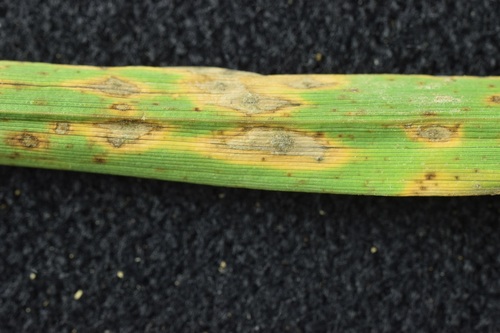
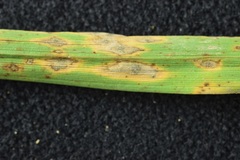 Pyricularia oryzaee1pathogen
- Gene
- OsCERK1e0
- Outcome
- hyphal growthe0
- Direction
- increasede0
Not reportedComparator
Organisms pictured · Representative pictures of the matched species, not figures from the paper.
Verbatim
e0“disruption of OsCERK1 led to increased hyphal growth in leaf sheath cells”
e1“rice blast fungus (Magnaporthe oryzae)”
Claim · model-written summary
Tagged OsCERK1 localized around primary infection hyphae.
- Taxon
- riceOryza sativat0
- Gene
- OsCERK1e0
- Outcome
- localized around the primary infection hyphaee0
Organisms pictured · Representative pictures of the matched species, not figures from the paper.
Verbatim
e0“Green fluorescent protein-tagged OsCERK1 was localized around the primary infection hyphae”
t0“Rice”
Claim · model-written summary
The authors conclude OsCERK1 is indispensable for chitin perception.
- Taxon
- riceOryza sativae0
- Gene
- OsCERK1e0
- Outcome
- chitin perceptione0
Organisms pictured · Representative pictures of the matched species, not figures from the paper.
Verbatim
e0“OsCERK1 is indispensable for chitin perception and participates in innate immunity in rice”
Claim · model-written summary
The authors conclude OsCERK1 participates in innate rice immunity.
- Taxon
- riceOryza sativae0
- Gene
- OsCERK1e0
- Outcome
- innate immunitye0
Organisms pictured · Representative pictures of the matched species, not figures from the paper.
Verbatim
e0“OsCERK1 is indispensable for chitin perception and participates in innate immunity in rice”
Claim · model-written summary
The authors conclude OsCERK1 mediates peptidoglycan response.
- Taxon
- riceOryza sativat0
- Gene
- OsCERK1e1
- Outcome
- peptidoglycan responsee0
- Qualifier
- mediatese0
Organisms pictured · Representative pictures of the matched species, not figures from the paper.
Verbatim
e0“also mediates the peptidoglycan response”
e1“These results demonstrate that OsCERK1 is indispensable for chitin perception”
t0“Rice”
Claim · model-written summary
The authors suggest OsCERK1 signals fungal and bacterial patterns via different LysM proteins.
- Taxon
- riceOryza sativat0
- Gene
- OsCERK1e0
- Outcome
- signaling pathways of both fungal and bacterial molecular patternse0
- Qualifier
- interacting with different LysM-containing receptor-like proteinse0
Organisms pictured · Representative pictures of the matched species, not figures from the paper.
Verbatim
e0“OsCERK1 mediates the signaling pathways of both fungal and bacterial molecular patterns by interacting with different LysM-containing receptor-like proteins”
t0“Rice”
The same questions in other papers
oligomer · molecular: expression · Oryza sativa (rice)Positive and negative results
1 in the opposite direction
- positive
resistance inducer · physiology: oxidative · Oryza sativa (rice)Positive and negative results
4 in the opposite direction
- positive
- positive
- positive
1 paper more in this group
See all 5 papers →resistance inducer · molecular: expression · Oryza sativa (rice)Positive and negative results
1 paper in the same direction as this paper · 15 in the opposite direction
- positive
- positive
- positive
13 papers more in this group
See all 17 papers →loss of function · Pyricularia oryzae · Oryza sativa (rice)Positive and negative results
25 papers in the same direction as this paper · 41 in the opposite direction
- positive
- negative
- negative
63 papers more in this group
See all 67 papers →Claims are grouped by organism, treatment and what was measured or targeted. A paper counts as positive when any of its claims in the group is positive.