Abstract
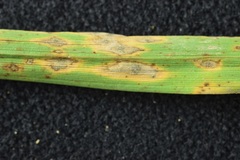
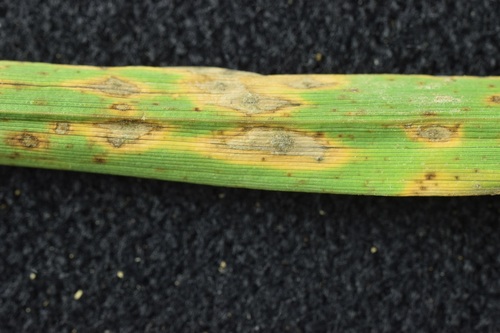
Carolina foxtail (Alopecurus carolinianus) has not been reported to host Magnaporthe oryzae. A collection of Carolina foxtail obtained from several Arkansas locations over a 4-year period was inoculated with four races of the fungus under greenhouse conditions and, in all cases, inoculation resulted in the formation of irregular, yellow and brown lesions without obvious gray centers that are characteristic for blast on rice. Differences in these lesions were not observed among our collection. These lesions appeared to differ from typical blast lesions on inoculated rice leaves but were evident following artificial inoculation of Carolina foxtail in the greenhouse. M. oryzae races that differed in pathogenicity toward rice cultivars also displayed differences in lesion development on Carolina foxtail. The most virulent race on rice cultivars also produced lesions most rapidly on Carolina foxtail. These lesions developed more quickly on Carolina foxtail than on the most susceptible rice cultivars tested, including a susceptible California cultivar, M202. M. oryzae isolates cultured from these lesions in the infected Carolina foxtail caused typical disease symptoms of blast on inoculated rice cultivars. We suggest that Carolina foxtail is a new and previously unrecognized host for the blast pathogen.
Abstract from the paper’s OpenAlex record, shown for indexing and research. Copyright remains with the authors or the publisher. Read at the source ↗
The text the model read, with the source record’s inline markup (italics, sub- and superscripts) rendered and its character entities decoded; quote offsets refer to the raw text.
Claims 8
Claim · model-written summary
Inoculation produced irregular yellow and brown lesions on Carolina foxtail.
- Taxon
- Carolina foxtaile1
- Treatment
- inoculatione0
- Interactor
- Magnaporthe oryzae
 Pyricularia oryzaet0pathogen
- Outcome
- formation of irregular, yellow and brown lesions without obvious gray centerse0
Not reportedComparatorDirection
Organisms pictured · Representative pictures of the matched species, not figures from the paper.
Verbatim
e0“inoculation resulted in the formation of irregular, yellow and brown lesions without obvious gray centers”
t0“Magnaporthe oryzae”
e1“Carolina foxtail (Alopecurus carolinianus)”
Claim · model-written summary
Lesions did not differ among the Carolina foxtail collection.
- Taxon
- Carolina foxtailt0
- Interactor
- Magnaporthe oryzaePyricularia oryzaet0pathogen
- Outcome
- Differences in these lesionse0
- Direction
- not observede0
Organisms pictured · Representative pictures of the matched species, not figures from the paper.
Verbatim
e0“Differences in these lesions were not observed among our collection”
t0“Carolina Foxtail (Alopecurus carolinianus): Susceptibility and Suitability as an Alternative Host to Rice Blast Disease (Magnaporthe oryzae [formerly M. grisea])”
Claim · model-written summary
Carolina foxtail lesions differed from typical blast lesions on rice.
- Taxon
- Carolina foxtailt0
- Interactor
- Magnaporthe oryzaePyricularia oryzaet0pathogen
- Outcome
- lesionse0
- Direction
- differe0
- Comparator
- inoculated rice leavese0
Organisms pictured · Representative pictures of the matched species, not figures from the paper.
Verbatim
e0“These lesions appeared to differ from typical blast lesions on inoculated rice leaves”
t0“Carolina Foxtail (Alopecurus carolinianus): Susceptibility and Suitability as an Alternative Host to Rice Blast Disease (Magnaporthe oryzae [formerly M. grisea])”
Claim · model-written summary
M. oryzae races differed in lesion development on Carolina foxtail.
- Taxon
- Carolina foxtaile0
- Interactor
- M. oryzaePyricularia oryzaee0pathogen
- Outcome
- lesion developmente0
- Direction
- differencese0
Organisms pictured · Representative pictures of the matched species, not figures from the paper.
Verbatim
e0“M. oryzae races that differed in pathogenicity toward rice cultivars also displayed differences in lesion development on Carolina foxtail”
Claim · model-written summary
The most virulent race on rice caused the fastest lesion development on Carolina foxtail.
- Taxon
- Carolina foxtaile0
- Interactor
- M. oryzaePyricularia oryzaee1pathogen
- Outcome
- lesionse0
- Direction
- most rapidlye0
Organisms pictured · Representative pictures of the matched species, not figures from the paper.
Verbatim
e0“The most virulent race on rice cultivars also produced lesions most rapidly on Carolina foxtail”
e1“M. oryzae races”
Claim · model-written summary
Lesions developed faster on Carolina foxtail than on susceptible rice cultivars.
- Taxon
- Carolina foxtaile0
- Interactor
- M. oryzaePyricularia oryzaet0pathogen
- Outcome
- lesionse0
- Direction
- more quicklye0
- Comparator
- the most susceptible rice cultivars testede0
Organisms pictured · Representative pictures of the matched species, not figures from the paper.
Verbatim
e0“These lesions developed more quickly on Carolina foxtail than on the most susceptible rice cultivars tested”
t0“M. oryzae races that differed”
Claim · model-written summary
M. oryzae isolates from infected Carolina foxtail caused typical blast symptoms on inoculated rice.
- Taxon
- rice cultivars
 Oryza sativae0
- Treatment
- M. oryzae isolates cultured from these lesionse0
- Interactor
- M. oryzaePyricularia oryzaee0pathogen
- Outcome
- typical disease symptoms of blaste0
Not reportedComparatorDirection
Organisms pictured · Representative pictures of the matched species, not figures from the paper.

Verbatim
e0“M. oryzae isolates cultured from these lesions in the infected Carolina foxtail caused typical disease symptoms of blast on inoculated rice cultivars”
Claim · model-written summary
The authors identify Carolina foxtail as a previously unrecognized host of rice blast.
- Taxon
- Carolina foxtaile0
- Interactor
- Magnaporthe oryzaePyricularia oryzaet0pathogen
- Outcome
- new and previously unrecognized host for the blast pathogene0
Organisms pictured · Representative pictures of the matched species, not figures from the paper.
Verbatim
e0“We suggest that Carolina foxtail is a new and previously unrecognized host for the blast pathogen”
t0“Magnaporthe oryzae”
The same questions in other papers
Pyricularia oryzae · disease · Oryza sativa (rice)Positive and negative results
5 papers in the same direction as this paper · 7 in the opposite direction
- positive
- positive
- positive
9 papers more in this group
See all 13 papers →Claims are grouped by organism, treatment and what was measured or targeted. A paper counts as positive when any of its claims in the group is positive.