Abstract
It is well documented that slag-based silicon fertilizers have beneficial effects on the growth and disease resistance of rice. However, their effects vary greatly with sources of slag and are closely related to availability of silicon (Si) in these materials. To date, few researches have been done to compare the differences in plant performance and disease resistance between different slag-based silicon fertilizers applied at the same rate of plant-available Si. In the present study both steel and iron slags were chosen to investigate their effects on rice growth and disease resistance under greenhouse conditions. Both scanning electron microscopy (SEM) and transmission electron microscopy (TEM) were used to examine the effects of slags on ultrastructural changes in leaves of rice naturally infected by Bipolaris oryaze, the causal agent of brown spot. The results showed that both slag-based Si fertilizers tested significantly increased rice growth and yield, but decreased brown spot incidence, with steel slag showing a stronger effect than iron slag. The results of SEM analysis showed that application of slags led to more pronounced cell silicification in rice leaves, more silica cells, and more pronounced and larger papilla as well. The results of TEM analysis showed that mesophyll cells of slag-untreated rice leaf were disorganized, with colonization of the fungus (Bipolaris oryzae), including chloroplast degradation and cell wall alterations. The application of slag maintained mesophyll cells relatively intact and increased the thickness of silicon layer. It can be concluded that applying slag-based fertilizer to Si-deficient paddy soil is necessary for improving both rice productivity and brown spot resistance. The immobile silicon deposited in host cell walls and papillae sites is the first physical barrier for fungal penetration, while the soluble Si in the cytoplasm enhances physiological or induced resistance to fungal colonization.
Abstract from the paper’s OpenAlex record; open copy licensed cc-by. Read at the source ↗
The text the model read, with the source record’s inline markup (italics, sub- and superscripts) rendered and its character entities decoded; quote offsets refer to the raw text.
Claims 12
Claim · model-written summary
Both slag silicon fertilizers significantly increased rice growth.
- Taxon
- rice
 Oryza sativae0
- Treatment
- slag-based Si fertilizerse0
- Outcome
- rice growthe0
- Direction
- increasede0
Not reportedComparator
Organisms pictured · Representative pictures of the matched species, not figures from the paper.

Verbatim
e0“both slag-based Si fertilizers tested significantly increased rice growth and yield”
Claim · model-written summary
Both slag silicon fertilizers significantly increased rice yield.
- Taxon
- riceOryza sativae0
- Treatment
- slag-based Si fertilizerse0
- Outcome
- yielde0
- Direction
- increasede0
Not reportedComparator
Organisms pictured · Representative pictures of the matched species, not figures from the paper.
Verbatim
e0“both slag-based Si fertilizers tested significantly increased rice growth and yield”
Claim · model-written summary
Both slag fertilizers decreased rice brown spot incidence.
- Taxon
- riceOryza sativae0
- Treatment
- slag-based Si fertilizerse0
- Outcome
- brown spot incidencee0
- Direction
- decreasede0
Not reportedComparator
Organisms pictured · Representative pictures of the matched species, not figures from the paper.
Verbatim
e0“both slag-based Si fertilizers tested significantly increased rice growth and yield, but decreased brown spot incidence”
Claim · model-written summary
Steel slag had a stronger effect on rice growth, yield and brown spot than iron slag.
- Taxon
- riceOryza sativae0
- Treatment
- steel slage0
- Outcome
- rice growth and yield, but decreased brown spot incidencee0
- Direction
- stronger effecte0
- Comparator
- iron slage0
Organisms pictured · Representative pictures of the matched species, not figures from the paper.
Verbatim
e0“both slag-based Si fertilizers tested significantly increased rice growth and yield, but decreased brown spot incidence, with steel slag showing a stronger effect than iron slag.”
Claim · model-written summary
Slag application increased rice leaf cell silicification and silica cells.
- Taxon
- riceOryza sativae0
- Treatment
- slagse0
- Outcome
- cell silicification in rice leaves, more silica cellse0
- Direction
- more pronouncede0
Not reportedComparator
Organisms pictured · Representative pictures of the matched species, not figures from the paper.
Verbatim
e0“application of slags led to more pronounced cell silicification in rice leaves, more silica cells”
Claim · model-written summary
Slag application produced more pronounced and larger papillae in rice leaves.
- Taxon
- riceOryza sativae0
- Treatment
- slagse0
- Outcome
- papillae0
- Direction
- more pronounced and largere0
Not reportedComparator
Organisms pictured · Representative pictures of the matched species, not figures from the paper.
Verbatim
e0“application of slags led to more pronounced cell silicification in rice leaves, more silica cells, and more pronounced and larger papilla as well.”
Claim · model-written summary
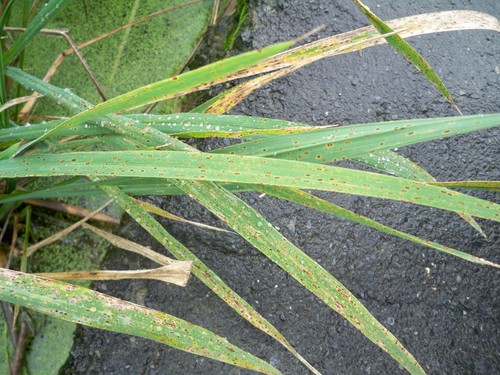
Untreated infected rice leaves had disorganized mesophyll cells, fungal colonization, chloroplast degradation and cell wall alterations.
- Taxon
- riceOryza sativae0
- Interactor
- Bipolaris oryzae
 Bipolaris oryzaee0pathogen
- Outcome
- mesophyll cellse0
- Direction
- disorganizede0
Organisms pictured · Representative pictures of the matched species, not figures from the paper.
Verbatim
e0“mesophyll cells of slag-untreated rice leaf were disorganized, with colonization of the fungus (Bipolaris oryzae), including chloroplast degradation and cell wall alterations.”
Claim · model-written summary
Slag application kept rice mesophyll cells relatively intact.
- Taxon
- RiceOryza sativat0
- Treatment
- slage0
- Outcome
- mesophyll cellse0
- Direction
- relatively intacte0
Not reportedComparator
Organisms pictured · Representative pictures of the matched species, not figures from the paper.
Verbatim
e0“The application of slag maintained mesophyll cells relatively intact and increased the thickness of silicon layer.”
t0“Rice”
Claim · model-written summary
Slag application increased the thickness of the silicon layer in rice leaves.
- Taxon
- RiceOryza sativat0
- Treatment
- slage0
- Outcome
- thickness of silicon layere0
- Direction
- increasede0
Not reportedComparator
Organisms pictured · Representative pictures of the matched species, not figures from the paper.
Verbatim
e0“The application of slag maintained mesophyll cells relatively intact and increased the thickness of silicon layer.”
t0“Rice”
Claim · model-written summary
The authors recommend slag fertilizer for Si-deficient paddy soil to improve rice productivity and brown spot resistance.
- Taxon
- riceOryza sativae0
- Outcome
- applying slag-based fertilizer to Si-deficient paddy soile0
Organisms pictured · Representative pictures of the matched species, not figures from the paper.
Verbatim
e0“applying slag-based fertilizer to Si-deficient paddy soil is necessary for improving both rice productivity and brown spot resistance.”
Claim · model-written summary
Deposited silicon in rice cell walls and papillae is asserted to impede fungal penetration.
- Taxon
- RiceOryza sativat0
- Organ / stage
- cell walls and papillaee0
- Compound
- silicone0
- Outcome
- physical barrier for fungal penetratione0
Organisms pictured · Representative pictures of the matched species, not figures from the paper.
Verbatim
e0“The immobile silicon deposited in host cell walls and papillae sites is the first physical barrier for fungal penetration”
t0“Rice”
Claim · model-written summary
Soluble Si in rice cytoplasm is asserted to enhance resistance to fungal colonization.
- Taxon
- RiceOryza sativat0
- Organ / stage
- cytoplasme0
- Compound
- Sie0
- Outcome
- physiological or induced resistance to fungal colonizatione0
Organisms pictured · Representative pictures of the matched species, not figures from the paper.
Verbatim
e0“the soluble Si in the cytoplasm enhances physiological or induced resistance to fungal colonization.”
t0“Rice”
The same questions in other papers
silicon atom · growth · Oryza sativa (rice)Results differ
156 papers in the same direction as this paper · 14 in the opposite direction
- positive
- positive
- positive
167 papers more in this group
See all 171 papers →silicon atom · yield · Oryza sativa (rice)Results differ
201 papers in the same direction as this paper · 16 in the opposite direction
- no effect
- positive
- positive
214 papers more in this group
See all 218 papers →silicon atom · disease · Oryza sativa (rice)Positive and negative results
68 papers in the same direction as this paper · 3 in the opposite direction · 2 reporting no difference from an alternative
- positive
- positive
- positive
70 papers more in this group
See all 74 papers →fertilization · disease · Oryza sativa (rice)Positive and negative results
90 papers in the same direction as this paper · 23 in the opposite direction · 1 reporting no difference from an alternative
- negative
- negative
- negative
111 papers more in this group
See all 115 papers →fertilization · growth · Oryza sativa (rice)Positive and negative results
669 papers in the same direction as this paper · 81 in the opposite direction · 8 reporting no difference from an alternative
- positive
- positive
- negative
755 papers more in this group
See all 759 papers →fertilization · yield · Oryza sativa (rice)Positive and negative results
3,182 papers in the same direction as this paper · 207 in the opposite direction · 65 reporting no difference from an alternative
- positive
- positive
- positive
3,451 papers more in this group
See all 3,455 papers →Claims are grouped by organism, treatment and what was measured or targeted. A paper counts as positive when any of its claims in the group is positive.