Abstract
To search for an alternative to alfalfa under conditions of salinity and drought, a comparative study was carried out to explore the effect of salinity on the symbiosis of alfalfa and local esparcet species (Onobrychis transcaucasica and Onobrychis chorassanica) inoculated with their nodule bacteria. The salinity of up to 30 mM NaCl insignificantly affected the biomass growth of shoots and roots of alfalfa plants, but the increase in the salinity from 30 to as high as 140 mM NaCl led to the biomass decrease. The salinity produced a double effect on the nodulation process in inoculated alfalfa plants as follows: 1) at 30 - 100 mM NaCl the stimulation of nodulation and increased leghemoglobin activity were observed; 2) at salinity concentrations higher than 100 mM NaCl the suppression of both nodule formation and leghemoglobin activity was observed. Alfalfa plants under inoculation with the Sinorhizobium meliloti 10 strain obtained a considerable resistance to salinity (50 - 80 mM NaCl). The efficient symbiosis of O. transcaucasica plants with Rhizobium sp. OT111 and O. chorassanica plants with Rhizobium sp. OC109 enhanced the adaptation of plants to salinity up to 150 mM NaCl. The gradual growth suppression of both Onobrychis plants species started from 200 mM NaCl, and salinity concentration 300 mM NaCl was critical (sublethal) for plants independently of inoculation by nodule bacteria. In field conditions, O. chorassanica was more resistant to salinity than O. transcaucasica, but minimal irrigation for both species of Onobrychis showed a higher effect on their growth and development than the moderate salinity at the concentration 75 mM NaCl. The lower limit (drought threshold) of drought-resistance of Onobrychis plants was 6% - 8% of soil humidity. In shoot and roots of alfalfa, both Onobrychis plant species subject to salt stress, aldehyde oxidase and xanthine dehydrogenase enzymes and different number of their isoforms as well as their electrophoretic mobilities/activities were found.
Abstract from the paper’s OpenAlex record; open copy licensed cc-by. Read at the source ↗
The text the model read, with the source record’s inline markup (italics, sub- and superscripts) rendered and its character entities decoded; quote offsets refer to the raw text.
Claims 15
Claim · model-written summary
Salinity of up to 30 mM NaCl did not significantly affect alfalfa shoot and root biomass.
- Taxon
- alfalfa
 Medicago sativae0
- Treatment
- salinity of up to 30 mM NaCle0
- Outcome
- biomass growth of shoots and rootse0
- Direction
- insignificantly affectede0
Not reportedComparator
Organisms pictured · Representative pictures of the matched species, not figures from the paper.

Verbatim
e0“The salinity of up to 30 mM NaCl insignificantly affected the biomass growth of shoots and roots of alfalfa plants”
Claim · model-written summary
Increasing salinity from 30 to 140 mM NaCl decreased alfalfa biomass.
- Taxon
- alfalfaMedicago sativae0
- Treatment
- salinity from 30 to as high as 140 mM NaCle1
- Outcome
- biomasse1
- Direction
- decreasee1
Not reportedComparator
Organisms pictured · Representative pictures of the matched species, not figures from the paper.
Verbatim
e0“The salinity of up to 30 mM NaCl insignificantly affected the biomass growth of shoots and roots of alfalfa plants”
e1“the increase in the salinity from 30 to as high as 140 mM NaCl led to the biomass decrease”
Claim · model-written summary
At 30 - 100 mM NaCl, salinity stimulated nodulation in inoculated alfalfa.
- Taxon
- alfalfaMedicago sativae0
- Treatment
- 30 - 100 mM NaCle1
- Interactor
- Sinorhizobium meliloti 10
 Sinorhizobium melilotie0symbiont
- Outcome
- nodulatione1
- Direction
- stimulatione1
Not reportedComparator
Organisms pictured · Representative pictures of the matched species, not figures from the paper.

Verbatim
e0“Alfalfa plants under inoculation with the Sinorhizobium meliloti 10 strain obtained a considerable resistance to salinity (50 - 80 mM NaCl)”
e1“at 30 - 100 mM NaCl the stimulation of nodulation and increased leghemoglobin activity were observed”
Claim · model-written summary
At 30 - 100 mM NaCl, salinity increased leghemoglobin activity in inoculated alfalfa.
- Taxon
- alfalfaMedicago sativae0
- Treatment
- 30 - 100 mM NaCle1
- Interactor
- Sinorhizobium meliloti 10Sinorhizobium melilotie0symbiont
- Outcome
- leghemoglobin activitye1
- Direction
- increasede1
Not reportedComparator
Organisms pictured · Representative pictures of the matched species, not figures from the paper.
Verbatim
e0“Alfalfa plants under inoculation with the Sinorhizobium meliloti 10 strain obtained a considerable resistance to salinity (50 - 80 mM NaCl)”
e1“at 30 - 100 mM NaCl the stimulation of nodulation and increased leghemoglobin activity were observed”
Claim · model-written summary
Above 100 mM NaCl, salinity suppressed nodule formation in inoculated alfalfa.
- Taxon
- alfalfaMedicago sativae0
- Treatment
- salinity concentrations higher than 100 mM NaCle1
- Outcome
- nodule formatione1
- Direction
- suppressione1
Not reportedComparator
Organisms pictured · Representative pictures of the matched species, not figures from the paper.
Verbatim
e0“The salinity produced a double effect on the nodulation process in inoculated alfalfa plants”
e1“at salinity concentrations higher than 100 mM NaCl the suppression of both nodule formation and leghemoglobin activity was observed”
Claim · model-written summary
Above 100 mM NaCl, salinity suppressed leghemoglobin activity in inoculated alfalfa.
- Taxon
- alfalfaMedicago sativae0
- Treatment
- salinity concentrations higher than 100 mM NaCle1
- Outcome
- leghemoglobin activitye1
- Direction
- suppressione1
Not reportedComparator
Organisms pictured · Representative pictures of the matched species, not figures from the paper.
Verbatim
e0“The salinity produced a double effect on the nodulation process in inoculated alfalfa plants”
e1“at salinity concentrations higher than 100 mM NaCl the suppression of both nodule formation and leghemoglobin activity was observed”
Claim · model-written summary
Alfalfa inoculated with Sinorhizobium meliloti 10 obtained considerable resistance to salinity at 50 - 80 mM NaCl.
- Taxon
- AlfalfaMedicago sativae0
- Treatment
- inoculation with the Sinorhizobium meliloti 10 straine0
- Interactor
- Sinorhizobium meliloti 10Sinorhizobium melilotie0symbiont
- Outcome
- resistance to salinitye0
- Direction
- increaseinferrede0
- Qualifier
- 50 - 80 mM NaCle0
Not reportedComparator
Organisms pictured · Representative pictures of the matched species, not figures from the paper.
Verbatim
e0“Alfalfa plants under inoculation with the Sinorhizobium meliloti 10 strain obtained a considerable resistance to salinity (50 - 80 mM NaCl)”
Claim · model-written summary
Efficient symbiosis of O. transcaucasica with Rhizobium sp. OT111 enhanced its adaptation to salinity up to 150 mM NaCl.
- Taxon
- O. transcaucasica
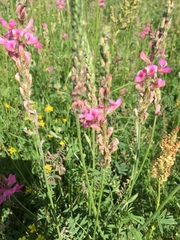 Onobrychis transcaucasicae0
- Treatment
- efficient symbiosise0
- Interactor
- Rhizobium sp. OT111e0symbiont
- Outcome
- adaptation of plants to salinitye0
- Direction
- enhancede0
- Qualifier
- 150 mM NaCle0
Not reportedComparator
Organisms pictured · Representative pictures of the matched species, not figures from the paper.

Verbatim
e0“The efficient symbiosis of O. transcaucasica plants with Rhizobium sp. OT111 and O. chorassanica plants with Rhizobium sp. OC109 enhanced the adaptation of plants to salinity up to 150 mM NaCl”
Claim · model-written summary
Efficient symbiosis of O. chorassanica with Rhizobium sp. OC109 enhanced its adaptation to salinity up to 150 mM NaCl.
- Taxon
- O. chorassanicaOnobrychis chorassanicae0
- Treatment
- efficient symbiosise0
- Interactor
- Rhizobium sp. OC109e0symbiont
- Outcome
- adaptation of plants to salinitye0
- Direction
- enhancede0
- Qualifier
- 150 mM NaCle0
Not reportedComparator
Verbatim
e0“The efficient symbiosis of O. transcaucasica plants with Rhizobium sp. OT111 and O. chorassanica plants with Rhizobium sp. OC109 enhanced the adaptation of plants to salinity up to 150 mM NaCl”
Claim · model-written summary
Growth of Onobrychis species was suppressed from 200 mM NaCl onward.
- Taxon
- Onobrychis
 Onobrychise0
- Treatment
- 200 mM NaCle0
- Outcome
- growth suppressione0
- Direction
- suppressione0
Not reportedComparator
Organisms pictured · Representative pictures of the matched species, not figures from the paper.

Verbatim
e0“The gradual growth suppression of both Onobrychis plants species started from 200 mM NaCl, and salinity concentration 300 mM NaCl was critical (sublethal) for plants independently of inoculation by nodule bacteria”
Claim · model-written summary
Salinity of 300 mM NaCl was critical (sublethal) for Onobrychis plants, independently of inoculation.
- Taxon
- OnobrychisOnobrychise0
- Treatment
- salinity concentration 300 mM NaCle0
- Outcome
- critical (sublethal)e0
- Qualifier
- independently of inoculation by nodule bacteriae0
Organisms pictured · Representative pictures of the matched species, not figures from the paper.
Verbatim
e0“The gradual growth suppression of both Onobrychis plants species started from 200 mM NaCl, and salinity concentration 300 mM NaCl was critical (sublethal) for plants independently of inoculation by nodule bacteria”
Claim · model-written summary
In field conditions, O. chorassanica was more resistant to salinity than O. transcaucasica.
Verbatim
e0“In field conditions, O. chorassanica was more resistant to salinity than O. transcaucasica”
Claim · model-written summary
In the field, minimal irrigation had a higher effect on Onobrychis growth and development than moderate salinity at 75 mM NaCl.
- Taxon
- OnobrychisOnobrychise0
- Treatment
- minimal irrigatione0
- Outcome
- growth and developmente0
- Direction
- higher effecte0
- Comparator
- moderate salinity at the concentration 75 mM NaCle0
Organisms pictured · Representative pictures of the matched species, not figures from the paper.
Verbatim
e0“minimal irrigation for both species of Onobrychis showed a higher effect on their growth and development than the moderate salinity at the concentration 75 mM NaCl”
Claim · model-written summary
The drought threshold of Onobrychis plants was 6% - 8% of soil humidity.
- Taxon
- OnobrychisOnobrychise0
- Outcome
- drought thresholde0
- Value
- 6% - 8%e0
- Qualifier
- soil humiditye0
Organisms pictured · Representative pictures of the matched species, not figures from the paper.
Verbatim
e0“The lower limit (drought threshold) of drought-resistance of Onobrychis plants was 6% - 8% of soil humidity”
Claim · model-written summary
Under salt stress, aldehyde oxidase and xanthine dehydrogenase and their isoforms were found in alfalfa shoots and roots.
- Taxon
- alfalfaMedicago sativae0
- Organ / stage
- shoot and rootse0
- Treatment
- salt stresse0
- Gene
- aldehyde oxidase and xanthine dehydrogenasee0
- Outcome
- number of their isoformse0
- Qualifier
- electrophoretic mobilities/activitiese0
Organisms pictured · Representative pictures of the matched species, not figures from the paper.
Verbatim
e0“In shoot and roots of alfalfa, both Onobrychis plant species subject to salt stress, aldehyde oxidase and xanthine dehydrogenase enzymes and different number of their isoforms as well as their electrophoretic mobilities/activities were found”
The same questions in other papers
sodium chloride · growth · Medicago sativa (alfalfa)Results differ
38 papers in the same direction as this paper · 4 in the opposite direction
- positive
- positive
- positive
39 papers more in this group
See all 43 papers →sodium chloride · symbiosis · Medicago sativa (alfalfa)Positive and negative results
4 papers in the same direction as this paper · 1 in the opposite direction
- positive
- negative
- negative
2 papers more in this group
See all 6 papers →sodium chloride · molecular: metabolites · Medicago sativa (alfalfa)Positive and negative results
2 papers in the same direction as this paper · 4 in the opposite direction
- positive
- positive
- positive
3 papers more in this group
See all 7 papers →sodium chloride · Sinorhizobium meliloti · Medicago sativa (alfalfa)Results agree
1 paper in the same direction as this paper
- positive
Sinorhizobium meliloti · disease · Medicago sativa (alfalfa)Results agree
1 paper in the same direction as this paper
- positive
salinity · molecular: metabolites · Medicago sativa (alfalfa)Positive and negative results
5 papers in the same direction as this paper · 4 in the opposite direction
- positive
- positive
- positive
6 papers more in this group
See all 10 papers →salinity · symbiosis · Medicago sativa (alfalfa)Positive and negative results
11 papers in the same direction as this paper · 3 in the opposite direction
- positive
- positive
- positive
11 papers more in this group
See all 15 papers →inoculation · disease · Medicago sativa (alfalfa)Positive and negative results
21 papers in the same direction as this paper · 14 in the opposite direction
- no effect
- negative
- negative
32 papers more in this group
See all 36 papers →8 of 9 groups shown: named compounds and organisms first, then groups whose results differ (checked claim by claim), then those with positive and negative results, then the smaller groups.
Claims are grouped by organism, treatment and what was measured or targeted. A paper counts as positive when any of its claims in the group is positive.