View: List Claim type Research area Organism Taxon as written Decade Paper Association observed original result measured Claim · model-written summary
Yield losses due to rice tungro disease decrease with increasing attainable yield s.
increasing attainable yields e1 rice tungro disease e1 pathogen Verbatim
e1 “yield losses due to sheath blight, weed infestation, and rice tungro disease tend to increase, remain stable, and decrease , respectively, with increasing attainable yield s ”
✓ located verbatim in the source · abstract, characters 1464–1635 Other claims from this paper (10) Association observed original result negative measured Claim · model-written summary
Each 1% increase in lodging rate corresponded to a 58.05 kg ha-1 yield decrease .
1% increase in lodging rate e0 Not reported Comparator
Verbatim
t0 “maize lodging ”
✓ located verbatim in the source · title, characters 61–74 e0 “A 1% increase in lodging rate, led to a decrease of 58.05 kg ha-1 in yield ”
✓ located verbatim in the source · abstract, characters 863–937 Other claims from this paper (10) Association observed original result negative measured Claim · model-written summary
Each 1% rise in biomass lignin was associated with an expected methane yield decrease of 7.49 LCH4 kgTS.
increase of 1% lignin content e0 Verbatim
e0 “The expected average decrease in methane yield is 7.49 LCH4 kgTS with an increase of 1% lignin content in biomass ”
✓ located verbatim in the source · abstract, characters 734–847 t0 “energy crops ”
✓ located verbatim in the source · title, characters 27–39 Other claims from this paper (5) Association observed original result negative measured Claim · model-written summary
Berry yield decrease was linked to above-recommended ammonium sulfate applications and soil pH and EC changes.
ammonium sulfate applications above recommended rates e0 berry yield decrease e0 changes in soil pH and EC e0 Verbatim
e0 “Principal component analysis linked berry yield decrease with ammonium sulfate applications above recommended rates (FERT and BROAD) and with changes in soil pH and EC. ”
✓ located verbatim in the source · abstract, characters 1725–1893 t0 “Blueberry ”
✓ located verbatim in the source · title, characters 82–91 Other claims from this paper (7) Association observed original result measured Claim · model-written summary
The extent of the decrease in malt extract yield with increasing protein varied among the regions.
extent of decrease e1 among the regions e1 Verbatim
e1 “although the extent of decrease varied among the regions ”
✓ located verbatim in the source · abstract, characters 636–692 t0 “Barleys ”
✓ located verbatim in the source · title, characters 42–49 Other claims from this paper (5) Association observed original result measured Claim · model-written summary
Confidence intervals for herbage yield tended to decrease as sample size increased.
an increase in sample size e3 .95 confidence intervals for herbage yield e3 tended to decrease e3 Verbatim
e0 “in orchardgrass and Kentucky bluegrass pastures ”
✓ located verbatim in the source · abstract, characters 102–149 e3 “The .95 confidence intervals for herbage yield tended to decrease with an increase in sample size ”
✓ located verbatim in the source · abstract, characters 531–628 Other claims from this paper (3) Association observed original result negative measured Claim · model-written summary
Yield decrease was greater with a larger b-parameter.
Verbatim
e0 “we examined the fertilizer reaction of maize hybrids ”
✓ located verbatim in the source · abstract, characters 362–414 e7 “If the value of the b-parameter is other than, zero then the effect is clearly unfavorable, because with the increase of this value, the yield decrease is also greater ”
✓ located verbatim in the source · abstract, characters 2641–2808 Other claims from this paper (7) Association observed original result negative significant (as stated) measured Claim · model-written summary
Increasing nutsedge density was associated with a significant linear decrease in seed cotton yield
Increasing nutsedge density e0 seed cotton yield e0 Verbatim
t0 “yellow nutsedge (Cyperus esculentus ) density on cotton (Gossypium hirsutum ) ”
✓ located verbatim in the source · title, characters 29–104 e0 “Increasing nutsedge density caused a significant linear decrease in seed cotton yield ”
✓ located verbatim in the source · abstract, characters 230–315 Other claims from this paper (9) Association observed original result negative measured Claim · model-written summary
For Wells rice, head rice yield fell 11.3 pp per 1.0 pp decrease in surface lipid content.
1.0 pp decrease in SLC e0 Verbatim
e0 “Millability curves of Wells had greater slopes, 11.3 pp decrease in HRY for every 1.0 pp decrease in SLC ”
✓ located verbatim in the source · abstract, characters 696–800 e1 “rice cultivars ”
✓ located verbatim in the source · abstract, characters 494–508 Other claims from this paper (3) Association observed review summary negative basis n/a Claim · model-written summary
The gene is also associated with decrease d yield .
it is also responsible for a decrease in yield e0 Not reported Gene
Verbatim
e0 “it is also responsible for a decrease in yield . ”
✓ located verbatim in the source · abstract, characters 1045–1092 t0 “Wheat biofortification ”
✓ located verbatim in the source · title, characters 0–22 Other claims from this paper (2) Lexical search (BM25). All words must match; if nothing does, any word. Organism names also match every spelling of the same organism. No semantic search yet.
 Oryza sativa
 Zea mays
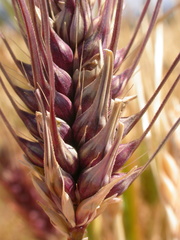 Hordeum
 Dactylis glomerata
 Poa pratensis
 Gossypium hirsutum
 Triticum aestivum