View: List Claim type Research area Organism Taxon as written Decade Paper Intervention effect observed original result negative simulated Claim · model-written summary
Reduced water permeability combined with shorter roots enlarged the predicted lint yield decrease .
decreased root length was combined with reduced soil water permeability e0 decrease in lint yield e0 Not reported Comparator
Verbatim
e0 “This decrease in lint yield was much larger when decrease d root length was combined with reduced soil water permeability in remaining roots. ”
✓ located verbatim in the source · abstract, characters 932–1072 t0 “Yield Decline in Cotton. ”
✓ located verbatim in the source · title, characters 25–49 Other claims from this paper (6) Intervention effect observed original result no effect not significant (as stated) measured Claim · model-written summary
Delayed topping did not significantly decrease yield , grade index, or leaf chemistry.
delay in topping until four additional leaves were produced e0 yield, grade index, or leaf chemistry e0 did not significantly decrease e0 Not reported Comparator
Verbatim
t0 “Tobacco ”
✓ located verbatim in the source · title, characters 84–91 e0 “The delay in topping until four additional leaves were produced did not significantly decrease yield , grade index, or leaf chemistry ”
✓ located verbatim in the source · abstract, characters 1181–1313 Other claims from this paper (2) Intervention effect observed original result negative significant (as stated) measured Claim · model-written summary
A combined analysis found that 20 to 30% terminal bud destruction was required to produce a significant decrease in total yield in cotton.
Not reported Comparator
Verbatim
t0 “Larvae on Cotton Plants ”
✓ located verbatim in the source · title, characters 41–64 e4 “20 to 30% TBD was required to produce a significant decrease in total yield ”
✓ located verbatim in the source · abstract, characters 612–687 Other claims from this paper (5) Observation observed original result negative measured Claim · model-written summary
Continuous corn rotation on Hoytville soil had an average annual yield decrease of 880 kg ha −1 under no-tillage.
continuous corn rotation treatment e0 Verbatim
e0 “The negative response to no‐tillage on the Hoytville soil was primarily due to the large decrease in yield obtained as a result of the continuous corn rotation treatment (average annual yield decrease , 880 kg ha −1 ). ”
✓ located verbatim in the source · abstract, characters 1293–1510 Other claims from this paper (7) Intervention effect observed original result negative measured Claim · model-written summary
Delaying planting past 20 May caused a rapid decrease in maize yield .
planting was delayed past 20 May e1 rapid decrease e1 Not reported Comparator
Verbatim
e0 “Reduced stands after planting may force maize ( Zea mays L.) producers to consider the feasibility of replanting ”
✓ located verbatim in the source · abstract, characters 9–121 e1 “a rapid decrease in yield due to planting date occurred when planting was delayed past 20 May ”
✓ located verbatim in the source · abstract, characters 1062–1155 Other claims from this paper (10) Association observed original result no effect not significant (as stated) measured Claim · model-written summary
The increased latex yield did not significantly decrease tree growth over three years.
increase of latex yield e0 did not result in a significant decrease e0 over a period of three years e0 Verbatim
t0 “Hevea brasiliensis
✓ located verbatim in the source · title, characters 61–79 e0 “The increase of latex yield did not result in a significant decrease in the growth of trees over a period of three years. ”
✓ located verbatim in the source · abstract, characters 524–645 Other claims from this paper (9) Observation observed original result no effect measured Claim · model-written summary
Seed yield of determinate soybean cultivars did not decrease until planting was delayed past early June.
determinate cultivars e4 did not decrease e4 planting date was delayed past early June e4 Verbatim
t0 “Determinate and Indeterminate Soybeans ”
✓ located verbatim in the source · title, characters 12–50 e4 “whereas, seed yield of the determinate cultivars did not decrease until planting date was delayed past early June ”
✓ located verbatim in the source · abstract, characters 1147–1260 Other claims from this paper (11) Intervention effect observed original result no effect not significant (as stated) measured Claim · model-written summary
Liquid manure substituted for commercial fertilizer without a significant decrease in soy-sorghum dry matter yield per acre.
soy-sorghum DM yield per acre e0 without a significant decrease e0 commercial fertilizer e0 Verbatim
e0 “Liquid manure may be substituted for commercial fertilizer without a significant decrease in soy-sorghum DM yield per acre ”
✓ located verbatim in the source · abstract, characters 283–405 e1 “Soybeans interseeded with grain sorghum ”
✓ located verbatim in the source · abstract, characters 0–39 Other claims from this paper (2) Intervention effect observed original result no effect measured Claim · model-written summary
Nitrogen up to 150 lbs. per acre produced neither a corn yield increase nor decrease in Day County under dry conditions.
nitrogen rates up to 125 and 150 lbs. per acre e0 Neither a yield increase of a yield decrease e0 Not reported Comparator
Verbatim
e0 “Wheat in McPherson Co. and corn in Day Co. received nitrogen rates up to 125 and 150 lbs. per acre. Neither a yield increase of a yield decrease was measure at either location. ”
✓ located verbatim in the source · abstract, characters 297–473 Other claims from this paper (3) Observation observed original result measured Claim · model-written summary
The highest yield decrease from weed competition was in the E. crus-galli ssp. hispidula and S. maritimus community.
S. Maritimus e7 weed yield decrease due to weed competition e7 Verbatim
t0 “transplanted lowland rice ”
✓ located verbatim in the source · title, characters 27–52 e7 “The highest yield decrease due to weed competition was obtained from the E. crus-galli ssp. hispidula -S. Maritimus community ”
✓ located verbatim in the source · abstract, characters 808–932 Other claims from this paper (14) Lexical search (BM25). All words must match; if nothing does, any word. Organism names also match every spelling of the same organism. No semantic search yet.
 Gossypium hirsutumt0
 Nicotiana tabacum
 Zea mays subsp. mays
 Zea mays
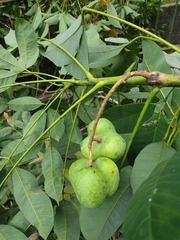 Hevea brasiliensis
 Glycine max
 Oryza sativa
 Echinochloa crus-galli subsp. hispidula