View: List Claim type Research area Organism Taxon as written Decade Paper Association observed original result negative measured Claim · model-written summary
Increasing mottle disease severity was associated with moderate yield decrease .
disease severity e0 Verbatim
e0 “Increasing disease severity affect moderately plant yield decrease . ”
✓ located verbatim in the source · abstract, characters 1180–1247 t0 “Black Pepper Yield ”
✓ located verbatim in the source · title, characters 70–88 Other claims from this paper (4) Observation observed review summary negative basis n/a Claim · model-written summary
Mycotoxins of phytopathogenic fungi lead to a decrease in the yield and quality of grain.
yield and quality of grain e0 Not reported Taxon
Verbatim
e0 “Mycotoxins lead to a decrease in the yield and quality of grain ”
✓ located verbatim in the source · abstract, characters 1157–1220 Observation author interpretation original result negative measured Claim · model-written summary
The disease causes a decrease in tobacco leaf yield .
tobacco leaf yield e1 Verbatim
t0 “Causing Leaf Spot on Tobacco ”
✓ located verbatim in the source · title, characters 47–75 e1 “The disease spreads widely and causes a decrease in tobacco leaf yield ”
✓ located verbatim in the source · abstract, characters 3314–3384 Other claims from this paper (5) Observation author interpretation review summary measured Claim · model-written summary
Diseases may decrease marketable root yield .
yield of marketable roots e0 Verbatim
e0 “decrease the yield of marketable roots ”
✓ located verbatim in the source · abstract, characters 275–313 t0 “table beet ”
✓ located after whitespace/quote normalisation · title, characters 107–117 Other claims from this paper (12) Observation observed original result positive measured Claim · model-written summary
Liaoyan 16 yield components did not decrease markedly under weedy rice interference.
yield components e0 no decrease markerly e0 Verbatim
e0 “However,the yield components of Liaoyan 16 was no decrease markerly. ”
✓ located verbatim in the source · abstract, characters 630–698 Other claims from this paper (4) Association observed original result negative measured Claim · model-written summary
Seed cotton yield tended to decrease as weed density increased.
Goosegrass t1 weed Seed cotton yield e0 Verbatim
e0 “Seed cotton yield tended to decrease with the increase in weed density ”
✓ located verbatim in the source · abstract, characters 379–449 t0 “cotton ”
✓ located verbatim in the source · title, characters 48–54 t1 “Goosegrass ”
✓ located verbatim in the source · title, characters 0–10 Other claims from this paper (10) Intervention effect observed original result no effect not significant (as stated) measured Claim · model-written summary
The liquid spray did not significantly decrease potato yield .
Not reported Comparator
Verbatim
t0 “Alternative protection of potatoes ”
✓ located verbatim in the source · title, characters 0–34 e3 “The liquid spray against the late blight (Phytophthora infestans ) did not signincantly decrease neither occurrence oflate blight or the yield ”
✓ located verbatim in the source · abstract, characters 377–518 Other claims from this paper (4) Observation author interpretation review summary negative basis n/a Claim · model-written summary
Watermelon blight can decrease watermelon yield and quality.
watermelon yields and quality e0 Verbatim
e0 “Watermelon blight,an important soil-borne and seeds-borne disease,could decrease the watermelon yield s and quality ”
✓ located verbatim in the source · abstract, characters 0–114 Observation observed original result negative projected Claim · model-written summary
Climate change was projected to greatly decrease untreated winter oilseed rape yield in southern England.
greatly decrease e0 southern England e1 Verbatim
e0 “greatly decrease yield of untreated winter oilseed rape ”
✓ located verbatim in the source · abstract, characters 967–1022 e1 “southern England the combination ”
✓ located verbatim in the source · abstract, characters 746–778 Other claims from this paper (3) Intervention effect observed original result negative measured Claim · model-written summary
Herbicide injury and defoliation interacted to decrease soybean yield .
herbicide injury and defoliation e3 interacted over 1990 and 1991 e3 Not reported Comparator
Verbatim
e1 “seed yield of soybean [ Glycine max (L.) Merr.] ”
✓ located verbatim in the source · abstract, characters 525–572 e3 “Moreover, herbicide injury and defoliation interacted over 1990 and 1991 to decrease yield ”
✓ located verbatim in the source · abstract, characters 1207–1297 Other claims from this paper (10) Intervention effect observed original result no effect measured Claim · model-written summary
Bromoxynil did not decrease mean yield of the three rice cultivars.
did not decrease e0 Not reported Comparator
Verbatim
e0 “Bromoxynil did not decrease the average yield of any of the three cultivars. ”
✓ located verbatim in the source · abstract, characters 855–931 t0 “Rice (Oryza sativa ) ”
✓ located verbatim in the source · title, characters 22–41 Other claims from this paper (9) Intervention effect observed original result no effect measured Claim · model-written summary
One simulated defoliation did not decrease cassava root yield .
A single defoliation e0 does not decrease e0 Not reported Comparator
Verbatim
e0 “A single defoliation of cassava (to simulate Z. variegatus feeding damage) does not decrease root yield , but additional ones do. ”
✓ located verbatim in the source · abstract, characters 3181–3309 Other claims from this paper (10) Association observed review summary negative measured Claim · model-written summary
Weed competition can decrease alfalfa yield .
Verbatim
e0 “Weeds compete with alfalfa for water, nutrients, light, and space. This competition can decrease yield s ”
✓ located verbatim in the source · abstract, characters 0–103 Other claims from this paper (4) Intervention effect observed original result negative projected Claim · model-written summary
Loss of seed treatments would decrease corn yield through yield losses.
The loss of seed treatments e2 decrease inferred e2 Not reported Comparator
Verbatim
e2 “The loss of seed treatments would result in yield losses to both corn and soybeans ”
✓ located verbatim in the source · abstract, characters 203–285 Other claims from this paper (4) Intervention effect observed original result negative projected Claim · model-written summary
Loss of seed treatments would decrease soybean yield through yield losses.
The loss of seed treatments e2 decrease inferred e2 Not reported Comparator
Verbatim
e2 “The loss of seed treatments would result in yield losses to both corn and soybeans ”
✓ located verbatim in the source · abstract, characters 203–285 Other claims from this paper (4) Intervention effect observed original result negative measured Claim · model-written summary
Increasing simazino rates tended to decrease wheat yield .
Increasing rates of simazino e1 Not reported Comparator
Verbatim
e0 “it tended to decrease wheat yield s ”
✓ located verbatim in the source · abstract, characters 255–289 e1 “Increasing rates of simazino ”
✓ located verbatim in the source · abstract, characters 180–208 t0 “Maize - Wheat Rotation ”
✓ located verbatim in the source · title, characters 25–47 Other claims from this paper (7) Intervention effect observed original result negative significant (as stated) measured Claim · model-written summary
Unprotected B. campestris had a significant yield decrease .
Not reported Comparator
Verbatim
e0 “B. campestris a significant decrease . ”
✓ located verbatim in the source · abstract, characters 790–827 t0 “RESPONSE OF FOUR BRASSICA SEED CROP SPECIES TO ATTACK BY THE CRUCIFER FLEA BEETLE, PHYLLOTRETA CRUCIFERAE ”
✓ located verbatim in the source · title, characters 0–105 e1 “Nevertheless the unprotected B. juncea treatment yield ed as much as the protected; B. napus , however, suffered an apparent appreciable decrease and B. campestris a significant decrease . ”
✓ located verbatim in the source · abstract, characters 642–827 Other claims from this paper (7) Intervention effect observed original result negative measured Claim · model-written summary
Organophosphate treatments could decrease yield through toxicity when nematode populations were low.
organophosphate e1 the toxicity of the materials was manifested when nematode populations were low e0 Not reported Comparator
Verbatim
e0 “or in a yield decrease , because the toxicity of the materials was manifested when nematode populations were low. ”
✓ located verbatim in the source · abstract, characters 851–963 e1 “with organophosphate and carbamate nematicides ”
✓ located verbatim in the source · abstract, characters 706–752 t0 “Cotton ”
✓ located verbatim in the source · title, characters 61–67 Other claims from this paper (12) Association observed original result negative measured Claim · model-written summary
Root loss of 50% after 21 weeks did not affect fruit yield , whereas 40% loss within 11 weeks accompanied a 45% yield decrease .
40% loss within 11 weeks of planting e0 Verbatim
t0 “tomato ”
✓ located verbatim in the source · title, characters 20–26 e0 “A 50% root loss after 21 weeks did not affect fruit yield s whereas a 40% loss within 11 weeks of planting was reflected by a 45% yield decrease ”
✓ located verbatim in the source · abstract, characters 2287–2430 Other claims from this paper (19) Association observed original result negative measured Claim · model-written summary
Weeds decrease d soybean yield .
Verbatim
e0 “Weeds decrease soybean yield . ”
✓ located verbatim in the source · abstract, characters 484–513 Intervention effect observed original result negative measured Claim · model-written summary
The relation of yield index to weed density was a curve in which the rate of yield decrease rose progressively with density.
Not reported Comparator
Verbatim
t0 “Rice Plants ”
✓ located verbatim in the source · title, characters 25–36 e0 “タイヌビエの発生本数による水稲収量 ”
✓ located verbatim in the source · abstract, characters 38–55 e1 “収量指数と発生本数との関係は, 発生本数の増加にともなつて, 収量減少速度の漸増する曲線として示される ”
✓ located verbatim in the source · abstract, characters 258–309 Other claims from this paper (15) Intervention effect observed original result no effect measured Claim · model-written summary
Selection for nematode resistance did not decrease sugar beet root yield .
Selection for resistance to nematode e0 did not decrease e0 Not reported Taxon Comparator
Verbatim
e0 “Selection for resistance to nematode did not decrease root yield s. ”
✓ located verbatim in the source · abstract, characters 183–249 Other claims from this paper (1) Intervention effect author interpretation original result negative measured Claim · model-written summary
Higher insecticide rates may decrease soybean yield .
higher rates of application e0 may cause foliage injury e0 Not reported Comparator
Verbatim
t0 “Soybeans ”
✓ located verbatim in the source · title, characters 76–84 e0 “higher rates of application may cause foliage injury to the extent of decreasing yield . ”
✓ located verbatim in the source · abstract, characters 173–260 Other claims from this paper (6) Association author interpretation original result negative measured Claim · model-written summary
Yield is inferred to decrease by ten to thirty per cent in the disease.
Ten to thirty per cent e2 Verbatim
t0 “A Rice Nematode Disease "Senchu Shingare Byo" : Ⅰ. Symptom and Pathogenic Nematode ”
✓ located verbatim in the source · title, characters 0–82 e2 “Ten to thirty per cent decrease in yield is inferred ”
✓ located verbatim in the source · abstract, characters 1094–1146 e1 “The causal nematode, Aphelenchoides oryzae Yokoo, is characteristic in having star shaped, trifurcated mucro at its tail end ”
✓ located verbatim in the source · abstract, characters 1218–1342 Other claims from this paper (16) Association observed original result negative measured Claim · model-written summary
Caterpillar borers attacking sugarcane canes during growth cause a decrease in sugar yield .
caterpillar borers e2 pest Verbatim
e0 “Sugarcane is no more free from the attentions of insect-pests ”
✓ located verbatim in the source · abstract, characters 0–61 e2 “The shoots are liable to attack by, at least, three kinds of caterpillar borers, which kill them outright ”
✓ located verbatim in the source · abstract, characters 286–391 e3 “These borers may also attack the joints of canes during their growth and cause a decrease in the yield of sugar ”
✓ located verbatim in the source · abstract, characters 393–504 Other claims from this paper (6) Mechanism author interpretation original result measured Claim · model-written summary
The yield decrease from sulphate of ammonia is ascribed to more lodging and a greater incidence of foot rot.
reduction in yield e2 more lodging and greater incidence of e4 Verbatim
e1 “study the effect of the time of application of sulphate of ammonia to autumn-sown wheat ”
✓ located verbatim in the source · abstract, characters 74–161 e2 “in those three cases sulphate of ammonia decrease d yield , irrespective of time of application; the reduction in yield was of the order of 10 per cent ”
✓ located verbatim in the source · abstract, characters 269–418 e4 “is ascribed to more lodging and greater incidence of ”
✓ located verbatim in the source · abstract, characters 424–476 Other claims from this paper (4) Observation author interpretation original result negative measured Claim · model-written summary
Stem borer is said to reduce rice yield by about ten per cent annually.
Schoenobius Bipunctifer e0 pest Not reported Taxon
Verbatim
e0 “stem borer (Schoenobius Bipunctifer) is said to be res- ponsible for the decrease of about ten per cent in the yield every year ”
✓ located verbatim in the source · abstract, characters 759–886 Other claims from this paper (2) Lexical search (BM25). All words must match; if nothing does, any word. Organism names also match every spelling of the same organism. No semantic search yet.
 Nicotiana tabacum
 Beta vulgaris subsp. vulgaris
 Gossypium hirsutum
 Solanum tuberosum
 Citrullus lanatus
 Brassica napus
 Glycine max
 Oryza sativa
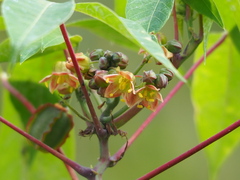 Manihot esculenta
 Zonocerus variegatus
 Medicago sativa
 Zea mays subsp. mays
 Triticum aestivum
 Brassica rapa subsp. oleifera
 Solanum lycopersicum