Abstract
Background: The ascomycete Botrytis cinerea is a major pathogen of strawberry, often causing grey mold and significant yield losses. Its management has largely relied on chemical fungicides, which, while effective, can lead to resistant pathogens and harm to non-target organisms and pose health risks. Objectives: This study explored a strategy for minimizing chemical usage by combining biocontrol agents (BCAs) with half-strength fungicide input. Results: In vitro results of fungicide-amended culture plates indicated that the presence of 625 µg mL−1 Azoxystrobin exhibited no growth inhibition of T. atroviride T19 and T. harzianum T16 but increased conidial density of T16 by 90%. Copper (750 µg mL−1) did not suppress the growth of T. virens TVSC or T16 but rather promoted it by 9.5% and 6%, respectively. Additionally, copper increased T16 sporulation by 1.4-fold. Greenhouse trials demonstrated that combining T23 with half-strength Azoxystrobin was as effective as the full dosage in suppressing flower rot. Among the antagonists assessed, Kosakonia sp. exhibited the lowest incidence of fruit rot, whereas T23 resulted in a moderate incidence. Moreover, the combination of T16 or Kosakonia sp. with half-strength copper was almost as effective as the full dosage in reducing fruit rot. Conclusions: Our findings suggest integrating these BCAs in the sustainable management of grey mold in strawberries.
Abstract from the paper’s OpenAlex record; open copy licensed cc-by. Read at the source ↗
The text the model read, with the source record’s inline markup (italics, sub- and superscripts) rendered and its character entities decoded; quote offsets refer to the raw text.
Claims 12
Claim · model-written summary
Azoxystrobin at 625 µg mL−1 did not inhibit T. atroviride T19 growth in vitro.
- Taxon
- Strawberries
 Fragaria ×ananassat0
- Treatment
- 625 µg mL−1 Azoxystrobine0
- Interactor
- T. atroviride T19
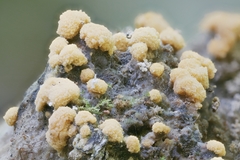 Trichoderma atroviridee0biocontrol_agent
- Outcome
- growth inhibition of T. atroviride T19e0
- Direction
- no growth inhibitione0
Not reportedComparator
Organisms pictured · Representative pictures of the matched species, not figures from the paper.

Verbatim
t0“Strawberries”
e0“the presence of 625 µg mL−1 Azoxystrobin exhibited no growth inhibition of T. atroviride T19 and T. harzianum T16”
Claim · model-written summary
Azoxystrobin at 625 µg mL−1 did not inhibit T. harzianum T16 growth in vitro.
- Taxon
- StrawberriesFragaria ×ananassat0
- Treatment
- 625 µg mL−1 Azoxystrobine0
- Interactor
- T. harzianum T16
 Trichoderma harzianume0biocontrol_agent
- Outcome
- growth inhibition of T. atroviride T19 and T. harzianum T16e0
- Direction
- no growth inhibitione0
Not reportedComparator
Organisms pictured · Representative pictures of the matched species, not figures from the paper.

Verbatim
t0“Strawberries”
e0“the presence of 625 µg mL−1 Azoxystrobin exhibited no growth inhibition of T. atroviride T19 and T. harzianum T16”
Claim · model-written summary
Azoxystrobin increased T16 conidial density by 90%.
- Taxon
- StrawberriesFragaria ×ananassat0
- Interactor
- T16e0biocontrol_agent
- Outcome
- conidial density of T16e0
- Direction
- increasede0
- Value
- 90%e0
Not reportedTreatmentComparator
Organisms pictured · Representative pictures of the matched species, not figures from the paper.
Verbatim
t0“Strawberries”
e0“increased conidial density of T16 by 90%”
Claim · model-written summary
Copper at 750 µg mL−1 promoted T. virens TVSC growth by 9.5%.
- Taxon
- StrawberriesFragaria ×ananassat0
- Treatment
- Copper (750 µg mL−1)e0
- Interactor
- T. virens TVSCTrichoderma virense0biocontrol_agent
- Outcome
- growth of T. virens TVSCe0
- Direction
- promotede0
- Value
- 9.5%e0
Not reportedComparator
Organisms pictured · Representative pictures of the matched species, not figures from the paper.
Verbatim
t0“Strawberries”
e0“Copper (750 µg mL−1) did not suppress the growth of T. virens TVSC or T16 but rather promoted it by 9.5% and 6%, respectively.”
Claim · model-written summary
Copper at 750 µg mL−1 promoted T16 growth by 6%.
- Taxon
- StrawberriesFragaria ×ananassat0
- Treatment
- Copper (750 µg mL−1)e0
- Interactor
- T16e0biocontrol_agent
- Outcome
- growth of T. virens TVSC or T16e0
- Direction
- promotede0
- Value
- 6%e0
Not reportedComparator
Organisms pictured · Representative pictures of the matched species, not figures from the paper.
Verbatim
t0“Strawberries”
e0“Copper (750 µg mL−1) did not suppress the growth of T. virens TVSC or T16 but rather promoted it by 9.5% and 6%, respectively.”
Claim · model-written summary
Copper increased T16 sporulation 1.4-fold.
- Taxon
- StrawberriesFragaria ×ananassat0
- Treatment
- coppere0
- Interactor
- T16e0biocontrol_agent
- Outcome
- T16 sporulatione0
- Direction
- increasede0
- Value
- 1.4-folde0
Not reportedComparator
Organisms pictured · Representative pictures of the matched species, not figures from the paper.
Verbatim
t0“Strawberries”
e0“Additionally, copper increased T16 sporulation by 1.4-fold.”
Claim · model-written summary
T23 plus half-strength Azoxystrobin matched the full dose in suppressing strawberry flower rot.
- Taxon
- StrawberriesFragaria ×ananassat0
- Treatment
- combining T23 with half-strength Azoxystrobine0
- Interactor
- T23e0biocontrol_agent
- Outcome
- flower rote0
- Direction
- as effective ase0
- Comparator
- full dosagee0
- Setting
- Greenhousee0
Organisms pictured · Representative pictures of the matched species, not figures from the paper.
Verbatim
t0“Strawberries”
e0“Greenhouse trials demonstrated that combining T23 with half-strength Azoxystrobin was as effective as the full dosage in suppressing flower rot.”
Claim · model-written summary
Kosakonia sp. produced the lowest fruit rot incidence among tested antagonists.
- Taxon
- StrawberriesFragaria ×ananassat0
- Treatment
- Kosakonia sp.e0
- Outcome
- incidence of fruit rote0
- Direction
- loweste0
- Comparator
- antagonists assessede0
Organisms pictured · Representative pictures of the matched species, not figures from the paper.
Verbatim
t0“Strawberries”
e0“Among the antagonists assessed, Kosakonia sp. exhibited the lowest incidence of fruit rot”
Claim · model-written summary
T23 yielded a moderate fruit rot incidence among tested antagonists.
- Taxon
- StrawberriesFragaria ×ananassat0
- Treatment
- T23e0
- Interactor
- T23e0biocontrol_agent
- Outcome
- incidence of fruit rote0
- Direction
- moderatee0
- Comparator
- antagonists assessede0
Organisms pictured · Representative pictures of the matched species, not figures from the paper.
Verbatim
t0“Strawberries”
e0“Among the antagonists assessed, Kosakonia sp. exhibited the lowest incidence of fruit rot, whereas T23 resulted in a moderate incidence.”
Claim · model-written summary
T16 plus half-strength copper was almost as effective as a full dose for fruit rot reduction.
- Taxon
- StrawberriesFragaria ×ananassat0
- Treatment
- T16 or Kosakonia sp. with half-strength coppere0
- Interactor
- T16e0biocontrol_agent
- Outcome
- fruit rote0
- Direction
- reducinge0
- Comparator
- full dosagee0
Organisms pictured · Representative pictures of the matched species, not figures from the paper.
Verbatim
t0“Strawberries”
e0“the combination of T16 or Kosakonia sp. with half-strength copper was almost as effective as the full dosage in reducing fruit rot.”
Claim · model-written summary
Kosakonia sp. plus half-strength copper was almost as effective as a full dose for fruit rot reduction.
- Taxon
- StrawberriesFragaria ×ananassat0
- Treatment
- Kosakonia sp. with half-strength coppere0
- Outcome
- fruit rote0
- Direction
- reducinge0
- Comparator
- full dosagee0
Organisms pictured · Representative pictures of the matched species, not figures from the paper.
Verbatim
t0“Strawberries”
e0“the combination of T16 or Kosakonia sp. with half-strength copper was almost as effective as the full dosage in reducing fruit rot.”
Claim · model-written summary
The authors recommend integrating the biocontrol agents in sustainable strawberry grey mold management.
- Taxon
- strawberriesFragaria ×ananassae0
- Outcome
- integrating these BCAs in the sustainable management of grey molde0
Organisms pictured · Representative pictures of the matched species, not figures from the paper.
Verbatim
e0“Our findings suggest integrating these BCAs in the sustainable management of grey mold in strawberries.”
The same questions in other papers
copper atom · growth · Fragaria x ananassa (strawberry)Results agree
1 paper in the same direction as this paper
- positive
copper atom · disease · Fragaria x ananassa (strawberry)Results agree
1 paper in the same direction as this paper
- positive
azoxystrobin · disease · Fragaria x ananassa (strawberry)Results agree
2 papers in the same direction as this paper
- positive
- positive
Claims are grouped by organism, treatment and what was measured or targeted. A paper counts as positive when any of its claims in the group is positive.