Abstract
Cucumber is one of the top ten vegetables globally and is widely cultivated worldwide. However, Fusarium wilt, caused by Fusarium oxysporum f. sp. Cucumerinum, is one of the most serious soil-borne diseases in cucumber cultivation, causing significant economic losses. Biological control has great potential in the prevention of cucumber wilt disease, but the mechanism involved still needs further research. In this study, biocontrol isolate Bacillus subtilis 1JN2, which was isolated in our previous work, was evaluated in field conditions against Fusarium wilt, and the rhizosphere fungal diversity was analyzed. The results indicated that the biocontrol efficacy of B. subtilis 1JN2 reached 58.5% compared with the blank control, and the population density of F. oxysporum in the rhizosphere decreased from 495 copies/g of soil before inoculation to 20 copies/g 14 days after treatment. High-throughput sequencing demonstrated that after an inoculation of 1JN2, the populations that decreased significantly include the genera of Olpidium and Pseudallescheria, from more than 20% to less than 8%. And the most increased population belonged to the family Chaetomiaceae, from 6.82% to 18.77%, 12.39%, 44.41%, and 19.41% at the four sample time points after treatment. In addition, soil-related enzyme activities, including catalase, soil dehydrogenase, alkaline phosphatase, and polyphenol oxidase, were analyzed before and after treatment with 1JN2. The results indicated that all the enzyme activities showed an upward trend following inoculation. These findings demonstrate the potential of using B. subtilis 1JN2 as a biocontrol agent for controlling Fusarium wilt in cucumber.
Abstract from the paper’s OpenAlex record; open copy licensed cc-by. Read at the source ↗
The text the model read, with the source record’s inline markup (italics, sub- and superscripts) rendered and its character entities decoded; quote offsets refer to the raw text.
Claims 10
Claim · model-written summary
Bacillus subtilis 1JN2 had 58.5% biocontrol efficacy against cucumber Fusarium wilt compared with a blank control.
- Taxon
- Cucumber
 Cucumis sativust0
- Treatment
- B. subtilis 1JN2e0
- Second interactor
- B. subtilis 1JN2
 Bacillus subtilise0biocontrol_agent
- Outcome
- biocontrol efficacye0
- Value
- 58.5%e0
- Comparator
- blank controle0
 Fusarium
Not reportedDirection
Organisms pictured · Representative pictures of the matched species, not figures from the paper.


Verbatim
e0“the biocontrol efficacy of B. subtilis 1JN2 reached 58.5% compared with the blank control”
t0“Biological Control Potential of Bacillus subtilis Isolate 1JN2 against Fusarium Wilt on Cucumber”
Claim · model-written summary
Rhizosphere F. oxysporum population density fell from 495 to 20 copies/g of soil by 14 days after treatment.
- Taxon
- CucumberCucumis sativust0
- Treatment
- inoculatione0
- Interactor
- F. oxysporum
 Fusarium oxysporume0pathogen
- Outcome
- population density of F. oxysporum in the rhizospheree0
- Direction
- decreasede0
- Value
- 20 copies/ge0
- Qualifier
- 495 copies/g of soile0
- Comparator
- before inoculatione0
Organisms pictured · Representative pictures of the matched species, not figures from the paper.

Verbatim
e0“the population density of F. oxysporum in the rhizosphere decreased from 495 copies/g of soil before inoculation to 20 copies/g 14 days after treatment”
t0“Biological Control Potential of Bacillus subtilis Isolate 1JN2 against Fusarium Wilt on Cucumber”
Claim · model-written summary
Olpidium declined significantly from more than 20% to less than 8% after inoculation.
- Taxon
- CucumberCucumis sativust0
- Treatment
- inoculation of 1JN2e0
- Outcome
- Olpidiume0
- Direction
- decreasede0
- Value
- less than 8%e0
- Qualifier
- more than 20%e0
 Olpidium
Not reportedComparator
Organisms pictured · Representative pictures of the matched species, not figures from the paper.
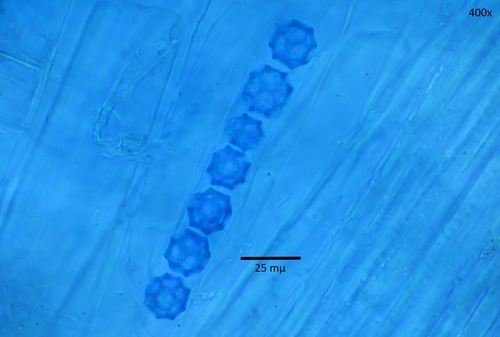
Verbatim
e0“after an inoculation of 1JN2, the populations that decreased significantly include the genera of Olpidium and Pseudallescheria, from more than 20% to less than 8%”
t0“Biological Control Potential of Bacillus subtilis Isolate 1JN2 against Fusarium Wilt on Cucumber”
Claim · model-written summary
Pseudallescheria declined significantly from more than 20% to less than 8% after inoculation.
- Taxon
- CucumberCucumis sativust0
- Treatment
- inoculation of 1JN2e0
- Interactor
- PseudallescheriaPseudallescheriae0other
- Outcome
- Pseudallescheriae0
- Direction
- decreasede0
- Value
- less than 8%e0
- Qualifier
- more than 20%e0
Not reportedComparator
Organisms pictured · Representative pictures of the matched species, not figures from the paper.
Verbatim
e0“after an inoculation of 1JN2, the populations that decreased significantly include the genera of Olpidium and Pseudallescheria, from more than 20% to less than 8%”
t0“Biological Control Potential of Bacillus subtilis Isolate 1JN2 against Fusarium Wilt on Cucumber”
Claim · model-written summary
Chaetomiaceae rose from 6.82% to 18.77% at the first sampling point.
- Taxon
- CucumberCucumis sativust0
- Treatment
- treatmente0
- Interactor
- ChaetomiaceaeChaetomiaceaee0other
- Outcome
- Chaetomiaceaee0
- Direction
- increaseinferrede0
- Value
- 18.77%e0
Not reportedComparator
Organisms pictured · Representative pictures of the matched species, not figures from the paper.
Verbatim
e0“Chaetomiaceae, from 6.82% to 18.77%, 12.39%, 44.41%, and 19.41% at the four sample time points after treatment”
t0“Biological Control Potential of Bacillus subtilis Isolate 1JN2 against Fusarium Wilt on Cucumber”
Claim · model-written summary
Chaetomiaceae rose from 6.82% to 12.39% at the second sampling point.
- Taxon
- CucumberCucumis sativust0
- Treatment
- treatmente0
- Interactor
- ChaetomiaceaeChaetomiaceaee0other
- Outcome
- Chaetomiaceaee0
- Direction
- increaseinferrede0
- Value
- 12.39%e0
Not reportedComparator
Organisms pictured · Representative pictures of the matched species, not figures from the paper.
Verbatim
e0“Chaetomiaceae, from 6.82% to 18.77%, 12.39%, 44.41%, and 19.41% at the four sample time points after treatment”
t0“Biological Control Potential of Bacillus subtilis Isolate 1JN2 against Fusarium Wilt on Cucumber”
Claim · model-written summary
Chaetomiaceae rose from 6.82% to 44.41% at the third sampling point.
- Taxon
- CucumberCucumis sativust0
- Treatment
- treatmente0
- Interactor
- ChaetomiaceaeChaetomiaceaee0other
- Outcome
- Chaetomiaceaee0
- Direction
- increaseinferrede0
- Value
- 44.41%e0
Not reportedComparator
Organisms pictured · Representative pictures of the matched species, not figures from the paper.
Verbatim
e0“Chaetomiaceae, from 6.82% to 18.77%, 12.39%, 44.41%, and 19.41% at the four sample time points after treatment”
t0“Biological Control Potential of Bacillus subtilis Isolate 1JN2 against Fusarium Wilt on Cucumber”
Claim · model-written summary
Chaetomiaceae rose from 6.82% to 19.41% at the fourth sampling point.
- Taxon
- CucumberCucumis sativust0
- Treatment
- treatmente0
- Interactor
- ChaetomiaceaeChaetomiaceaee0other
- Outcome
- Chaetomiaceaee0
- Direction
- increaseinferrede0
- Value
- 19.41%e0
Not reportedComparator
Organisms pictured · Representative pictures of the matched species, not figures from the paper.
Verbatim
e0“Chaetomiaceae, from 6.82% to 18.77%, 12.39%, 44.41%, and 19.41% at the four sample time points after treatment”
t0“Biological Control Potential of Bacillus subtilis Isolate 1JN2 against Fusarium Wilt on Cucumber”
Claim · model-written summary
Soil catalase, dehydrogenase and alkaline phosphatase activities trended upward after inoculation.
- Taxon
- CucumberCucumis sativust0
- Treatment
- inoculatione0
- Outcome
- catalase, soil dehydrogenase, alkaline phosphatasee0
- Direction
- upward trende0
- Comparator
- beforee0
Organisms pictured · Representative pictures of the matched species, not figures from the paper.
Verbatim
e0“soil-related enzyme activities, including catalase, soil dehydrogenase, alkaline phosphatase, and polyphenol oxidase, were analyzed before and after treatment with 1JN2. The results indicated that all the enzyme activities showed an upward trend following inoculation”
t0“Biological Control Potential of Bacillus subtilis Isolate 1JN2 against Fusarium Wilt on Cucumber”
Claim · model-written summary
Soil polyphenol oxidase activity trended upward after inoculation.
- Taxon
- CucumberCucumis sativust0
- Treatment
- inoculatione0
- Outcome
- polyphenol oxidasee0
- Direction
- upward trende0
- Comparator
- beforee0
Organisms pictured · Representative pictures of the matched species, not figures from the paper.
Verbatim
e0“polyphenol oxidase, were analyzed before and after treatment with 1JN2. The results indicated that all the enzyme activities showed an upward trend following inoculation”
t0“Biological Control Potential of Bacillus subtilis Isolate 1JN2 against Fusarium Wilt on Cucumber”
The same questions in other papers
Bacillus subtilis · Fusarium · Cucumis sativus (cucumber)Results agree
3 papers in the same direction as this paper
- positive
- positive
- positive
inoculation · Fusarium oxysporum · Cucumis sativus (cucumber)Positive and negative results
4 papers in the same direction as this paper · 3 in the opposite direction
- negative
- negative
- negative
4 papers more in this group
See all 8 papers →Claims are grouped by organism, treatment and what was measured or targeted. A paper counts as positive when any of its claims in the group is positive.