Abstract
Abstract Phyllosphere colonizing antagonistic bacterial isolates were evaluated for managing major rice foliar diseases, namely brown spot caused by Bipolaris oryzae and sheath rot caused by Sarocladium oryzae. Among these various isolates, Pseudomonas aeruginosa isolate 1 effectively inhibited the mycelial growth of B. oryzae and S. oryzae. The volatile compounds of Bacillus subtilis isolates effectively inhibited the mycelial growth of S. oryzae and B. oryzae . Non‐volatile compounds of P. aeruginosa isolate 2 and B. subtilis isolate 1 recorded the maximum inhibition of mycelial growth of B . oryzae and S. oryzae , respectively. P. aeruginosa isolates produced fluorescent pigments and hydrogen cyanide (HCN), whereas isolates of Bacillus spp. did not. All the isolates of P. aeruginosa and Bacillus spp. produced protease enzymes. P. aeruginosa isolates solubilized phosphate, whereas isolates of Bacillus spp. did not. Rice seeds treated with these bacterial suspensions showed improvement in plant growth parameters. The foliar application of two bacterial strains, namely P. aeruginosa isolate 1 + B. subtilis isolate 1 recorded the minimum brown spot and sheath rot disease incidence. Thus, the present showed that phyllosphere colonizing P. aeruginosa and B. subtilis have the potential application for managing foliar fungal diseases of rice plants.
Abstract from the paper’s OpenAlex record, shown for indexing and research. Copyright remains with the authors or the publisher. Read at the source ↗
The text the model read, with the source record’s inline markup (italics, sub- and superscripts) rendered and its character entities decoded; quote offsets refer to the raw text.
Claims 11
Claim · model-written summary
Pseudomonas aeruginosa isolate 1 inhibited the mycelial growth of B. oryzae.
- Treatment
- Pseudomonas aeruginosa isolate 1e0
- Interactor
- B. oryzae
 Bipolaris oryzaee0pathogen
- Second interactor
- Pseudomonas aeruginosa isolate 1
 Pseudomonas aeruginosae0biocontrol_agent
- Outcome
- mycelial growthe0
- Direction
- inhibitede0
Not reportedTaxonComparator
Organisms pictured · Representative pictures of the matched species, not figures from the paper.
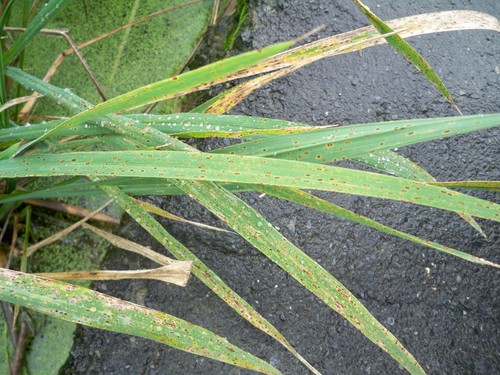

Verbatim
e0“Pseudomonas aeruginosa isolate 1 effectively inhibited the mycelial growth of B. oryzae and S. oryzae”
Claim · model-written summary
Pseudomonas aeruginosa isolate 1 inhibited the mycelial growth of S. oryzae.
- Treatment
- Pseudomonas aeruginosa isolate 1e0
- Interactor
- S. oryzae
 Sarocladium oryzaee0pathogen
- Second interactor
- Pseudomonas aeruginosa isolate 1Pseudomonas aeruginosae0biocontrol_agent
- Outcome
- mycelial growthe0
- Direction
- inhibitede0
Not reportedTaxonComparator
Organisms pictured · Representative pictures of the matched species, not figures from the paper.

Verbatim
e0“Pseudomonas aeruginosa isolate 1 effectively inhibited the mycelial growth of B. oryzae and S. oryzae”
Claim · model-written summary
Volatile compounds of Bacillus subtilis isolates inhibited the mycelial growth of S. oryzae.
- Treatment
- Bacillus subtilis isolatese0
- Interactor
- S. oryzaeSarocladium oryzaee0pathogen
- Second interactor
- Bacillus subtilis isolates
 Bacillus subtilise0biocontrol_agent
- Outcome
- mycelial growthe0
- Direction
- inhibitede0
Not reportedTaxonComparator
Organisms pictured · Representative pictures of the matched species, not figures from the paper.

Verbatim
e0“The volatile compounds of Bacillus subtilis isolates effectively inhibited the mycelial growth of S. oryzae and B. oryzae”
Claim · model-written summary
Volatile compounds of Bacillus subtilis isolates inhibited the mycelial growth of B. oryzae.
- Treatment
- Bacillus subtilis isolatese0
- Interactor
- B. oryzaeBipolaris oryzaee0pathogen
- Second interactor
- Bacillus subtilis isolatesBacillus subtilise0biocontrol_agent
- Outcome
- mycelial growthe0
- Direction
- inhibitede0
Not reportedTaxonComparator
Organisms pictured · Representative pictures of the matched species, not figures from the paper.
Verbatim
e0“The volatile compounds of Bacillus subtilis isolates effectively inhibited the mycelial growth of S. oryzae and B. oryzae”
Claim · model-written summary
Non-volatile compounds of P. aeruginosa isolate 2 gave the maximum inhibition of mycelial growth of B. oryzae.
- Treatment
- P. aeruginosa isolate 2e0
- Interactor
- B . oryzaeBipolaris oryzaee0pathogen
- Second interactor
- P. aeruginosa isolate 2Pseudomonas aeruginosae0biocontrol_agent
- Outcome
- inhibition of mycelial growthe0
- Direction
- maximume0
Not reportedTaxonComparator
Organisms pictured · Representative pictures of the matched species, not figures from the paper.
Verbatim
e0“Non‐volatile compounds of P. aeruginosa isolate 2 and B. subtilis isolate 1 recorded the maximum inhibition of mycelial growth of B . oryzae and S. oryzae , respectively”
Claim · model-written summary
Non-volatile compounds of B. subtilis isolate 1 gave the maximum inhibition of mycelial growth of S. oryzae.
- Treatment
- B. subtilis isolate 1e0
- Interactor
- S. oryzaeSarocladium oryzaee0pathogen
- Second interactor
- B. subtilis isolate 1Bacillus subtilise0biocontrol_agent
- Outcome
- inhibition of mycelial growthe0
- Direction
- maximume0
Not reportedTaxonComparator
Organisms pictured · Representative pictures of the matched species, not figures from the paper.
Verbatim
e0“Non‐volatile compounds of P. aeruginosa isolate 2 and B. subtilis isolate 1 recorded the maximum inhibition of mycelial growth of B . oryzae and S. oryzae , respectively”
Claim · model-written summary
P. aeruginosa isolates produced fluorescent pigments and hydrogen cyanide, whereas Bacillus spp. isolates did not.
- Interactor
- P. aeruginosa isolatesPseudomonas aeruginosae0other
- Outcome
- fluorescent pigments and hydrogen cyanide (HCN)e0
Not reportedTaxon
Organisms pictured · Representative pictures of the matched species, not figures from the paper.
Verbatim
e0“P. aeruginosa isolates produced fluorescent pigments and hydrogen cyanide (HCN), whereas isolates of Bacillus spp. did not”
Claim · model-written summary
All isolates of P. aeruginosa and Bacillus spp. produced protease enzymes.
Not reportedTaxon
Verbatim
e0“All the isolates of P. aeruginosa and Bacillus spp. produced protease enzymes”
Claim · model-written summary
P. aeruginosa isolates solubilized phosphate, whereas Bacillus spp. isolates did not.
- Interactor
- P. aeruginosa isolatesPseudomonas aeruginosae0other
- Outcome
- solubilized phosphatee0
Not reportedTaxon
Organisms pictured · Representative pictures of the matched species, not figures from the paper.
Verbatim
e0“P. aeruginosa isolates solubilized phosphate, whereas isolates of Bacillus spp. did not”
Claim · model-written summary
Rice seeds treated with the bacterial suspensions showed improved plant growth parameters.
- Taxon
- Rice
 Oryza sativae0
- Organ / stage
- seedse0
- Treatment
- treated with these bacterial suspensionse0
- Outcome
- plant growth parameterse0
- Direction
- improvemente0
Not reportedComparator
Organisms pictured · Representative pictures of the matched species, not figures from the paper.

Verbatim
e0“Rice seeds treated with these bacterial suspensions showed improvement in plant growth parameters”
Claim · model-written summary
Foliar application of P. aeruginosa isolate 1 plus B. subtilis isolate 1 gave the minimum brown spot and sheath rot disease incidence.
- Taxon
- riceOryza sativat0
- Treatment
- foliar application of two bacterial strains, namely P. aeruginosa isolate 1 + B. subtilis isolate 1e0
- Outcome
- brown spot and sheath rot disease incidencee0
- Direction
- minimume0
Not reportedComparator
Organisms pictured · Representative pictures of the matched species, not figures from the paper.
Verbatim
t0“rice”
e0“The foliar application of two bacterial strains, namely P. aeruginosa isolate 1 + B. subtilis isolate 1 recorded the minimum brown spot and sheath rot disease incidence”
The same questions in other papers
Bacillus subtilis · disease · Oryza sativa (rice)Positive and negative results
13 papers in the same direction as this paper · 1 in the opposite direction
- negative
- positive
- positive
11 papers more in this group
See all 15 papers →Bacillus subtilis · Bipolaris oryzae · Oryza sativa (rice)Results agree
1 paper in the same direction as this paper
- positive
Pseudomonas aeruginosa · disease · Oryza sativa (rice)Results agree
1 paper in the same direction as this paper
- positive
inoculation · disease · Oryza sativa (rice)Positive and negative results
105 papers in the same direction as this paper · 51 in the opposite direction · 1 reporting no difference from an alternative
- no effect
- negative
- negative
154 papers more in this group
See all 158 papers →application · disease · Oryza sativa (rice)Positive and negative results
154 papers in the same direction as this paper · 16 in the opposite direction
- negative
- negative
- no effect
167 papers more in this group
See all 171 papers →Claims are grouped by organism, treatment and what was measured or targeted. A paper counts as positive when any of its claims in the group is positive.