Abstract
The objective of the current study was to assess the in-vitro efficacy of plant extracts and bio-agents in managing Alternaria burnsii, the causal agent of blight disease in cumin. Eleven plants extract were selected based on their availability in the local region and evaluated for antifungal activity in the laboratory for their effectiveness against A. burnsii. Plants extract was tested at four different concentrations 5%, 10%, 15% and 20% each by food poisoning technique. Additionally, four bio-agents, namely Trichoderma harzianum, T. viride, Pseudomonas fluorescens and Bacillus subtilis were evaluated against A. burnsii. The experiments were conducted from 2019 to 2021 at the Advanced Laboratory on Bioagents in the Plant Pathology Department, SKRAU, Bikaner. Among the plant extracts, Neem Seed Kernel Extract (NSKE) and Neem leaf extract were found to be the most effective, resulting in mean growth inhibition of 48.88 per cent and 45.85 per cent, respectively. The least per cent mean growth inhibition, 13.14 per cent, was recorded with Eucalyptus (Eucalyptus globulus). Among the four different bio-agents, Trichoderma harzianum was found to be the most effective in suppressing the growth of the pathogen, achieving a growth inhibition of 69.63 per cent. This study provides valuable insights into the use of locally available plant extracts and bio-agents for the management of cumin blight, promoting eco-friendly approaches.
Abstract from the paper’s OpenAlex record, shown for indexing and research. Copyright remains with the authors or the publisher. Read at the source ↗
The text the model read, with the source record’s inline markup (italics, sub- and superscripts) rendered and its character entities decoded; quote offsets refer to the raw text.
Claims 5
Claim · model-written summary
Neem Seed Kernel Extract (NSKE) was the most effective plant extract against Alternaria burnsii, with mean growth inhibition of 48.88 per cent.
- Taxon
- cumin
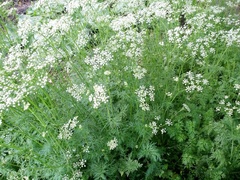 Cuminum cyminume0
- Treatment
- Neem Seed Kernel Extract (NSKE)e1
- Interactor
- Alternaria burnsiiAlternaria burnsiie0pathogen
- Outcome
- mean growth inhibitione1
- Direction
- most effectivee1
- Value
- 48.88 per cente1
Not reportedComparatorSetting
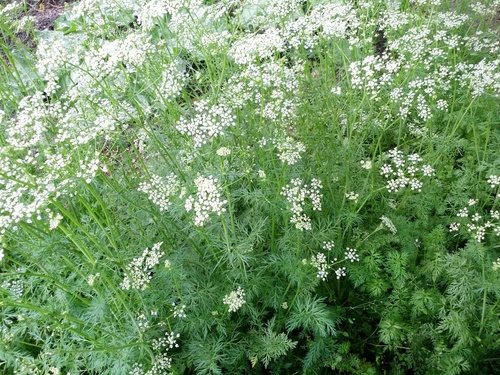
Organisms pictured · Representative pictures of the matched species, not figures from the paper.
Verbatim
e0“to assess the in-vitro efficacy of plant extracts and bio-agents in managing Alternaria burnsii, the causal agent of blight disease in cumin”
e1“Among the plant extracts, Neem Seed Kernel Extract (NSKE) and Neem leaf extract were found to be the most effective, resulting in mean growth inhibition of 48.88 per cent and 45.85 per cent, respectively”
Claim · model-written summary
Neem leaf extract was the most effective plant extract against Alternaria burnsii, with mean growth inhibition of 45.85 per cent.
- Taxon
- cuminCuminum cyminume0
- Treatment
- Neem leaf extracte1
- Interactor
- Alternaria burnsiiAlternaria burnsiie0pathogen
- Outcome
- mean growth inhibitione1
- Direction
- most effectivee1
- Value
- 45.85 per cente1
Not reportedComparatorSetting
Organisms pictured · Representative pictures of the matched species, not figures from the paper.
Verbatim
e0“to assess the in-vitro efficacy of plant extracts and bio-agents in managing Alternaria burnsii, the causal agent of blight disease in cumin”
e1“Among the plant extracts, Neem Seed Kernel Extract (NSKE) and Neem leaf extract were found to be the most effective, resulting in mean growth inhibition of 48.88 per cent and 45.85 per cent, respectively”
Claim · model-written summary
Eucalyptus (Eucalyptus globulus) extract gave the least mean growth inhibition of Alternaria burnsii, 13.14 per cent.
- Taxon
- cuminCuminum cyminume0
- Treatment
- Eucalyptus (Eucalyptus globulus)e2
- Interactor
- Alternaria burnsiiAlternaria burnsiie0pathogen
- Outcome
- mean growth inhibitione2
- Direction
- leaste2
- Value
- 13.14 per cente2
Not reportedComparatorSetting
Organisms pictured · Representative pictures of the matched species, not figures from the paper.
Verbatim
e0“to assess the in-vitro efficacy of plant extracts and bio-agents in managing Alternaria burnsii, the causal agent of blight disease in cumin”
e2“The least per cent mean growth inhibition, 13.14 per cent, was recorded with Eucalyptus (Eucalyptus globulus)”
Claim · model-written summary
Trichoderma harzianum was the most effective bio-agent in suppressing the growth of Alternaria burnsii, with growth inhibition of 69.63 per cent.
- Taxon
- cuminCuminum cyminume0
- Treatment
- Trichoderma harzianume3
- Interactor
- Alternaria burnsiiAlternaria burnsiie0pathogen
- Second interactor
- Trichoderma harzianum
 Trichoderma harzianume3biocontrol_agent
- Outcome
- growth of the pathogene3
- Direction
- suppressinge3
- Value
- 69.63 per cente3
- Comparator
- the four different bio-agentse3
Not reportedSetting
Organisms pictured · Representative pictures of the matched species, not figures from the paper.

Verbatim
e0“to assess the in-vitro efficacy of plant extracts and bio-agents in managing Alternaria burnsii, the causal agent of blight disease in cumin”
e3“Among the four different bio-agents, Trichoderma harzianum was found to be the most effective in suppressing the growth of the pathogen, achieving a growth inhibition of 69.63 per cent”
Claim · model-written summary
Locally available plant extracts and bio-agents are suggested for managing cumin blight in an eco-friendly way.
- Taxon
- cuminCuminum cyminume4
- Treatment
- locally available plant extracts and bio-agentse4
- Outcome
- management of cumin blighte4
Organisms pictured · Representative pictures of the matched species, not figures from the paper.
Verbatim
e4“This study provides valuable insights into the use of locally available plant extracts and bio-agents for the management of cumin blight, promoting eco-friendly approaches”
The same questions in other papers
Trichoderma harzianum · Alternaria burnsii · Cuminum cyminum (cumin)Results agree
2 papers in the same direction as this paper
- positive
- positive
botanical · Alternaria burnsii · Cuminum cyminum (cumin)Results agree
1 paper in the same direction as this paper
- positive
Claims are grouped by organism, treatment and what was measured or targeted. A paper counts as positive when any of its claims in the group is positive.