Abstract
Widespread production of grain crops and rejection of classical tillage technology have led to a noticeable increase of harmfulness of phytopathogens. First of all, this appertains to facultative parasites with a wide specialization - Bipolaris spp., Fusarium spp., as well as to secondary fungi from Alternaria spp., Cladosporium spp., Penicillium spp. genera and others. There is a simultaneous change of dominance in microbial community of seeds obtained in the Trans-Urals. Fungi of Fusarium spp. genus occupied the leading place among the most harmful pathogens, placing Bipolaris sorokiniana Sacc. Shoem. to the background. F. oxysporum (Schleht) Snyd, F. graminearum Schwabe, F. sporotrichoides Sherb are most spread on spring wheat, both in the tillering phase and at milk-wax stage of grain ripeness. The abundance and diversity of species was significantly higher in the tillering phase than when counted at the end of the vegetation season. To reduce the spread and development of any phytopathogen, it is necessary to apply a set of measures. One of the most effective measures is pre-sowing disinfection of seeds. However, the proposed preparations are not all equally effective in suppressing the development of the fungus of Fusarium spp. genus. During the experiment, it was found that seed treatment fungicides from the class of benzimidazoles - Zim (carbendazim), mixtures of active substances from the classes of triazoles with imidazole - HYIP (triticonazole + prochloraz), and also two triazoles - Oplot (difenoconazole + tebuconazole) were distinguished by high activity from 5.2 to 7.5 units. Application of a microbiological preparation (Bacillus subtilis), as well as its mixtures with a reduced application rate of a chemical disinfectant, showed the absence or low inhibition of fungus mycelium development.
Abstract from the paper’s OpenAlex record, shown for indexing and research. Copyright remains with the authors or the publisher. Read at the source ↗
The text the model read, with the source record’s inline markup (italics, sub- and superscripts) rendered and its character entities decoded; quote offsets refer to the raw text.
Claims 7
Claim · model-written summary
Seed treatment fungicides were distinguished by high activity against Fusarium spp., from 5.2 to 7.5 units.
- Taxon
- wheat
 Triticum aestivumt0
- Treatment
- seed treatment fungicidese1
- Outcome
- activitye2
- Direction
- highe2
- Value
- from 5.2 to 7.5 unitse2
 Fusarium
Not reportedComparator
Organisms pictured · Representative pictures of the matched species, not figures from the paper.


Verbatim
t0“PLANTS OF WHEAT”
e1“seed treatment fungicides from the class of benzimidazoles”
e2“were distinguished by high activity from 5.2 to 7.5 units”
e3“the proposed preparations are not all equally effective in suppressing the development of the fungus of Fusarium spp. genus”
Claim · model-written summary
Bacillus subtilis preparation, alone or mixed with a reduced rate of chemical disinfectant, showed absence or low inhibition of fungus mycelium development.
- Taxon
- wheatTriticum aestivumt0
- Treatment
- microbiological preparation (Bacillus subtilis)e1
- Interactor
- funguse1pathogen
- Second interactor
- Bacillus subtilis
 Bacillus subtilise1biocontrol_agent
- Outcome
- inhibition of fungus mycelium developmente1
- Direction
- lowe1
Not reportedComparator
Organisms pictured · Representative pictures of the matched species, not figures from the paper.

Verbatim
t0“PLANTS OF WHEAT”
e1“Application of a microbiological preparation (Bacillus subtilis), as well as its mixtures with a reduced application rate of a chemical disinfectant, showed the absence or low inhibition of fungus mycelium development”
Claim · model-written summary
Fusarium oxysporum, F. graminearum and F. sporotrichoides were most spread on spring wheat in the tillering phase and at milk-wax stage.
- Taxon
- spring wheatTriticum aestivume1
- Organ / stage
- tillering phasee1
- Interactor
- F. oxysporum
 Fusarium oxysporume1pathogen
- Second interactor
- F. graminearum
 Fusarium graminearume1pathogen
- Outcome
- most spreade1
- Qualifier
- F. sporotrichoidese1
Organisms pictured · Representative pictures of the matched species, not figures from the paper.


Verbatim
e1“F. oxysporum (Schleht) Snyd, F. graminearum Schwabe, F. sporotrichoides Sherb are most spread on spring wheat, both in the tillering phase and at milk-wax stage of grain ripeness”
Claim · model-written summary
Fungi of Fusarium spp. occupied the leading place among the most harmful wheat pathogens, ahead of Bipolaris sorokiniana.
- Taxon
- wheatTriticum aestivumt0
- Second interactor
- Bipolaris sorokiniana
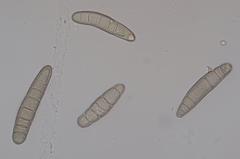 Bipolaris sorokinianae1pathogen
- Outcome
- leading place among the most harmful pathogense1
Organisms pictured · Representative pictures of the matched species, not figures from the paper.
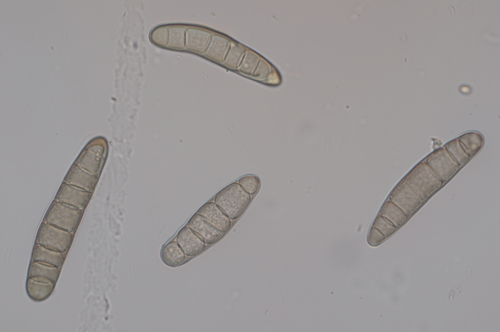
Verbatim
t0“PLANTS OF WHEAT”
e1“Fungi of Fusarium spp. genus occupied the leading place among the most harmful pathogens, placing Bipolaris sorokiniana Sacc. Shoem. to the background”
Claim · model-written summary
The microbial community of wheat seeds in the Trans-Urals changed in dominance.
- Taxon
- wheatTriticum aestivumt0
- Organ / stage
- seedse1
- Outcome
- change of dominance in microbial communitye1
- Setting
- Trans-Uralse1
Organisms pictured · Representative pictures of the matched species, not figures from the paper.
Verbatim
t0“PLANTS OF WHEAT”
e1“There is a simultaneous change of dominance in microbial community of seeds obtained in the Trans-Urals”
Claim · model-written summary
Abundance and diversity of fungal species on wheat were higher in the tillering phase than at the end of the vegetation season.
- Taxon
- wheatTriticum aestivumt0
- Organ / stage
- tillering phasee1
- Outcome
- abundance and diversity of speciese1
- Direction
- highere1
- Comparator
- end of the vegetation seasone1
Organisms pictured · Representative pictures of the matched species, not figures from the paper.
Verbatim
t0“PLANTS OF WHEAT”
e1“The abundance and diversity of species was significantly higher in the tillering phase than when counted at the end of the vegetation season”
Claim · model-written summary
Pre-sowing seed disinfection is one of the most effective measures against wheat phytopathogens.
- Taxon
- wheatTriticum aestivumt0
- Outcome
- pre-sowing disinfection of seedse1
Organisms pictured · Representative pictures of the matched species, not figures from the paper.
Verbatim
t0“PLANTS OF WHEAT”
e1“One of the most effective measures is pre-sowing disinfection of seeds”
The same questions in other papers
Bacillus subtilis · disease · Triticum aestivum (wheat)Positive and negative results
20 in the opposite direction
- positive
- positive
- positive
17 papers more in this group
See all 21 papers →fungicide · Fusarium · Triticum aestivum (wheat)Results differ
21 papers in the same direction as this paper · 6 in the opposite direction
- no effect
- negative
- no effect
24 papers more in this group
See all 28 papers →seed treatment · Fusarium · Triticum aestivum (wheat)Positive and negative results
10 papers in the same direction as this paper · 1 in the opposite direction
- no effect
- positive
- positive
8 papers more in this group
See all 12 papers →Claims are grouped by organism, treatment and what was measured or targeted. A paper counts as positive when any of its claims in the group is positive.