Abstract
Cumin (Cuminum cyminum L.) is the second most popular spice in the world, after black pepper, which is sensitive to salinity. In order to investigate the effect of seed bio-inoculation with plant growth promoting Rhizobacteria on germination and seedling indices of cumin under salinity stress, an experiment was laid out based on a completely randomized design with two factors and four replications in 2017 at Seed Science and Technology Laboratory, Yasouj University, Iran. Experimental factors included bio-inoculation with 3 strains, viz. PF2, PF25, and CHA0 of Pseudomonas fluorescents, and Bacillus subtilis and non-primed (control) and three levels of salinity stress (0, -4 and -8 bar). Results indicated that salt stress reduced germination (up to 40%) and seedling indices of cumin under -4 and -8 bar, the highest germination percentage, germination rate, seedling length, and seedling vigor index were achieved in the seeds inoculated with P. fluorescens, CHA0. At all levels of stress, seed bio-inoculation were increasing the seed soluble protein content compared to non-primed. The effect of this treatment was more obvious under salinity potential of -8 bar. The results indicated that salinity can affect cumin seed germination and the beneficial effect of PGPR could be used for improving its salt tolerance.
Abstract from the paper’s OpenAlex record; open copy licensed cc-by-nc-sa. Read at the source ↗
The text the model read, with the source record’s inline markup (italics, sub- and superscripts) rendered and its character entities decoded; quote offsets refer to the raw text.
Claims 7
Claim · model-written summary
Salt stress at -4 and -8 bar reduced cumin germination by up to 40%.
- Taxon
- cumin
 Cuminum cyminume0
- Treatment
- salt stresse0
- Outcome
- germinatione0
- Direction
- reducede0
- Value
- up to 40%e0
- Qualifier
- -4 and -8 bare0
Not reportedComparator
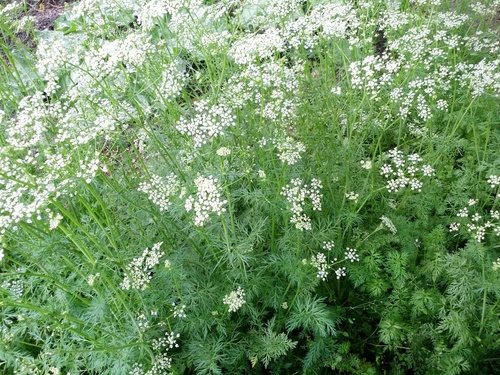
Organisms pictured · Representative pictures of the matched species, not figures from the paper.
Verbatim
e0“salt stress reduced germination (up to 40%) and seedling indices of cumin under -4 and -8 bar”
Claim · model-written summary
Salt stress at -4 and -8 bar reduced cumin seedling indices.
- Taxon
- cuminCuminum cyminume0
- Treatment
- salt stresse0
- Outcome
- seedling indicese0
- Direction
- reducede0
- Qualifier
- -4 and -8 bare0
Not reportedComparator
Organisms pictured · Representative pictures of the matched species, not figures from the paper.
Verbatim
e0“salt stress reduced germination (up to 40%) and seedling indices of cumin under -4 and -8 bar”
Claim · model-written summary
P. fluorescens CHA0 inoculation produced the highest germination percentage and rate in cumin seeds.
- Taxon
- cuminCuminum cyminumt0
- Treatment
- inoculated with P. fluorescens, CHA0e0
- Interactor
- P. fluorescens
 Pseudomonas fluorescense0symbiont
- Outcome
- germination percentage, germination ratee0
- Direction
- higheste0
Not reportedComparator
Organisms pictured · Representative pictures of the matched species, not figures from the paper.

Verbatim
e0“the highest germination percentage, germination rate, seedling length, and seedling vigor index were achieved in the seeds inoculated with P. fluorescens, CHA0”
t0“cumin (Cuminum cyminum)”
Claim · model-written summary
P. fluorescens CHA0 inoculation produced the highest seedling length and vigor index in cumin.
- Taxon
- cuminCuminum cyminumt0
- Treatment
- inoculated with P. fluorescens, CHA0e0
- Interactor
- P. fluorescensPseudomonas fluorescense0symbiont
- Outcome
- seedling length, and seedling vigor indexe0
- Direction
- higheste0
Not reportedComparator
Organisms pictured · Representative pictures of the matched species, not figures from the paper.
Verbatim
e0“the highest germination percentage, germination rate, seedling length, and seedling vigor index were achieved in the seeds inoculated with P. fluorescens, CHA0”
t0“cumin (Cuminum cyminum)”
Claim · model-written summary
Seed bio-inoculation increased cumin seed soluble protein content relative to non-primed seeds at all stress levels.
- Taxon
- cuminCuminum cyminumt0
- Treatment
- seed bio-inoculatione0
- Outcome
- seed soluble protein contente0
- Direction
- increasinge0
- Qualifier
- At all levels of stresse0
- Comparator
- non-primede0
Organisms pictured · Representative pictures of the matched species, not figures from the paper.
Verbatim
e0“At all levels of stress, seed bio-inoculation were increasing the seed soluble protein content compared to non-primed”
t0“cumin (Cuminum cyminum)”
Claim · model-written summary
The bio-inoculation effect on seed soluble protein was more obvious at -8 bar salinity.
- Taxon
- cuminCuminum cyminumt0
- Outcome
- seed soluble protein contente1
- Direction
- more obviouse0
- Qualifier
- salinity potential of -8 bare0
Organisms pictured · Representative pictures of the matched species, not figures from the paper.
Verbatim
e0“The effect of this treatment was more obvious under salinity potential of -8 bar”
e1“seed soluble protein content”
t0“cumin (Cuminum cyminum)”
Claim · model-written summary
The authors proposed PGPR use to improve cumin salt tolerance.
- Taxon
- cuminCuminum cyminumt0
- Outcome
- PGPR could be used for improving its salt tolerancee0
Organisms pictured · Representative pictures of the matched species, not figures from the paper.
Verbatim
e0“the beneficial effect of PGPR could be used for improving its salt tolerance”
t0“cumin (Cuminum cyminum)”
The same questions in other papers
inoculation · growth · Cuminum cyminum (cumin)Results agree
2 papers in the same direction as this paper
- positive
- positive
salinity · growth · Cuminum cyminum (cumin)Results agree
5 papers in the same direction as this paper
- negative
- negative
- negative
2 papers more in this group
See all 6 papers →Claims are grouped by organism, treatment and what was measured or targeted. A paper counts as positive when any of its claims in the group is positive.