Abstract
Objective: To isolate the fungus with phytotoxic activity from the gut of Pantala flavescens larvae. Methods: Strain QTYC-51 was identified by morphological observation and 5.8S rDNA-ITS sequence analysis. Petri dish bioassay was used to test the phytotoxic activity of fermentation broth and monomer compounds of strain QTYC-51 on Echinochloa crusgalli and Amaranthus retroflexus. Bioactive components were isolated from ethyl acetate extracts via chromatographic methods, and the structures were determined by mass spectrum and nuclear magnetic resonance analyses. Results: QTYC-51 was identified as Paraconiothyrium sp.. The fermentation broth had good phytotoxic activity on radical growth of E. crusgalli and A. retroflexus with the inhibition rates of 76.9% and 56.5%, respectively. Five monomer compounds were purified from the fermentation products, including 1,8-dihydroxyanthraquinone, 1-hydroxy-10-methoxy-dibenz[b,e]oxepin-6,11-dione, hydroxyvertixanthone, globosuxanthone and 1,3,6,8-tetrahydroxyanthraquinone. At the concentration of 100 μg/mL, compound globosuxanthone was found to possess obvious phytotoxic effects on radical growth of E. crusgalli and A. retroflexus with the inhibition rates of 94.1% and 79.0%, respectively, which were comparable to that of positive control 2,4-dichlorophenoxyacetic acid. Compound 1-hydroxy-10-methoxy-dibenz[b,e] oxepin-6,11-dione showed potent phytotoxic activity against E. crusgalli and A. retroflexus with inhibition rates of 50.3% and 58.6%, respectively. Conclusion: Strain QTYC-51 could be potentially developed as a microbial herbicide.
Abstract from the paper’s OpenAlex record, shown for indexing and research. Copyright remains with the authors or the publisher. Read at the source ↗
The text the model read, with the source record’s inline markup (italics, sub- and superscripts) rendered and its character entities decoded; quote offsets refer to the raw text.
Claims 9
Claim · model-written summary
QTYC-51 was identified as Paraconiothyrium sp.
- Taxon
- Paraconiothyrium sp.
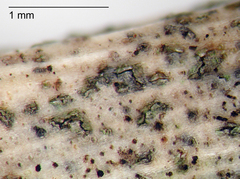 Paraconiothyriume0
- Outcome
- identified as Paraconiothyrium sp.e0
Organisms pictured · Representative pictures of the matched species, not figures from the paper.
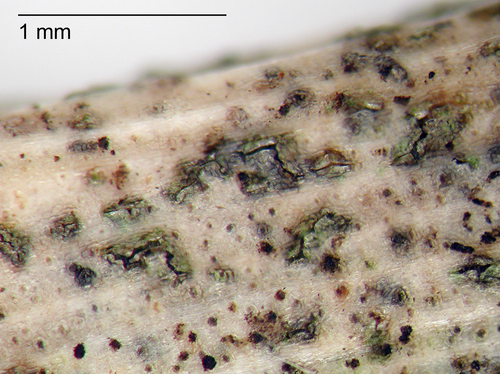
Verbatim
e0“QTYC-51 was identified as Paraconiothyrium sp.”
Claim · model-written summary
Fermentation broth inhibited E. crusgalli radical growth by 76.9%.
- Taxon
- E. crusgalli
 Echinochloa crus-gallie0
- Treatment
- fermentation brothe0
- Outcome
- radical growth of E. crusgallie0
- Direction
- inhibitione0
- Value
- 76.9%e0
Not reportedComparator
Organisms pictured · Representative pictures of the matched species, not figures from the paper.

Verbatim
e0“The fermentation broth had good phytotoxic activity on radical growth of E. crusgalli and A. retroflexus with the inhibition rates of 76.9% and 56.5%, respectively”
Claim · model-written summary
Fermentation broth inhibited A. retroflexus radical growth by 56.5%.
- Taxon
- A. retroflexus
 Amaranthus retroflexuse0
- Treatment
- fermentation brothe0
- Outcome
- radical growthe0
- Direction
- inhibitione0
- Value
- 56.5%e0
Not reportedComparator
Organisms pictured · Representative pictures of the matched species, not figures from the paper.

Verbatim
e0“The fermentation broth had good phytotoxic activity on radical growth of E. crusgalli and A. retroflexus with the inhibition rates of 76.9% and 56.5%, respectively”
Claim · model-written summary
Five compounds were purified from QTYC-51 fermentation products.
- Taxon
- Paraconiothyrium sp.Paraconiothyriume1
- Outcome
- Five monomer compounds were purifiede0
- Value
- Five monomer compoundse0
Organisms pictured · Representative pictures of the matched species, not figures from the paper.
Verbatim
e0“Five monomer compounds were purified from the fermentation products, including 1,8-dihydroxyanthraquinone, 1-hydroxy-10-methoxy-dibenz[b,e]oxepin-6,11-dione, hydroxyvertixanthone, globosuxanthone and 1,3,6,8-tetrahydroxyanthraquinone”
e1“QTYC-51 was identified as Paraconiothyrium sp.”
Claim · model-written summary
Globosuxanthone inhibited E. crusgalli radical growth by 94.1% at 100 μg/mL.
- Taxon
- E. crusgalliEchinochloa crus-gallie0
- Treatment
- 100 μg/mL, compound globosuxanthonee0
- Outcome
- radical growth of E. crusgallie0
- Direction
- inhibitione0
- Value
- 94.1%e0
- Comparator
- positive control 2,4-dichlorophenoxyacetic acide0
Organisms pictured · Representative pictures of the matched species, not figures from the paper.
Verbatim
e0“At the concentration of 100 μg/mL, compound globosuxanthone was found to possess obvious phytotoxic effects on radical growth of E. crusgalli and A. retroflexus with the inhibition rates of 94.1% and 79.0%, respectively, which were comparable to that of positive control 2,4-dichlorophenoxyacetic acid”
Claim · model-written summary
Globosuxanthone inhibited A. retroflexus radical growth by 79.0% at 100 μg/mL.
- Taxon
- A. retroflexusAmaranthus retroflexuse0
- Treatment
- 100 μg/mL, compound globosuxanthonee0
- Outcome
- radical growthe0
- Direction
- inhibitione0
- Value
- 79.0%e0
- Comparator
- positive control 2,4-dichlorophenoxyacetic acide0
Organisms pictured · Representative pictures of the matched species, not figures from the paper.
Verbatim
e0“At the concentration of 100 μg/mL, compound globosuxanthone was found to possess obvious phytotoxic effects on radical growth of E. crusgalli and A. retroflexus with the inhibition rates of 94.1% and 79.0%, respectively, which were comparable to that of positive control 2,4-dichlorophenoxyacetic acid”
Claim · model-written summary
1-hydroxy-10-methoxy-dibenz[b,e] oxepin-6,11-dione inhibited E. crusgalli growth by 50.3%.
- Taxon
- E. crusgalliEchinochloa crus-gallie0
- Treatment
- 1-hydroxy-10-methoxy-dibenz[b,e] oxepin-6,11-dionee0
- Outcome
- phytotoxic activity against E. crusgallie0
- Direction
- inhibitione0
- Value
- 50.3%e0
Not reportedComparator
Organisms pictured · Representative pictures of the matched species, not figures from the paper.
Verbatim
e0“Compound 1-hydroxy-10-methoxy-dibenz[b,e] oxepin-6,11-dione showed potent phytotoxic activity against E. crusgalli and A. retroflexus with inhibition rates of 50.3% and 58.6%, respectively”
Claim · model-written summary
1-hydroxy-10-methoxy-dibenz[b,e] oxepin-6,11-dione inhibited A. retroflexus growth by 58.6%.
- Taxon
- A. retroflexusAmaranthus retroflexuse0
- Treatment
- 1-hydroxy-10-methoxy-dibenz[b,e] oxepin-6,11-dionee0
- Outcome
- phytotoxic activitye0
- Direction
- inhibitione0
- Value
- 58.6%e0
Not reportedComparator
Organisms pictured · Representative pictures of the matched species, not figures from the paper.
Verbatim
e0“Compound 1-hydroxy-10-methoxy-dibenz[b,e] oxepin-6,11-dione showed potent phytotoxic activity against E. crusgalli and A. retroflexus with inhibition rates of 50.3% and 58.6%, respectively”
Claim · model-written summary
The authors propose QTYC-51 as a potential microbial herbicide.
- Taxon
- Paraconiothyrium sp.Paraconiothyriume1
- Outcome
- developed as a microbial herbicidee0
Organisms pictured · Representative pictures of the matched species, not figures from the paper.
Verbatim
e0“Strain QTYC-51 could be potentially developed as a microbial herbicide”
e1“QTYC-51 was identified as Paraconiothyrium sp.”
The same questions in other papers
processing · growth · Echinochloa crus-galli (barnyard grass)Positive and negative results
2 papers in the same direction as this paper · 2 in the opposite direction
- negative
- negative
- positive
1 paper more in this group
See all 5 papers →processing · growth · Amaranthus retroflexus (redroot amaranth)Results agree
2 papers in the same direction as this paper
- positive
- positive
Claims are grouped by organism, treatment and what was measured or targeted. A paper counts as positive when any of its claims in the group is positive.