Abstract
We evaluated the insecticide activities of aqueous extracts of five species of plants from the Ecuadorian Amazon (Deguelia utilis (ACSm.) AMGAZEVEDO (Leguminosae: Papilionoideae), Xanthosoma purpuratum K. Krause (Alismatales: Araceae), Clibadium sp. (Asteracea: Asterales), Witheringia solanacea L'Hér (Solanales: Solanaceae), and Dieffenbachia costata H. Karst. ex Schott (Alismatales: Araceae)) plus Cymbopogon citratus Stapf. (Poales: Poaceae) under laboratory, open-field conditions in Plutella xylostella L. (diamondback moth), and semifield conditions in Brevicoryne brassicae L. Tap water was used as a negative control, and synthetic insecticides were used as positive controls. In a laboratory bioassay, aqueous extracts of D. utilis resulted in P. xylostella larval mortality. In contrast to chlorpyrifos, all botanicals were oviposition deterrents. All extracts except Clibadium sp. decreased leaf consumption by P. xylostella larvae. In semifield experiments, D. utilis, Clibadium sp., D. costata, and X. purpuratum initially controlled the population of B. brassicae, but 7 d after application, all botanicals except the D. utilis lost their ability to control the pest. In field experiments on broccoli crops in both dry and rainy seasons, the extracts did not control the abundance of P. xylostella, where as a mixture of two insecticides (chlorpyrifos + lambda cyhalothrin) did. These results show some incongruences from laboratory to semifield and field conditions, indicating that more studies, including the identification of the chemicals responsible for the biological activity, its stability, and the effects of chemotypes on insecticidal activity, are needed to understand the potential of these plant species as botanical insecticides.
Abstract from the paper’s OpenAlex record, shown for indexing and research. Copyright remains with the authors or the publisher. Read at the source ↗
The text the model read, with the source record’s inline markup (italics, sub- and superscripts) rendered and its character entities decoded; quote offsets refer to the raw text.
Claims 10
Claim · model-written summary
D. utilis extract caused P. xylostella larval mortality in a laboratory bioassay.
- Taxon
- D. utilis
 Lonchocarpus utilise0
- Treatment
- aqueous extracts of D. utilise0
- Interactor
- P. xylostellae0pest
- Outcome
- P. xylostella larval mortalitye0
- Comparator
- Tap watere1
Not reportedDirection
Organisms pictured · Representative pictures of the matched species, not figures from the paper.

Verbatim
e0“In a laboratory bioassay, aqueous extracts of D. utilis resulted in P. xylostella larval mortality.”
e1“Tap water was used as a negative control”
Claim · model-written summary
All botanical extracts deterred oviposition relative to chlorpyrifos.
- Interactor
- Plutella xylostella
 Plutella xylostellae1pest
- Outcome
- oviposition deterrentse0
- Comparator
- chlorpyrifose0
Not reportedTaxonDirection
Organisms pictured · Representative pictures of the matched species, not figures from the paper.

Verbatim
e0“In contrast to chlorpyrifos, all botanicals were oviposition deterrents.”
e1“in Plutella xylostella L. (diamondback moth)”
Claim · model-written summary
All extracts except Clibadium sp. reduced leaf consumption by P. xylostella larvae.
- Interactor
- P. xylostellae0pest
- Outcome
- leaf consumption by P. xylostella larvaee0
- Direction
- decreasede0
- Qualifier
- except Clibadium sp.e0
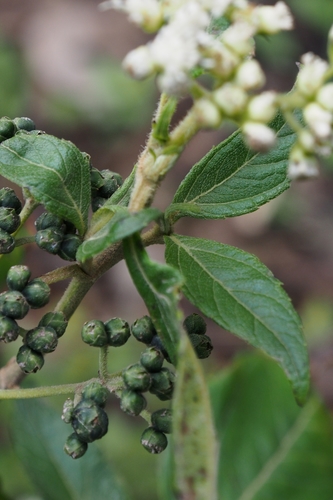
 Clibadium
Organisms pictured · Representative pictures of the matched species, not figures from the paper.
Verbatim
e0“All extracts except Clibadium sp. decreased leaf consumption by P. xylostella larvae.”
Claim · model-written summary
D. utilis initially controlled B. brassicae and retained control seven days after application.
- Taxon
- D. utilisLonchocarpus utilise0
- Treatment
- D. utilise0
- Interactor
- B. brassicae
 Brevicoryne brassicaee0pest
- Outcome
- population of B. brassicaee0
- Direction
- controllede0
- Qualifier
- 7 d after applicatione0
Not reportedComparator
Organisms pictured · Representative pictures of the matched species, not figures from the paper.

Verbatim
e0“In semifield experiments, D. utilis, Clibadium sp., D. costata, and X. purpuratum initially controlled the population of B. brassicae, but 7 d after application, all botanicals except the D. utilis lost their ability to control the pest.”
Claim · model-written summary
Clibadium sp. initially controlled B. brassicae but lost efficacy by day seven.
- Treatment
- Clibadium sp.e0
- Interactor
- B. brassicaeBrevicoryne brassicaee0pest
- Outcome
- population of B. brassicaee0
- Direction
- controllede0
- Qualifier
- 7 d after applicatione0
Not reportedComparator
Organisms pictured · Representative pictures of the matched species, not figures from the paper.
Verbatim
e0“In semifield experiments, D. utilis, Clibadium sp., D. costata, and X. purpuratum initially controlled the population of B. brassicae, but 7 d after application, all botanicals except the D. utilis lost their ability to control the pest.”
Claim · model-written summary
D. costata initially controlled B. brassicae but lost efficacy by day seven.
- Taxon
- D. costatae0
- Treatment
- D. costatae0
- Interactor
- B. brassicaeBrevicoryne brassicaee0pest
- Outcome
- population of B. brassicaee0
- Direction
- controllede0
- Qualifier
- 7 d after applicatione0
Not reportedComparator
Organisms pictured · Representative pictures of the matched species, not figures from the paper.
Verbatim
e0“In semifield experiments, D. utilis, Clibadium sp., D. costata, and X. purpuratum initially controlled the population of B. brassicae, but 7 d after application, all botanicals except the D. utilis lost their ability to control the pest.”
Claim · model-written summary
X. purpuratum initially controlled B. brassicae but lost efficacy by day seven.
- Taxon
- X. purpuratume0
- Treatment
- X. purpuratume0
- Interactor
- B. brassicaeBrevicoryne brassicaee0pest
- Outcome
- population of B. brassicaee0
- Direction
- controllede0
- Qualifier
- 7 d after applicatione0
Not reportedComparator
Organisms pictured · Representative pictures of the matched species, not figures from the paper.
Verbatim
e0“In semifield experiments, D. utilis, Clibadium sp., D. costata, and X. purpuratum initially controlled the population of B. brassicae, but 7 d after application, all botanicals except the D. utilis lost their ability to control the pest.”
Claim · model-written summary
Botanical extracts did not control P. xylostella abundance in broccoli field crops across dry and rainy seasons.
- Taxon
- broccoli
 Brassica oleracea var. italicae0
- Treatment
- extractse0
- Interactor
- P. xylostellae0pest
- Outcome
- abundance of P. xylostellae0
- Direction
- did not controle0
- Qualifier
- both dry and rainy seasonse0
- Setting
- field experimentse0
Not reportedComparator
Organisms pictured · Representative pictures of the matched species, not figures from the paper.

Verbatim
e0“In field experiments on broccoli crops in both dry and rainy seasons, the extracts did not control the abundance of P. xylostella”
Claim · model-written summary
A chlorpyrifos and lambda cyhalothrin mixture controlled P. xylostella abundance in broccoli fields.
- Taxon
- broccoliBrassica oleracea var. italicae0
- Treatment
- chlorpyrifos + lambda cyhalothrine0
- Interactor
- P. xylostellae0pest
- Outcome
- abundance of P. xylostellae0
- Direction
- dide0
- Comparator
- extractse0
- Setting
- field experimentse0
Organisms pictured · Representative pictures of the matched species, not figures from the paper.
Verbatim
e0“In field experiments on broccoli crops in both dry and rainy seasons, the extracts did not control the abundance of P. xylostella, where as a mixture of two insecticides (chlorpyrifos + lambda cyhalothrin) did.”
Claim · model-written summary
The authors recommended further study of active chemicals, stability and chemotypes to assess botanical insecticide potential.
Verbatim
e0“more studies, including the identification of the chemicals responsible for the biological activity, its stability, and the effects of chemotypes on insecticidal activity, are needed to understand the potential of these plant species as botanical insecticides.”
The same questions in other papers
lambda-cyhalothrin · pest · Brassica oleracea (wild cabbage)Results agree
2 papers in the same direction as this paper
- positive
- positive
chlorpyrifos · pest · Brassica oleracea (wild cabbage)Results agree
6 papers in the same direction as this paper
- positive
- positive
- positive
3 papers more in this group
See all 7 papers →botanical · pest · Brassica oleracea (wild cabbage)Positive and negative results
12 papers in the same direction as this paper · 65 in the opposite direction
- positive
- positive
- positive
74 papers more in this group
See all 78 papers →Claims are grouped by organism, treatment and what was measured or targeted. A paper counts as positive when any of its claims in the group is positive.