Abstract
Preliminary greenhouse experiments indicated that Cucurbita pepo , when grown at high temperatures, shows a high incidence of female flower bud necrosis, preventing those flowers from reaching anthesis and thus delaying fruit set. This can lead to reduced yield in areas with short growing seasons. To determine if delayed fruit set also occurred under field conditions, replicated cultivar trials were conducted during the summer seasons of 1996 and 1997 in Ithaca and Albany, N.Y.; Wye, Md., and Bradenton, Fla. Mean growing season air temperatures were 20, 21, 24, and 28 °C, respectively, at the four locations. Delay in fruit set was indicated by the main stem node number at which the first fruit formed. In Ithaca and Albany, the six cultivars grown in both years formed their first fruit at node 17, while this was shifted to node 24 at Wye, and to node 26 or more at Bradenton. Fruit yields among the C. pepo cultivars ranged from 45 to 85 mt·ha –1 in all locations except Bradenton, where they ranged from 7 to 35 tons. Among C. pepo cultivars, `Appalachian' showed least yield decrease at Bradenton, and `Howden' and `Baby Bear' the most, in the hotter 1996 season. The C. maxima `Prize Winner' yielded well in all locations. The results indicate that delayed fruit set occurred most often in the highest temperature locations. There is scope for selecting for improved high temperature female flower development among C. pepo cultivars.
Abstract from the paper’s OpenAlex record, shown for indexing and research. Copyright remains with the authors or the publisher. Read at the source ↗
The text the model read, with the source record’s inline markup (italics, sub- and superscripts) rendered and its character entities decoded; quote offsets refer to the raw text.
Claims 10
Claim · model-written summary
High greenhouse temperatures caused female flower bud necrosis in Cucurbita pepo.
- Taxon
- Cucurbita pepo
 Cucurbita pepoe0
- Treatment
- high temperaturese0
- Outcome
- female flower bud necrosise0
- Direction
- high incidencee0
Not reportedComparator
Organisms pictured · Representative pictures of the matched species, not figures from the paper.

Verbatim
e0“Cucurbita pepo , when grown at high temperatures, shows a high incidence of female flower bud necrosis”
Claim · model-written summary
High temperatures delayed anthesis and fruit set in Cucurbita pepo.
- Taxon
- Cucurbita pepoCucurbita pepot0
- Treatment
- high temperaturese1
- Outcome
- fruit sete0
- Direction
- delayinge0
Not reportedComparator
Organisms pictured · Representative pictures of the matched species, not figures from the paper.
Verbatim
e0“preventing those flowers from reaching anthesis and thus delaying fruit set”
t0“Cucurbita pepo , when grown at high temperatures”
e1“high temperatures”
Claim · model-written summary
First fruit formed at node 17 in Ithaca and Albany and later at node 24 in Wye.
 Cucurbita
Organisms pictured · Representative pictures of the matched species, not figures from the paper.

Verbatim
e0“In Ithaca and Albany, the six cultivars grown in both years formed their first fruit at node 17, while this was shifted to node 24 at Wye”
t0“Cucurbita”
Claim · model-written summary
First fruit formed at node 26 or more at Bradenton.
Organisms pictured · Representative pictures of the matched species, not figures from the paper.
Verbatim
e0“and to node 26 or more at Bradenton”
t0“Cucurbita”
e1“the first fruit formed”
Claim · model-written summary
C. pepo fruit yields ranged from 45 to 85 mt·ha –1 outside Bradenton.
- Taxon
- C. pepoCucurbita pepoe0
- Outcome
- Fruit yieldse0
- Value
- 45 to 85 mt·ha –1e0
Organisms pictured · Representative pictures of the matched species, not figures from the paper.
Verbatim
e0“Fruit yields among the C. pepo cultivars ranged from 45 to 85 mt·ha –1 in all locations except Bradenton”
Claim · model-written summary
C. pepo fruit yields ranged from 7 to 35 tons at Bradenton.
- Taxon
- C. pepoCucurbita pepot0
- Outcome
- Fruit yieldse1
- Value
- 7 to 35 tonse0
- Setting
- Bradentone0
Organisms pictured · Representative pictures of the matched species, not figures from the paper.
Verbatim
e0“except Bradenton, where they ranged from 7 to 35 tons”
t0“Fruit yields among the C. pepo cultivars”
e1“Fruit yields”
Claim · model-written summary
Appalachian had the smallest yield decline at Bradenton in hot 1996.
- Taxon
- C. pepoCucurbita pepoe1
- Material
- `Appalachian'e0
- Outcome
- yield decreasee0
- Direction
- leaste0
- Setting
- Bradentone0
Organisms pictured · Representative pictures of the matched species, not figures from the paper.
Verbatim
e0“`Appalachian' showed least yield decrease at Bradenton”
e1“Among C. pepo cultivars”
Claim · model-written summary
Howden and Baby Bear had the largest yield decline at Bradenton in hot 1996.
- Taxon
- C. pepoCucurbita pepoe1
- Material
- `Howden' and `Baby Bear'e0
- Outcome
- yield decreasee2
- Direction
- moste0
Organisms pictured · Representative pictures of the matched species, not figures from the paper.
Verbatim
e0“`Howden' and `Baby Bear' the most, in the hotter 1996 season”
e1“Among C. pepo cultivars”
e2“yield decrease”
Claim · model-written summary
C. maxima Prize Winner yielded well across all locations.
- Taxon
- C. maxima
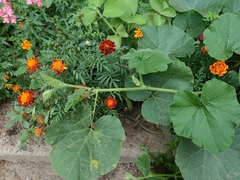 Cucurbita maximae0
- Material
- `Prize Winner'e0
- Outcome
- yielded welle0
- Direction
- welle0
Organisms pictured · Representative pictures of the matched species, not figures from the paper.

Verbatim
e0“The C. maxima `Prize Winner' yielded well in all locations”
Claim · model-written summary
The authors identify potential to select C. pepo for better high-temperature female flower development.
- Taxon
- C. pepoCucurbita pepoe0
- Outcome
- selecting for improved high temperature female flower developmente0
Organisms pictured · Representative pictures of the matched species, not figures from the paper.
Verbatim
e0“There is scope for selecting for improved high temperature female flower development among C. pepo cultivars”
The same questions in other papers
heat · disease · Cucurbita pepoPositive and negative results
1 in the opposite direction
- positive
Claims are grouped by organism, treatment and what was measured or targeted. A paper counts as positive when any of its claims in the group is positive.