Abstract
The fungal pathogens Cochliobolus sativus and Fusarium graminearum are frequently isolated from diseased barley spikes in western Canada. When seeds co-infected with these two species were plated on solid nutrient media, C. sativus strongly inhibited the growth of F. graminearum and at least five other Fusarium species associated with Fusarium head blight (FHB). An inhibitory substance was secreted into the media in advance of C. sativus hyphae, creating a clear zone of inhibition which was devoid of any hyphae. The size of this zone of inhibition varied between C. sativus isolates. C. sativus inhibited F. graminearum and FHB development when it was inoculated onto spikes of ‘AC Metcalfe’, ‘Manley’ or ‘Stander’ barley before inoculation with F. graminearum, whereas co-inoculation or inoculation with C. sativus after F. graminearum did not reduce FHB symptoms. A putative toxic compound was enriched from a liquid culture of C. sativus and shown to retain activity in vitro. The compound was partially purified by high performance liquid chromatography and its mass determined to be 234 u by electrospray ionization mass spectrometry and gas chromatography-mass spectrometry. Results from partial characterization of the enriched toxin are consistent with prehelminthosporol and it is likely that this, or one of its derivatives, was inhibiting F. graminearum. This antibiotic compound could enable C. sativus to compete more effectively with other fungal species on both plants and in the soil.
Abstract from the paper’s OpenAlex record, shown for indexing and research. Copyright remains with the authors or the publisher. Read at the source ↗
The text the model read, with the source record’s inline markup (italics, sub- and superscripts) rendered and its character entities decoded; quote offsets refer to the raw text.
Claims 8
Claim · model-written summary
C. sativus inhibited F. graminearum and at least five other Fusarium species in plated co-infected seed cultures.
- Taxon
- barley
 Hordeum vulgaret0
- Interactor
- F. graminearum
 Fusarium graminearume0pathogen
- Outcome
- growth of F. graminearum and at least five other Fusarium speciese0
- Direction
- inhibitede0
Organisms pictured · Representative pictures of the matched species, not figures from the paper.


Verbatim
e0“C. sativus strongly inhibited the growth of F. graminearum and at least five other Fusarium species associated with Fusarium head blight (FHB)”
t0“barley plants”
Claim · model-written summary
An inhibitory substance formed a hypha-free zone ahead of C. sativus hyphae.
- Taxon
- barleyHordeum vulgaret0
- Interactor
- C. sativus
 Bipolaris sorokinianae0pathogen
- Outcome
- clear zone of inhibition which was devoid of any hyphaee0
Organisms pictured · Representative pictures of the matched species, not figures from the paper.
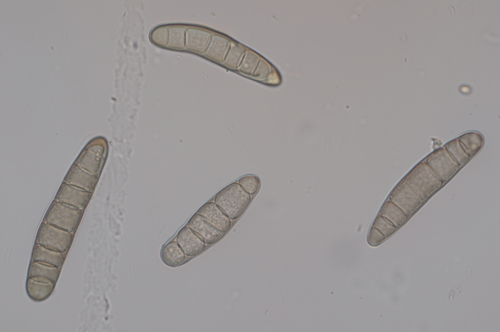
Verbatim
e0“An inhibitory substance was secreted into the media in advance of C. sativus hyphae, creating a clear zone of inhibition which was devoid of any hyphae”
t0“barley plants”
Claim · model-written summary
The inhibition-zone size varied among C. sativus isolates.
- Taxon
- barleyHordeum vulgaret0
- Interactor
- C. sativusBipolaris sorokinianae0pathogen
- Outcome
- size of this zone of inhibitione0
- Direction
- variede0
Organisms pictured · Representative pictures of the matched species, not figures from the paper.
Verbatim
e0“The size of this zone of inhibition varied between C. sativus isolates”
t0“barley plants”
Claim · model-written summary
Applying C. sativus before F. graminearum inhibited F. graminearum and FHB development on three barley cultivars.
- Taxon
- barleyHordeum vulgaree0
- Organ / stage
- spikese0
- Treatment
- C. sativuse0
- Interactor
- F. graminearumFusarium graminearume0pathogen
- Second interactor
- C. sativusBipolaris sorokinianae0biocontrol_agent
- Outcome
- F. graminearum and FHB developmente0
- Direction
- inhibitede0
- Comparator
- before inoculation with F. graminearume0
Organisms pictured · Representative pictures of the matched species, not figures from the paper.
Verbatim
e0“C. sativus inhibited F. graminearum and FHB development when it was inoculated onto spikes of ‘AC Metcalfe’, ‘Manley’ or ‘Stander’ barley before inoculation with F. graminearum”
Claim · model-written summary
Co-inoculation with C. sativus did not reduce FHB symptoms.
- Taxon
- barleyHordeum vulgaret0
- Treatment
- co-inoculatione0
- Interactor
- F. graminearumFusarium graminearume0pathogen
- Second interactor
- C. sativusBipolaris sorokinianae0biocontrol_agent
- Outcome
- FHB symptomse0
- Direction
- did not reducee0
- Comparator
- inoculation with C. sativus after F. graminearume0
Organisms pictured · Representative pictures of the matched species, not figures from the paper.
Verbatim
e0“whereas co-inoculation or inoculation with C. sativus after F. graminearum did not reduce FHB symptoms”
t0“barley plants”
Claim · model-written summary
An enriched compound from C. sativus liquid culture retained in vitro inhibitory activity.
- Taxon
- barleyHordeum vulgaret0
- Interactor
- C. sativusBipolaris sorokinianae0pathogen
- Outcome
- retain activity in vitroe0
Organisms pictured · Representative pictures of the matched species, not figures from the paper.
Verbatim
e0“A putative toxic compound was enriched from a liquid culture of C. sativus and shown to retain activity in vitro”
t0“barley plants”
Claim · model-written summary
The partially purified compound had a measured mass of 234 u.
- Taxon
- barleyHordeum vulgaret0
- Outcome
- masse0
- Value
- 234 ue0
Organisms pictured · Representative pictures of the matched species, not figures from the paper.
Verbatim
e0“The compound was partially purified by high performance liquid chromatography and its mass determined to be 234 u by electrospray ionization mass spectrometry and gas chromatography-mass spectrometry”
t0“barley plants”
Claim · model-written summary
The authors suggest prehelminthosporol or a derivative inhibited F. graminearum.
- Taxon
- barleyHordeum vulgaret0
- Interactor
- F. graminearumFusarium graminearume0pathogen
- Compound
- prehelminthosporole0
- Outcome
- inhibiting F. graminearume0
- Qualifier
- it is likelye0
Organisms pictured · Representative pictures of the matched species, not figures from the paper.
Verbatim
e0“Results from partial characterization of the enriched toxin are consistent with prehelminthosporol and it is likely that this, or one of its derivatives, was inhibiting F. graminearum”
t0“barley plants”
The same questions in other papers
inoculation · Fusarium graminearum · Hordeum vulgare (barley)Positive and negative results
2 papers in the same direction as this paper · 1 reporting no difference from an alternative
- positive
- negative
- negative
Claims are grouped by organism, treatment and what was measured or targeted. A paper counts as positive when any of its claims in the group is positive.