Abstract
The isoflavonoid profile of soybean was altered in different ways by stimulation of defense response upon germination. The combination of simultaneous germination and induction by Rhizopus oryzae increased the total isoflavonoid content of soybeans over 2-fold. Pterocarpans became the predominant isoflavonoids, up to 50% (w/w) of total isoflavonoids. To modulate both isoflavonoid content and composition further, the treatment was extended with wounding or light stimuli. The total isoflavonoid content could be increased over 3-fold compared to untreated beans by growing fungus-elicited soybean seedlings in light, whereas wounding was less effective. Interestingly, light altered the composition of prenylated pterocarpans by mediating the position of prenylation. The 2-prenylated pterocarpan level increased 2-fold, whereas that of 4-prenylated pterocarpan remained similar. Taken together, fungus was the most effective elicitor to alter the isoflavonoid content and composition of soybean seedlings, the impact of which can be further enhanced and mediated by additional stimuli, particularly light.
Abstract from the paper’s OpenAlex record, shown for indexing and research. Copyright remains with the authors or the publisher. Read at the source ↗
The text the model read, with the source record’s inline markup (italics, sub- and superscripts) rendered and its character entities decoded; quote offsets refer to the raw text.
Claims 7
Claim · model-written summary
Germination with Rhizopus oryzae raised total soybean isoflavonoids more than twofold.
- Taxon
- soybeans
 Glycine maxe0
- Treatment
- induction by Rhizopus oryzaee0
- Interactor
- Rhizopus oryzae
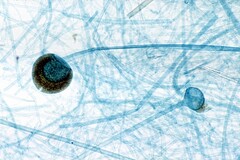 Rhizopus arrhizuse0other
- Outcome
- total isoflavonoid contente0
- Direction
- increasede0
- Value
- over 2-folde0
Not reportedComparator
Organisms pictured · Representative pictures of the matched species, not figures from the paper.


Verbatim
e0“The combination of simultaneous germination and induction by Rhizopus oryzae increased the total isoflavonoid content of soybeans over 2-fold.”
Claim · model-written summary
Pterocarpans became predominant among isoflavonoids, reaching half the total.
- Taxon
- SoybeanGlycine maxt0
- Outcome
- Pterocarpans became the predominant isoflavonoidse0
- Direction
- predominante0
- Value
- up to 50% (w/w)e0
Organisms pictured · Representative pictures of the matched species, not figures from the paper.
Verbatim
e0“Pterocarpans became the predominant isoflavonoids, up to 50% (w/w) of total isoflavonoids.”
t0“Soybean (Glycine max)”
Claim · model-written summary
Light increased total isoflavonoids in fungus-elicited soybean seedlings more than threefold against untreated beans.
- Taxon
- soybeanGlycine maxe0
- Treatment
- growing fungus-elicited soybean seedlings in lighte0
- Outcome
- total isoflavonoid contente0
- Direction
- increasede0
- Value
- over 3-folde0
- Comparator
- untreated beanse0
Organisms pictured · Representative pictures of the matched species, not figures from the paper.
Verbatim
e0“The total isoflavonoid content could be increased over 3-fold compared to untreated beans by growing fungus-elicited soybean seedlings in light, whereas wounding was less effective.”
Claim · model-written summary
Wounding was less effective than light at increasing isoflavonoids.
- Taxon
- soybeanGlycine maxe0
- Treatment
- woundinge0
- Outcome
- total isoflavonoid contente0
- Direction
- less effectivee0
- Comparator
- lighte0
Organisms pictured · Representative pictures of the matched species, not figures from the paper.
Verbatim
e0“The total isoflavonoid content could be increased over 3-fold compared to untreated beans by growing fungus-elicited soybean seedlings in light, whereas wounding was less effective.”
Claim · model-written summary
Light altered the positional composition of prenylated pterocarpans.
Not reportedTaxonComparatorDirection
Verbatim
e0“light altered the composition of prenylated pterocarpans by mediating the position of prenylation.”
Claim · model-written summary
The 2-prenylated pterocarpan level doubled.
- Taxon
- SoybeanGlycine maxt0
- Outcome
- 2-prenylated pterocarpan levele0
- Direction
- increasede0
- Value
- 2-folde0
Organisms pictured · Representative pictures of the matched species, not figures from the paper.
Verbatim
e0“The 2-prenylated pterocarpan level increased 2-fold, whereas that of 4-prenylated pterocarpan remained similar.”
t0“Soybean (Glycine max)”
Claim · model-written summary
The 4-prenylated pterocarpan level remained similar.
- Taxon
- SoybeanGlycine maxt0
- Outcome
- 4-prenylated pterocarpane0
- Direction
- remained similare0
Organisms pictured · Representative pictures of the matched species, not figures from the paper.
Verbatim
e0“The 2-prenylated pterocarpan level increased 2-fold, whereas that of 4-prenylated pterocarpan remained similar.”
t0“Soybean (Glycine max)”
The same questions in other papers
mechanical · molecular: metabolites · Glycine max (soybean)Positive and negative results
3 papers in the same direction as this paper · 5 in the opposite direction
- positive
- positive
- positive
5 papers more in this group
See all 9 papers →light · molecular: metabolites · Glycine max (soybean)Positive and negative results
26 papers in the same direction as this paper · 20 in the opposite direction · 1 reporting no difference from an alternative
- no effect
- no effect
- positive
44 papers more in this group
See all 48 papers →Claims are grouped by organism, treatment and what was measured or targeted. A paper counts as positive when any of its claims in the group is positive.