Abstract
The presence of rusts of daylily and geranium caused respectively by Puccinia hemerocallidis and P. pelargoniizonalis can result in reduced value of these ornamental crops. Experiments were conducted to determine the effects of fluorescent light and sunlight on urediniospore germination, germ tube elongation, lesion development and sporulation of the two fungal pathogens on detached leaves and whole plants. Exposure of dry or hydrated urediniospores of P. hemerocallidis to cool white fluorescent light (600 μmol s(-1) m(-2)) or to sunlight (950-1910 μmol s(-1) m(-2)) for 2 h or 4 h significantly reduced germination and germ tube elongation on detached daylily leaves. Germination but not germ tube elongation of hydrated urediniospores of P. pelargoniizonalis on detached geranium leaves was significantly reduced when exposed to fluorescent light for 2 h or 4 h. A 4 h exposure to either light source significantly reduced lesion development of P. hemerocallidis on detached daylily leaves with fewer lesions developing from hydrated compared to dry urediniospores. Sunlight exposures of 1 h and 2 h of hydrated and dry urediniospores respectively significantly reduced lesion development by either fungus on whole plants. Increasing exposure to fluorescent light negatively affected sporulation of P. hemerocallidis and P. pelargoniizonalis. Complete suppression of sporulation was not observed for either fungus with up to a 24 h exposure to fluorescent light. Light exposure negatively affected disease development by P. hemerocallidis and P. pelargoniizonalis. Exposure to high light intensities may affect spread of rust diseases on ornamental plants.
Abstract from the paper’s OpenAlex record, shown for indexing and research. Copyright remains with the authors or the publisher. Read at the source ↗
The text the model read, with the source record’s inline markup (italics, sub- and superscripts) rendered and its character entities decoded; quote offsets refer to the raw text.
Claims 11
Claim · model-written summary
Fluorescent light or sunlight for 2 or 4 h significantly reduced germination and germ tube elongation of Puccinia hemerocallidis urediniospores on detached daylily leaves.
- Taxon
- daylily
 Hemerocallis hybrid cultivare0
- Treatment
- cool white fluorescent lighte0
- Interactor
- P. hemerocallidis
 Puccinia hemerocallidise0pathogen
- Outcome
- germination and germ tube elongatione0
- Direction
- reducede0
Not reportedComparator
Organisms pictured · Representative pictures of the matched species, not figures from the paper.

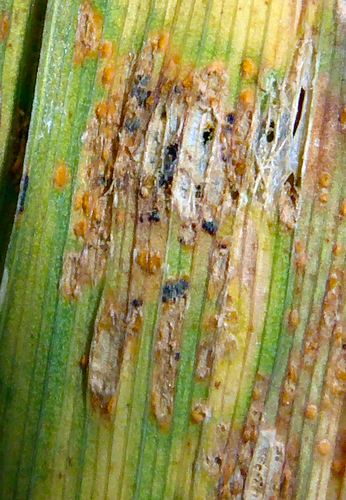
Verbatim
e0“Exposure of dry or hydrated urediniospores of P. hemerocallidis to cool white fluorescent light (600 μmol s(-1) m(-2)) or to sunlight (950-1910 μmol s(-1) m(-2)) for 2 h or 4 h significantly reduced germination and germ tube elongation on detached daylily leaves”
Claim · model-written summary
Fluorescent light for 2 or 4 h significantly reduced germination of Puccinia pelargoniizonalis urediniospores on detached geranium leaves.
- Treatment
- exposed to fluorescent lighte1
- Interactor
- P. pelargoniizonalise1pathogen
- Outcome
- Germinatione1
- Direction
- reducede1
 Geranium
Not reportedComparator
Organisms pictured · Representative pictures of the matched species, not figures from the paper.

Verbatim
e1“Germination but not germ tube elongation of hydrated urediniospores of P. pelargoniizonalis on detached geranium leaves was significantly reduced when exposed to fluorescent light for 2 h or 4 h”
Claim · model-written summary
Fluorescent light for 2 or 4 h did not reduce germ tube elongation of Puccinia pelargoniizonalis urediniospores on detached geranium leaves.
- Treatment
- exposed to fluorescent lighte1
- Interactor
- P. pelargoniizonalise1pathogen
- Outcome
- germ tube elongatione1
Not reportedComparatorDirection
Organisms pictured · Representative pictures of the matched species, not figures from the paper.
Verbatim
e1“Germination but not germ tube elongation of hydrated urediniospores of P. pelargoniizonalis on detached geranium leaves was significantly reduced when exposed to fluorescent light for 2 h or 4 h”
Claim · model-written summary
A 4 h exposure to either light source significantly reduced lesion development of Puccinia hemerocallidis on detached daylily leaves.
- Taxon
- daylilyHemerocallis hybrid cultivare2
- Treatment
- A 4 h exposure to either light sourcee2
- Interactor
- P. hemerocallidisPuccinia hemerocallidise2pathogen
- Outcome
- lesion developmente2
- Direction
- reducede2
Not reportedComparator
Organisms pictured · Representative pictures of the matched species, not figures from the paper.
Verbatim
e2“A 4 h exposure to either light source significantly reduced lesion development of P. hemerocallidis on detached daylily leaves with fewer lesions developing from hydrated compared to dry urediniospores”
Claim · model-written summary
Hydrated urediniospores of Puccinia hemerocallidis produced fewer lesions on detached daylily leaves than dry urediniospores.
- Taxon
- daylilyHemerocallis hybrid cultivare2
- Treatment
- hydrated compared to drye2
- Interactor
- P. hemerocallidisPuccinia hemerocallidise2pathogen
- Outcome
- lesions developinge2
- Direction
- fewere2
- Comparator
- dry urediniosporese2
Organisms pictured · Representative pictures of the matched species, not figures from the paper.
Verbatim
e2“A 4 h exposure to either light source significantly reduced lesion development of P. hemerocallidis on detached daylily leaves with fewer lesions developing from hydrated compared to dry urediniospores”
Claim · model-written summary
Sunlight for 1 h (hydrated) or 2 h (dry) significantly reduced lesion development of Puccinia hemerocallidis on whole daylily plants.
- Taxon
- daylilyHemerocallis hybrid cultivart0
- Treatment
- Sunlight exposures of 1 h and 2 he3
- Interactor
- Puccinia hemerocallidisPuccinia hemerocallidist0pathogen
- Outcome
- lesion developmente3
- Direction
- reducede3
- Qualifier
- on whole plantse3
Not reportedComparator
Organisms pictured · Representative pictures of the matched species, not figures from the paper.
Verbatim
t0“Puccinia hemerocallidis on daylily and Puccinia pelargoniizonalis on geranium”
e3“Sunlight exposures of 1 h and 2 h of hydrated and dry urediniospores respectively significantly reduced lesion development by either fungus on whole plants”
Claim · model-written summary
Sunlight for 1 h (hydrated) or 2 h (dry) significantly reduced lesion development of Puccinia pelargoniizonalis on whole geranium plants.
- Treatment
- Sunlight exposures of 1 h and 2 he3
- Interactor
- Puccinia pelargoniizonalist0pathogen
- Outcome
- lesion developmente3
- Direction
- reducede3
- Qualifier
- on whole plantse3
Not reportedComparator
Organisms pictured · Representative pictures of the matched species, not figures from the paper.
Verbatim
t0“Puccinia hemerocallidis on daylily and Puccinia pelargoniizonalis on geranium”
e3“Sunlight exposures of 1 h and 2 h of hydrated and dry urediniospores respectively significantly reduced lesion development by either fungus on whole plants”
Claim · model-written summary
Increasing fluorescent light exposure negatively affected sporulation of Puccinia hemerocallidis on daylily.
- Taxon
- daylilyHemerocallis hybrid cultivart0
- Treatment
- Increasing exposure to fluorescent lighte4
- Interactor
- P. hemerocallidisPuccinia hemerocallidise4pathogen
- Outcome
- sporulatione4
- Direction
- negatively affectede4
Not reportedComparator
Organisms pictured · Representative pictures of the matched species, not figures from the paper.
Verbatim
t0“Puccinia hemerocallidis on daylily and Puccinia pelargoniizonalis on geranium”
e4“Increasing exposure to fluorescent light negatively affected sporulation of P. hemerocallidis and P. pelargoniizonalis”
Claim · model-written summary
Increasing fluorescent light exposure negatively affected sporulation of Puccinia pelargoniizonalis on geranium.
- Treatment
- Increasing exposure to fluorescent lighte4
- Interactor
- P. pelargoniizonalise4pathogen
- Outcome
- sporulatione4
- Direction
- negatively affectede4
Not reportedComparator
Organisms pictured · Representative pictures of the matched species, not figures from the paper.
Verbatim
t0“Puccinia hemerocallidis on daylily and Puccinia pelargoniizonalis on geranium”
e4“Increasing exposure to fluorescent light negatively affected sporulation of P. hemerocallidis and P. pelargoniizonalis”
Claim · model-written summary
Complete suppression of sporulation was not observed for either rust with up to a 24 h exposure to fluorescent light.
- Taxon
- daylilyHemerocallis hybrid cultivart0
- Treatment
- up to a 24 h exposure to fluorescent lighte5
- Interactor
- Puccinia hemerocallidisPuccinia hemerocallidist0pathogen
- Second interactor
- Puccinia pelargoniizonalist0pathogen
- Outcome
- Complete suppression of sporulation was not observede5
Not reportedComparatorDirection
Organisms pictured · Representative pictures of the matched species, not figures from the paper.
Verbatim
t0“Puccinia hemerocallidis on daylily and Puccinia pelargoniizonalis on geranium”
e5“Complete suppression of sporulation was not observed for either fungus with up to a 24 h exposure to fluorescent light”
Claim · model-written summary
Exposure to high light intensities may affect the spread of rust diseases on ornamental plants.
Verbatim
e6“Exposure to high light intensities may affect spread of rust diseases on ornamental plants”
The same questions in other papers
light · growth · GeraniumPositive and negative results
6 papers in the same direction as this paper · 1 in the opposite direction · 1 reporting no difference from an alternative
- negative
- no effect
- positive
5 papers more in this group
See all 9 papers →light · disease · GeraniumResults agree
1 paper in the same direction as this paper
- positive
Claims are grouped by organism, treatment and what was measured or targeted. A paper counts as positive when any of its claims in the group is positive.