Abstract
Imidacloprid is a seed-applied nitroguanidine insecticide that has both contact and long-lasting systemic properties. Its direct effects on cereal aphid populations and indirect effects on barley yellow dwarf luteovirus (BYDV) incidence were examined in laboratory and field studies. Adult longevity and fecundity of three aphid species caged on various aged, imidacloprid-treated oat or wheat plants was reduced, although the quantitative efficacy of the compound differed among aphid species. The transmission efficiency of BYDV by aphids to imidacloprid-treated plants was lower, relative to nontreated plants, when plants were 10 days old, but similar to nontreated when plants were 24 days old. In three years of field trials using winter wheat and two years using spring oat, aphid populations were reduced significantly in imidacloprid-treated plots relative to nontreated plots. Although the number of alighting alate aphids did not differ significantly between imidacloprid-treated or nontreated plots, the number of apterous aphids remained significantly lower in the treated plots for the majority of the growing season. BYDV epidemics did not develop in spring oat in either of the two years. BYDV epidemics did develop in the fall in the emerging winter wheat crop. Rhopalosiphum maidis was the predominant aphid migrating into the 1991–1992 crop. The incidence of the BYDV-RMV serotype was three times higher in nontreated plots than in imidacloprid-treated plots. In the 1992–1993 and 1994–1995 seasons, R. maidis and R. padi were the predominant aphids migrating into the crop, although R. padi was the predominant colonizing aphid. The incidence of BYDV-RMV was similar in imidacloprid treated and nontreated plots in 1992–1993, but the incidence of the BYDV-PAV serotype was significantly less in the treated plots. In 1994–1995, the incidence of both BYDV-PAV and BYDV-RMV was higher in the nontreated plots than in the imidacloprid-treated plots. Imidacloprid offers several advantages both in terms of its long-lasting systemic activity and its mode of applicaiton. As a seed treatment, the amount of material applied is minimized, there is little waste and the environmental impacts are reduced. The effectiveness of the compound at reducing the fecundity or reproductive rate of several aphid species may be advantageous in controlling secondary spread of viruses. However, the contact properties of the compound, important in repelling aphids or preventing phloem feeding, may be short-lived, thus reducing its effectiveness in preventing primary spread of the virus into the crop, especially under high aphid and inoculum pressure.
Abstract from the paper’s OpenAlex record; open copy licensed cc-by-nc-nd. Read at the source ↗
The text the model read, with the source record’s inline markup (italics, sub- and superscripts) rendered and its character entities decoded; quote offsets refer to the raw text.
Claims 18
Claim · model-written summary
Imidacloprid-treated oat or wheat reduced adult longevity of three caged aphid species.
- Taxon
- oat
 Avena sativae0
- Treatment
- imidacloprid-treatede0
- Interactor
- aphid speciese0pest
- Outcome
- Adult longevitye0
- Direction
- reducede0
- Comparator
- nontreated plantse1
Organisms pictured · Representative pictures of the matched species, not figures from the paper.

Verbatim
e0“Adult longevity and fecundity of three aphid species caged on various aged, imidacloprid-treated oat or wheat plants was reduced”
e1“relative to nontreated plants”
Claim · model-written summary
Imidacloprid-treated oat or wheat reduced fecundity of three caged aphid species.
- Taxon
- wheat
 Triticum aestivume0
- Treatment
- imidacloprid-treatede0
- Interactor
- aphid speciese0pest
- Outcome
- fecundity of three aphid speciese0
- Direction
- reducede0
- Comparator
- nontreated plantse1
Organisms pictured · Representative pictures of the matched species, not figures from the paper.

Verbatim
e0“Adult longevity and fecundity of three aphid species caged on various aged, imidacloprid-treated oat or wheat plants was reduced”
e1“relative to nontreated plants”
Claim · model-written summary
Quantitative imidacloprid efficacy differed among aphid species.
- Taxon
- oatAvena sativae1
- Interactor
- aphid speciese0pest
- Outcome
- quantitative efficacy of the compound differed among aphid speciese0
Organisms pictured · Representative pictures of the matched species, not figures from the paper.
Verbatim
e0“the quantitative efficacy of the compound differed among aphid species”
e1“oat or wheat plants”
Claim · model-written summary
BYDV transmission efficiency to treated plants was lower at 10 days of plant age.
- Taxon
- oatAvena sativae1
- Treatment
- imidacloprid-treatede0
- Interactor
- BYDV
 Barley yellow dwarf viruse0pathogen
- Second interactor
- aphidsAphidomorphae0pest
- Outcome
- transmission efficiency of BYDVe0
- Direction
- lowere0
- Qualifier
- when plants were 10 days olde0
- Comparator
- nontreated plantse0
Organisms pictured · Representative pictures of the matched species, not figures from the paper.

Verbatim
e0“The transmission efficiency of BYDV by aphids to imidacloprid-treated plants was lower, relative to nontreated plants, when plants were 10 days old”
t0“barley yellow dwarf luteoviruses”
e1“oat or wheat plants”
Claim · model-written summary
BYDV transmission efficiency to treated plants was similar to nontreated plants at 24 days.
- Taxon
- oatAvena sativae2
- Treatment
- imidacloprid-treatede1
- Interactor
- BYDVBarley yellow dwarf viruse1pathogen
- Second interactor
- aphidsAphidomorphae1pest
- Outcome
- transmission efficiency of BYDVe1
- Direction
- similare0
- Qualifier
- when plants were 24 days olde0
- Comparator
- nontreatede0
Organisms pictured · Representative pictures of the matched species, not figures from the paper.
Verbatim
e0“but similar to nontreated when plants were 24 days old”
e1“The transmission efficiency of BYDV by aphids to imidacloprid-treated plants”
e2“oat or wheat plants”
Claim · model-written summary
Field aphid populations were significantly lower in treated winter wheat and spring oat plots.
- Taxon
- winter wheatTriticum aestivume0
- Treatment
- imidacloprid-treated plotse0
- Interactor
- aphide0pest
- Outcome
- aphid populationse0
- Direction
- reducede0
- Comparator
- nontreated plotse0
Organisms pictured · Representative pictures of the matched species, not figures from the paper.
Verbatim
e0“In three years of field trials using winter wheat and two years using spring oat, aphid populations were reduced significantly in imidacloprid-treated plots relative to nontreated plots”
Claim · model-written summary
Alighting alate aphid numbers did not differ significantly between treated and untreated plots.
- Taxon
- winter wheatTriticum aestivume1
- Treatment
- imidacloprid-treatede0
- Interactor
- aphidsAphidomorphae0pest
- Outcome
- number of alighting alate aphidse0
- Direction
- did not differe0
- Comparator
- nontreated plotse0
Organisms pictured · Representative pictures of the matched species, not figures from the paper.
Verbatim
e0“the number of alighting alate aphids did not differ significantly between imidacloprid-treated or nontreated plots”
e1“field trials using winter wheat”
Claim · model-written summary
Apterous aphid numbers stayed significantly lower in treated plots for most of the season.
- Taxon
- winter wheatTriticum aestivume2
- Treatment
- treated plotse0
- Interactor
- aphidsAphidomorphae0pest
- Outcome
- number of apterous aphidse0
- Direction
- lowere0
- Comparator
- nontreated plotse1
Organisms pictured · Representative pictures of the matched species, not figures from the paper.
Verbatim
e0“the number of apterous aphids remained significantly lower in the treated plots for the majority of the growing season”
e1“relative to nontreated plots”
e2“field trials using winter wheat”
Claim · model-written summary
BYDV epidemics did not develop in spring oat in either year.
- Taxon
- spring oatAvena sativae0
- Interactor
- BYDVBarley yellow dwarf viruse0pathogen
- Outcome
- BYDV epidemics did not develope0
Organisms pictured · Representative pictures of the matched species, not figures from the paper.
Verbatim
e0“BYDV epidemics did not develop in spring oat in either of the two years”
Claim · model-written summary
BYDV epidemics developed in emerging winter wheat in fall.
- Taxon
- winter wheatTriticum aestivume0
- Interactor
- BYDVBarley yellow dwarf viruse0pathogen
- Outcome
- BYDV epidemics did develope0
Organisms pictured · Representative pictures of the matched species, not figures from the paper.
Verbatim
e0“BYDV epidemics did develop in the fall in the emerging winter wheat crop”
Claim · model-written summary
Rhopalosiphum maidis predominated among aphids entering the 1991–1992 crop.
- Taxon
- winter wheatTriticum aestivume1
- Interactor
- Rhopalosiphum maidis
 Rhopalosiphum maidise0pest
- Outcome
- predominant aphid migrating into the 1991–1992 crope0
Organisms pictured · Representative pictures of the matched species, not figures from the paper.
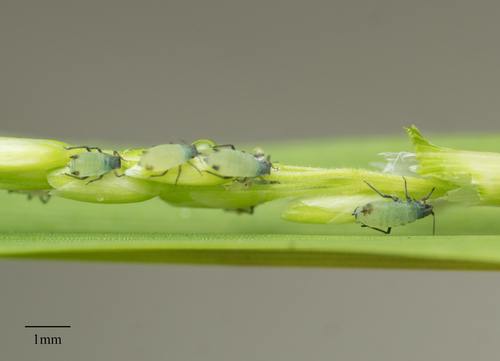
Verbatim
e0“Rhopalosiphum maidis was the predominant aphid migrating into the 1991–1992 crop”
e1“winter wheat crop”
Claim · model-written summary
BYDV-RMV incidence was three times higher in untreated plots in 1991–1992.
- Taxon
- winter wheatTriticum aestivume1
- Treatment
- imidacloprid-treated plotse0
- Interactor
- BYDV-RMVe0pathogen
- Outcome
- incidence of the BYDV-RMV serotypee0
- Direction
- highere0
- Value
- three timese0
- Comparator
- nontreated plotse0
Organisms pictured · Representative pictures of the matched species, not figures from the paper.
Verbatim
e0“The incidence of the BYDV-RMV serotype was three times higher in nontreated plots than in imidacloprid-treated plots”
e1“winter wheat crop”
Claim · model-written summary
R. maidis and R. padi predominated among migrating aphids in 1992–1993 and 1994–1995.
- Taxon
- winter wheatTriticum aestivume1
- Interactor
- R. maidisRhopalosiphum maidise0pest
- Second interactor
- R. padi
 Rhopalosiphum padie0pest
- Outcome
- predominant aphids migrating into the crope0
Organisms pictured · Representative pictures of the matched species, not figures from the paper.

Verbatim
e0“In the 1992–1993 and 1994–1995 seasons, R. maidis and R. padi were the predominant aphids migrating into the crop”
e1“winter wheat crop”
Claim · model-written summary
R. padi predominated among colonizing aphids in those seasons.
- Taxon
- winter wheatTriticum aestivume1
- Interactor
- R. padiRhopalosiphum padie0pest
- Outcome
- predominant colonizing aphide0
Organisms pictured · Representative pictures of the matched species, not figures from the paper.
Verbatim
e0“R. padi was the predominant colonizing aphid”
e1“winter wheat crop”
Claim · model-written summary
BYDV-RMV incidence was similar in treated and untreated plots in 1992–1993.
- Taxon
- winter wheatTriticum aestivume1
- Treatment
- imidacloprid treatede0
- Interactor
- BYDV-RMVe0pathogen
- Outcome
- incidence of BYDV-RMVe0
- Direction
- similare0
- Comparator
- nontreated plotse0
Organisms pictured · Representative pictures of the matched species, not figures from the paper.
Verbatim
e0“The incidence of BYDV-RMV was similar in imidacloprid treated and nontreated plots in 1992–1993”
e1“winter wheat crop”
Claim · model-written summary
BYDV-PAV incidence was significantly lower in treated plots in 1992–1993.
- Taxon
- winter wheatTriticum aestivume2
- Treatment
- treated plotse0
- Interactor
- BYDV-PAVe0pathogen
- Outcome
- incidence of the BYDV-PAV serotypee0
- Direction
- lesse0
- Comparator
- nontreated plotse1
Organisms pictured · Representative pictures of the matched species, not figures from the paper.
Verbatim
e0“the incidence of the BYDV-PAV serotype was significantly less in the treated plots”
e1“nontreated plots in 1992–1993”
e2“winter wheat crop”
Claim · model-written summary
BYDV-PAV incidence was higher in untreated than treated plots in 1994–1995.
- Taxon
- winter wheatTriticum aestivume1
- Treatment
- imidacloprid-treated plotse0
- Interactor
- BYDV-PAVe0pathogen
- Outcome
- incidence of both BYDV-PAV and BYDV-RMVe0
- Direction
- highere0
- Comparator
- nontreated plotse0
Organisms pictured · Representative pictures of the matched species, not figures from the paper.
Verbatim
e0“In 1994–1995, the incidence of both BYDV-PAV and BYDV-RMV was higher in the nontreated plots than in the imidacloprid-treated plots”
e1“winter wheat crop”
Claim · model-written summary
BYDV-RMV incidence was higher in untreated than treated plots in 1994–1995.
- Taxon
- winter wheatTriticum aestivume1
- Treatment
- imidacloprid-treated plotse0
- Interactor
- BYDV-RMVe0pathogen
- Outcome
- incidence of both BYDV-PAV and BYDV-RMVe0
- Direction
- highere0
- Comparator
- nontreated plotse0
Organisms pictured · Representative pictures of the matched species, not figures from the paper.
Verbatim
e0“In 1994–1995, the incidence of both BYDV-PAV and BYDV-RMV was higher in the nontreated plots than in the imidacloprid-treated plots”
e1“winter wheat crop”
The same questions in other papers
imidacloprid · disease · Triticum aestivum (wheat)Positive and negative results
2 in the opposite direction
- positive
- positive
Claims are grouped by organism, treatment and what was measured or targeted. A paper counts as positive when any of its claims in the group is positive.