Abstract
Penicillium oxalicum , a biocontrol agent for Fusarium oxysporum f.sp. lycopersici , was tested for its ability to induce resistance against tomato wilt. P. oxalicum and F. oxysporum f.sp. lycopersici were placed at separate sites on tomato plants or in soil, avoiding a direct interaction between the fungi. P. oxalicum induced resistance as expressed by a reduction in disease severity, area under disease progress curve and stunting induced by the pathogen. P. oxalicum colonized the tomato rhizosphere during the experiments but it was not detected inside stems, demonstrating that P. oxalicum and Fusarium oxysporum f.sp. lycopersici remained spatially separated. Biological control was observed both in sensitive and ‘resistant’ cultivars, indicating the role of a general resistance mechanism. In both cultivars P. oxalicum treatment alone did not produce disease symptoms. Therefore P. oxalicum could be a suitable biocontrol agent in cases of cultivar resistance failure. These results suggest that P. oxalicum can trigger defence mechanisms in the plant.
Abstract from the paper’s OpenAlex record, shown for indexing and research. Copyright remains with the authors or the publisher. Read at the source ↗
The text the model read, with the source record’s inline markup (italics, sub- and superscripts) rendered and its character entities decoded; quote offsets refer to the raw text.
Claims 7
Claim · model-written summary
P. oxalicum reduced tomato wilt severity, disease progress, and pathogen induced stunting.
- Taxon
- tomato
 Solanum lycopersicumt0
- Treatment
- P. oxalicume0
- Interactor
- pathogene0pathogen
- Second interactor
- P. oxalicum
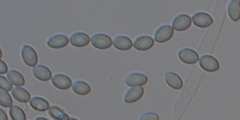 Penicillium oxalicume0biocontrol_agent
- Outcome
- disease severity, area under disease progress curve and stuntinge0
- Direction
- reductione0
Not reportedComparator
Organisms pictured · Representative pictures of the matched species, not figures from the paper.


Verbatim
e0“P. oxalicum induced resistance as expressed by a reduction in disease severity, area under disease progress curve and stunting induced by the pathogen”
t0“tomato”
Claim · model-written summary
P. oxalicum colonized the tomato rhizosphere.
- Taxon
- tomatoSolanum lycopersicume0
- Interactor
- P. oxalicumPenicillium oxalicume0biocontrol_agent
- Outcome
- colonized the tomato rhizospheree0
Not reportedDirection
Organisms pictured · Representative pictures of the matched species, not figures from the paper.
Verbatim
e0“P. oxalicum colonized the tomato rhizosphere”
Claim · model-written summary
P. oxalicum was not detected inside stems.
- Taxon
- tomatoSolanum lycopersicumt0
- Interactor
- P. oxalicumPenicillium oxalicume0biocontrol_agent
- Outcome
- not detected inside stemse0
Not reportedDirection
Organisms pictured · Representative pictures of the matched species, not figures from the paper.
Verbatim
e0“P. oxalicum colonized the tomato rhizosphere during the experiments but it was not detected inside stems”
t0“tomato”
Claim · model-written summary
Biological control occurred in both sensitive and resistant cultivars.
- Taxon
- tomatoSolanum lycopersicumt0
- Treatment
- Biological controle0
- Interactor
- Penicillum oxalicumt0biocontrol_agent
- Outcome
- observed both in sensitive and ‘resistant’ cultivarse0
Not reportedComparatorDirection
Organisms pictured · Representative pictures of the matched species, not figures from the paper.
Verbatim
e0“Biological control was observed both in sensitive and ‘resistant’ cultivars”
t0“Involvement of resistance induction by Penicillum oxalicum in the biocontrol of tomato wilt”
Claim · model-written summary
P. oxalicum alone caused no disease symptoms in either cultivar.
- Taxon
- tomatoSolanum lycopersicumt0
- Treatment
- P. oxalicum treatment alonee0
- Interactor
- P. oxalicumPenicillium oxalicume0biocontrol_agent
- Outcome
- disease symptomse0
- Direction
- did not producee0
Not reportedComparator
Organisms pictured · Representative pictures of the matched species, not figures from the paper.
Verbatim
e0“In both cultivars P. oxalicum treatment alone did not produce disease symptoms”
t0“tomato”
Claim · model-written summary
The authors suggest P. oxalicum can trigger plant defence mechanisms.
- Taxon
- tomatoSolanum lycopersicumt0
- Interactor
- P. oxalicumPenicillium oxalicume0biocontrol_agent
- Outcome
- defence mechanisms in the plante0
Organisms pictured · Representative pictures of the matched species, not figures from the paper.
Verbatim
e0“P. oxalicum can trigger defence mechanisms in the plant”
t0“tomato”
Claim · model-written summary
The authors propose P. oxalicum for biocontrol when cultivar resistance fails.
- Taxon
- tomatoSolanum lycopersicumt0
- Interactor
- P. oxalicumPenicillium oxalicume0biocontrol_agent
- Outcome
- suitable biocontrol agent in cases of cultivar resistance failuree0
Organisms pictured · Representative pictures of the matched species, not figures from the paper.
Verbatim
e0“P. oxalicum could be a suitable biocontrol agent in cases of cultivar resistance failure”
t0“tomato”
The same questions in other papers
Penicillium oxalicum · disease · Solanum lycopersicum (tomato)Results agree
1 paper in the same direction as this paper
- positive
biocontrol · disease · Solanum lycopersicum (tomato)Positive and negative results
37 papers in the same direction as this paper · 1 in the opposite direction
- no effect
- positive
- positive
35 papers more in this group
See all 39 papers →Claims are grouped by organism, treatment and what was measured or targeted. A paper counts as positive when any of its claims in the group is positive.