Abstract
The residual effect of a few herbicides viz: Atrataf (atrazine), 2,4-D and Aresin (monolinuron) sprayed in the previous season on the pigment concentration and primary productivity of the crops (viz: Zea mays and Cajanus cajan) grown in rotation, as well as their associated weeds has been studied. The results indicate that the residues of all the three herbicides were non toxic to Zea mays and toxic to Cajanus cajan as an increase in chlorophyll content and primary productivity occurred in the former, whereas the contrary is true for the latter. Weeds from residual plots have shown a considerable decrease in the chlorophyll content and primary productivity. The most susceptible weed to all the three herbicides was Acalypha malabarica, while Echinochloa colonum is susceptible to the residues of Atrazine but is tolerant to the residues of the other two herbicides. Recommendations based on the observations are presented in the paper.
Abstract from the paper’s OpenAlex record; open copy licensed cc-by. Read at the source ↗
The text the model read, with the source record’s inline markup (italics, sub- and superscripts) rendered and its character entities decoded; quote offsets refer to the raw text.
Claims 6
Claim · model-written summary
Residues of all three herbicides increased chlorophyll content and primary productivity in Zea mays.
- Treatment
- residues of all the three herbicidese0
- Outcome
- chlorophyll content and primary productivitye0
- Direction
- increasee0
 Zea mays
Not reportedComparator
Organisms pictured · Representative pictures of the matched species, not figures from the paper.

Verbatim
e0“residues of all the three herbicides were non toxic to Zea mays and toxic to Cajanus cajan as an increase in chlorophyll content and primary productivity occurred in the former”
Claim · model-written summary
Residues of all three herbicides decreased chlorophyll content and primary productivity in Cajanus cajan.
- Taxon
- Cajanus cajan
 Cajanus cajane0
- Treatment
- residues of all the three herbicidese0
- Outcome
- chlorophyll content and primary productivitye0
- Direction
- decreaseinferrede0
Not reportedComparator
Organisms pictured · Representative pictures of the matched species, not figures from the paper.

Verbatim
e0“residues of all the three herbicides were non toxic to Zea mays and toxic to Cajanus cajan as an increase in chlorophyll content and primary productivity occurred in the former, whereas the contrary is true for the latter”
Claim · model-written summary
Weeds in residual plots had lower chlorophyll content and primary productivity.
- Taxon
- cropst0
- Treatment
- residual plotse0
- Interactor
- Weedse0weed
- Outcome
- chlorophyll content and primary productivitye0
- Direction
- decreasee0
Not reportedComparator
Verbatim
e0“Weeds from residual plots have shown a considerable decrease in the chlorophyll content and primary productivity”
t0“succeeding crops and associated weeds”
Claim · model-written summary
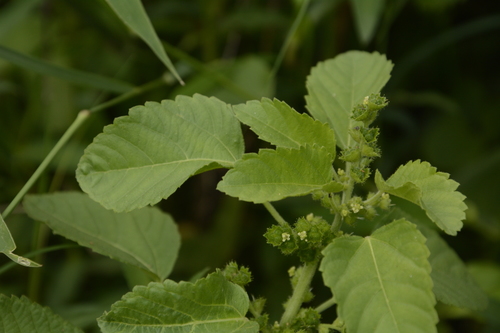
Acalypha malabarica was the most susceptible weed to all three herbicides.
- Taxon
- cropst0
- Interactor
- Acalypha malabarica
 Acalypha malabaricae0weed
- Outcome
- most susceptible weede0
Organisms pictured · Representative pictures of the matched species, not figures from the paper.
Verbatim
e0“The most susceptible weed to all the three herbicides was Acalypha malabarica”
t0“succeeding crops”
Claim · model-written summary
Echinochloa colonum was susceptible to Atrazine residues.
- Taxon
- cropst0
- Interactor
- Echinochloa colonum
 Echinochloa colonae0weed
- Outcome
- susceptible to the residues of Atrazinee0
Organisms pictured · Representative pictures of the matched species, not figures from the paper.

Verbatim
e0“Echinochloa colonum is susceptible to the residues of Atrazine”
t0“succeeding crops”
Claim · model-written summary
Echinochloa colonum tolerated residues of the other two herbicides.
- Taxon
- cropst0
- Interactor
- Echinochloa colonumEchinochloa colonae0weed
- Outcome
- tolerant to the residues of the other two herbicidese0
Organisms pictured · Representative pictures of the matched species, not figures from the paper.
Verbatim
e0“Echinochloa colonum is susceptible to the residues of Atrazine but is tolerant to the residues of the other two herbicides”
t0“succeeding crops”
The same questions in other papers
herbicide · physiology: pigments · Zea mays (maize)Positive and negative results
5 papers in the same direction as this paper · 11 in the opposite direction
- negative
- negative
- negative
13 papers more in this group
See all 17 papers →Claims are grouped by organism, treatment and what was measured or targeted. A paper counts as positive when any of its claims in the group is positive.