Abstract
Asparagine synthetase (AS) mRNA in Pisum sativum accumulates preferentially in plants grown in the dark. Nuclear run-on experiments demonstrate that expression of both the AS1 and AS2 genes is negatively regulated by light at the level of transcription. A decrease in the transcriptional rate of the AS1 gene can be detected as early as 20 min after exposure to light. Time course experiments reveal that the levels of AS mRNA fluctuate dramatically during a "normal" light/dark cycle. This is due to a direct effect of light and not to changes associated with circadian rhythm. A novel finding is that the light-repressed expression of the AS1 gene is as dramatic in nonphotosynthetic organs such as roots as it is in leaves. Experiments demonstrate that the small amount of light which passes through the soil is sufficient to repress AS1 expression in roots, indicating that light has a direct effect on AS1 gene expression in roots. The negative regulation of AS gene expression by light was shown to be a general phenomenon in plants which also occurs in nonlegumes such as Nicotiana plumbaginifolia and Nicotiana tabacum. Thus, the AS genes can serve as a model with which to dissect the molecular basis for light-regulated transcriptional repression in plants.
Abstract from the paper’s OpenAlex record, shown for indexing and research. Copyright remains with the authors or the publisher. Read at the source ↗
The text the model read, with the source record’s inline markup (italics, sub- and superscripts) rendered and its character entities decoded; quote offsets refer to the raw text.
Claims 9
Claim · model-written summary
AS mRNA accumulates preferentially in dark-grown Pisum sativum.
- Taxon
- Pisum sativum
 Lathyrus oleraceuse0
- Gene
- Asparagine synthetase (AS)e0
- Outcome
- AS) mRNAe0
- Direction
- preferentiallye0
- Setting
- in the darke0
Organisms pictured · Representative pictures of the matched species, not figures from the paper.

Verbatim
e0“Asparagine synthetase (AS) mRNA in Pisum sativum accumulates preferentially in plants grown in the dark.”
Claim · model-written summary
Light negatively regulates transcription of AS1 and AS2.
- Taxon
- Pisum sativumLathyrus oleraceuse1
- Treatment
- lighte0
- Gene
- AS1 and AS2e0
- Outcome
- expression of both the AS1 and AS2 genese0
- Direction
- negatively regulatede0
Not reportedComparator
Organisms pictured · Representative pictures of the matched species, not figures from the paper.
Verbatim
e0“expression of both the AS1 and AS2 genes is negatively regulated by light at the level of transcription”
e1“Asparagine synthetase (AS) mRNA in Pisum sativum”
Claim · model-written summary
AS1 transcription decreases within 20 min of light exposure.
- Taxon
- Pisum sativumLathyrus oleraceuse1
- Treatment
- exposure to lighte0
- Gene
- AS1e0
- Outcome
- transcriptional ratee0
- Direction
- decreasee0
- Value
- 20 mine0
Not reportedComparator
Organisms pictured · Representative pictures of the matched species, not figures from the paper.
Verbatim
e0“A decrease in the transcriptional rate of the AS1 gene can be detected as early as 20 min after exposure to light.”
e1“Pisum sativum”
Claim · model-written summary
AS mRNA levels fluctuate during a normal light/dark cycle.
- Taxon
- Pisum sativumLathyrus oleraceuse1
- Gene
- ASe0
- Outcome
- levels of AS mRNAe0
- Setting
- "normal" light/dark cyclee0
Organisms pictured · Representative pictures of the matched species, not figures from the paper.
Verbatim
e0“the levels of AS mRNA fluctuate dramatically during a "normal" light/dark cycle”
e1“Pisum sativum”
Claim · model-written summary
The AS mRNA fluctuation is attributed directly to light rather than circadian rhythm.
- Taxon
- Pisum sativumLathyrus oleraceuse2
- Treatment
- lighte0
- Outcome
- levels of AS mRNA fluctuatee1
- Qualifier
- not to changes associated with circadian rhythme0
Organisms pictured · Representative pictures of the matched species, not figures from the paper.
Verbatim
e0“This is due to a direct effect of light and not to changes associated with circadian rhythm.”
e1“the levels of AS mRNA fluctuate dramatically during a "normal" light/dark cycle”
e2“Pisum sativum”
Claim · model-written summary
Light represses AS1 expression in roots as strongly as in leaves.
- Taxon
- Pisum sativumLathyrus oleraceuse1
- Organ / stage
- rootse0
- Treatment
- lighte0
- Gene
- AS1e0
- Outcome
- expression of the AS1 genee0
- Direction
- light-repressede0
- Comparator
- leavese0
Organisms pictured · Representative pictures of the matched species, not figures from the paper.
Verbatim
e0“the light-repressed expression of the AS1 gene is as dramatic in nonphotosynthetic organs such as roots as it is in leaves”
e1“Pisum sativum”
Claim · model-written summary
Light passing through soil suffices to repress root AS1 expression.
- Taxon
- Pisum sativumLathyrus oleraceuse1
- Organ / stage
- rootse0
- Treatment
- light which passes through the soile0
- Gene
- AS1e0
- Outcome
- AS1 expressione0
- Direction
- represse0
Not reportedComparator
Organisms pictured · Representative pictures of the matched species, not figures from the paper.
Verbatim
e0“the small amount of light which passes through the soil is sufficient to repress AS1 expression in roots”
e1“Pisum sativum”
Claim · model-written summary
Light negatively regulates AS gene expression in Nicotiana plumbaginifolia.
- Taxon
- Nicotiana plumbaginifolia
 Nicotiana plumbaginifoliae0
- Treatment
- lighte0
- Gene
- ASe0
- Outcome
- AS gene expressione0
- Direction
- negative regulatione0
Not reportedComparator
Organisms pictured · Representative pictures of the matched species, not figures from the paper.
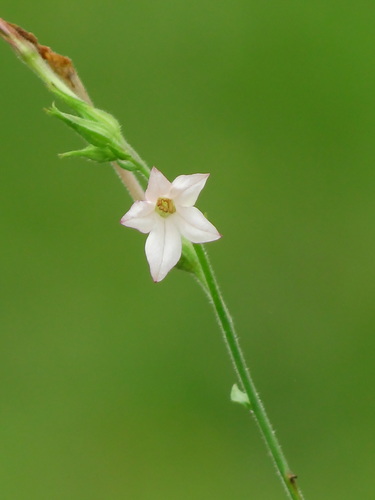
Verbatim
e0“negative regulation of AS gene expression by light was shown to be a general phenomenon in plants which also occurs in nonlegumes such as Nicotiana plumbaginifolia and Nicotiana tabacum”
Claim · model-written summary
Light negatively regulates AS gene expression in Nicotiana tabacum.
- Taxon
- Nicotiana tabacum
 Nicotiana tabacume0
- Treatment
- lighte0
- Gene
- ASe0
- Outcome
- AS gene expressione0
- Direction
- negative regulatione0
Not reportedComparator
Organisms pictured · Representative pictures of the matched species, not figures from the paper.

Verbatim
e0“negative regulation of AS gene expression by light was shown to be a general phenomenon in plants which also occurs in nonlegumes such as Nicotiana plumbaginifolia and Nicotiana tabacum”
The same questions in other papers
light · molecular: expression · Nicotiana tabacum (tobacco)Positive and negative results
5 papers in the same direction as this paper · 9 in the opposite direction
- positive
- positive
- positive
11 papers more in this group
See all 15 papers →light · molecular: expression · Lathyrus oleraceus (pea)Positive and negative results
8 papers in the same direction as this paper · 18 in the opposite direction
- no effect
- positive
- positive
23 papers more in this group
See all 27 papers →Claims are grouped by organism, treatment and what was measured or targeted. A paper counts as positive when any of its claims in the group is positive.