View: List Claim type Research area Organism Taxon as written Decade Paper Intervention effect observed original result no effect measured Claim · model-written summary
No tillage did not decrease maize grain yield relative to conventional tillage.
maize grain yield e0 without decreasing e0 Verbatim
e0 “No tillage increased the SOC accumulation in the topsoil layer, reduced CO2 emissions without decreasing maize grain yield and minimized the impact on climate change compared to CT system. ”
✓ located verbatim in the source · abstract, characters 1318–1506 t0 “maize ”
✓ located verbatim in the source · title, characters 108–113 Other claims from this paper (6) Intervention effect observed original result no effect not significant (as stated) measured Claim · model-written summary
No-till sorghum yield ed 1.44 t/ha versus 1.51 t/ha with traditional cultivation; the authors reported no decrease .
no-till technology e0 traditional methods e0 Verbatim
e0 “The yield of sorghum cultivated with traditional methods was 1.51 t/ha and 1.44 t/ha in the case of no-till technology (the least significant difference (0.5) is 0.21 t/ha). That means there is no decrease in yield in terms of direct seeding ”
✓ located verbatim in the source · abstract, characters 818–1059 Other claims from this paper (9) Intervention effect observed original result no effect not significant (as stated) measured Claim · model-written summary
The highest waste rate did not significantly reduce yield .
highest application rate e0 no significant decrease e0 Not reported Taxon Comparator
Verbatim
e0 “There was no significant decrease in yield at the highest application rate ”
✓ located verbatim in the source · abstract, characters 521–595 Other claims from this paper (8) Intervention effect observed original result no effect measured Claim · model-written summary
The decrease in fruit number and fruit size with increased plant density did not affect overall yield per plot area.
determinate tomato cultivars e0 increased plant density e2 overall yield per plot area e1 did not have an effect e1 Not reported Comparator
Verbatim
e0 “Four determinate tomato cultivars ”
✓ located verbatim in the source · abstract, characters 289–322 e1 “which did not have an effect on overall yield per plot area ”
✓ located verbatim in the source · abstract, characters 1379–1438 e2 “Number of fruit per plant as well as fruit size decrease d with increased plant density ”
✓ located verbatim in the source · abstract, characters 1272–1358 Other claims from this paper (10) Intervention effect observed original result no effect not significant (as stated) measured Claim · model-written summary
Field bean, snap bean, russet potato, white potato, clover and Perfection pea did not undergo a significant dry matter yield decrease under added soil Zn.
10, 100, 200, 300, 400, and 500 ppm Zn e1 no_change inferred e0 Not reported Taxon Comparator
Verbatim
e0 “did not undergo a significant YD ”
✓ located verbatim in the source · abstract, characters 891–923 e1 “treated with 10, 100, 200, 300, 400, and 500 ppm Zn ”
✓ located verbatim in the source · abstract, characters 270–321 Other claims from this paper (7) Intervention effect observed original result no effect measured Claim · model-written summary
Foliar application did not decrease the K/Mg ratio to the desirable level.
Foliar application e0 did not decrease e0 Not reported Comparator
Verbatim
e0 “Foliar application did not decrease the K/Mg ratio to the desirable level ”
✓ located verbatim in the source · abstract, characters 1677–1750 t0 “Grape ”
✓ located verbatim in the source · title, characters 90–95 Other claims from this paper (8) Intervention effect observed original result no effect measured Claim · model-written summary
Ear net photosynthetic rate did not decrease under water stress.
did not decrease e0 Not reported Comparator
Verbatim
t0 “Barley ”
✓ located verbatim in the source · title, characters 114–120 e0 “PN of the ears was higher at high VPD than at low VPD, and did not decrease as response to water stress ”
✓ located verbatim in the source · abstract, characters 919–1022 Other claims from this paper (13) Intervention effect observed original result no effect not significant (as stated) simulated Claim · model-written summary
Transplanting did not significantly decrease net irrigation requirement at any planting date.
net irrigation requirement e0 did not significantly decrease e0 any of the planting dates e0 Not reported Comparator
Verbatim
e0 “transplanting did not significantly decrease the amount of net irrigation requirement at any of the planting dates ”
✓ located verbatim in the source · abstract, characters 2815–2929 t0 “Maize ”
✓ located verbatim in the source · title, characters 67–72 Other claims from this paper (19) Intervention effect At 10 June planting, transplanting matured maize 16 to 26 days earlier than direct seeding. Intervention effect At 10 June planting, transplanting had no effect on maize yield. Intervention effect At 10 June planting, transplanting had no effect on net irrigation requirement. Observation Mean maize yield at the early planting date was 1331 g m-2. Observation Mean net irrigation requirement at the early planting date was 435 mm ha-1. Intervention effect At 25 June planting, transplanting matured maize 19 to 33 days earlier than direct seeding. Intervention effect At 25 June planting, planting method had no effect on maize yield. Intervention effect At 25 June planting, planting method had no effect on net irrigation. Observation At 25 June planting, average maize yield was 1329 g m2. Observation At 25 June planting, water requirement was 416 mm ha-1. Observation At 14 July planting, maize transplants with large seedlings completed growth before 22 November. Observation At 14 July planting, average maize yield was 1273 g m-2. Observation At 14 July planting, irrigation requirement was 381 mm ha-1. Observation At 14 July planting, direct seeded maize did not mature by 22 November. Observation At 14 July planting, maize transplants with small seedlings did not mature by 22 November. Observation At 27 July planting, no cultivation type completed growth before 22 November. Recommendation The authors recommend transplanting large maize seedlings only for the late planting date. Intervention effect Transplanting had higher costs. Intervention effect Transplanting had lower profit. Intervention effect observed original result no effect measured Claim · model-written summary
Pre-emergence spray of 150 g 2,4-D per 10 ares did not decrease soybean yield .
pre-emergence spray of 150 grams of 2, 4-D per 10 ares e0 the yield of soybean e0 without decreasing e0 Not reported Comparator
Verbatim
e0 “The pre-emergence spray of 150 grams of 2, 4-D per 10 ares was considerably effective for the weed without decreasing the yield of soybean ”
✓ located verbatim in the source · abstract, characters 1015–1153 Other claims from this paper (17) Observation Crab grass is a dominant weed in both sweet potato and soybean fields. Observation Crab grass is resistant to 2,4-D. Observation Both sweet potato and soybean are susceptible to 2,4-D. Recommendation Post-emergence 2,4-D spray on these crops cannot be expected to be a practical weed-control means. Intervention effect Sweet potato yield under pre-planting 2,4-D equalled that of the weeded plot. Intervention effect Weeds were reduced to about 1/10 to 1/3 of those in the untreated plot after 2,4-D pre-planting treatment. Intervention effect All sweet potato slips planted after 2,4-D treatment took root and crop growth was not retarded. Intervention effect Sweet potato planted immediately after 2,4-D application was severely injured, particularly in the drought year. Intervention effect Moistening and dusting sweet potato roots with active carbon relieved the 2,4-D injury to some extent. Intervention effect Pre-emergence spray of 150 g 2,4-D per 10 ares was considerably effective against the weeds in soybean. Intervention effect A 2,4-D spray above 150 grams was injurious to soybean growth. Intervention effect Seeds coated with active carbon before sowing were not injured even by a spray of 450 g 2,4-D. Mechanism The absence of injury was attributed to a protecting action of active carbon. Intervention effect Between-row soil treatment with 2,4-D after tillage was more effective on annual weeds than pre-emergence treatment. Intervention effect Soybean was not injured by 100 g 2,4-D per 10 ares on dry soil. Intervention effect Soybean was not injured by 200 g 2,4-D on moist soil. Association Yield decreased as the amount of 2,4-D applied increased. Association observed original result no effect measured Claim · model-written summary
Grain weight did not decrease as common root rot severity increased.
Verbatim
t0 “wheat ”
✓ located verbatim in the source · title, characters 54–59 e1 “Grain yield , tiller and grain number, but not grain weight decrease d as disease severity increased ”
✓ located verbatim in the source · abstract, characters 543–641 e3 “common root rot (CRR) caused by Bipolaris sorokiniana ”
✓ located verbatim in the source · abstract, characters 15–68 Other claims from this paper (9) Lexical search (BM25). All words must match; if nothing does, any word. Organism names also match every spelling of the same organism. No semantic search yet.
 Zea mays
 Sorghum
 Hordeum vulgare
 Glycine max
 Triticum aestivum
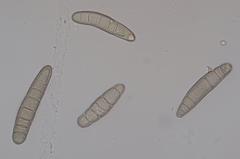 Bipolaris sorokiniana