View: List Claim type Research area Organism Taxon as written Decade Paper Intervention effect observed original result negative significant (as stated) measured Claim · model-written summary
Organic fields reduced cauliflower yield and floret weight by about 25% versus conventional fields.
Yield and florets weights e0 decrease inferred e0 about 25% on total average e0 Not reported Taxon
Verbatim
e0 “Yield and florets weights gave a significant decrease in OR (about 25% on total average) respect to CO. ”
✓ located verbatim in the source · abstract, characters 565–668 Title
Organic vs. conventional field trials: the effect on cauliflower quality.
R. Lo Scalzo; T. Iannoccari; A. Genna; et al. Cultivating the future based on science. Volume 2: Livestock, socio-economy and cross disciplinary research in organic agriculture. Proceedings of the Second Scientific Conference of the International Society of Organic Agriculture Research (ISOFAR), held at the 16th IFOAM Organic World Conference in Cooperation with the International Federation of Organic Agriculture Movements (IFOAM) and the Consorzio ModenaBio in Modena, Italy, 18-20 June, 2008. 2008
Other claims from this paper (7) Association observed original result negative significant (as stated) measured Claim · model-written summary
Weeds significantly decrease d crop yield in farmers fields.
Verbatim
e0 “major seasonal crops ”
✓ located verbatim in the source · abstract, characters 54–74 e1 “Study observed a significant decrease in crops yield due to various weeds found in farmers’ fields. ”
✓ located verbatim in the source · abstract, characters 1260–1359 Other claims from this paper (8) Intervention effect observed original result negative significant (as stated) measured Claim · model-written summary
Cold stress in open conditions significantly decrease d yield .
cold stress conditions in open e0 yield parameters e0 polyhouse conditions e0 Verbatim
e0 “significant decrease in the growth and yield parameters due to cold stress conditions in open as compared to polyhouse conditions ”
✓ located verbatim in the source · abstract, characters 639–768 t0 “marigold (Tagetes erecta ) ”
✓ located verbatim in the source · title, characters 46–71 Other claims from this paper (8) Association observed original result negative significant (as stated) measured Claim · model-written summary
Greater Xanthium density significantly reduced maize yield .
Verbatim
e0 “an increase in X. strumarium density causes a highly significant decrease in maize height, fresh weight, dry weight and leaf area at the 4-5 leaf growth stage, as well as maize yield ”
✓ located verbatim in the source · abstract, characters 768–950 Other claims from this paper (5) Intervention effect observed original result negative significant (as stated) measured Claim · model-written summary
Waterlogging significantly decrease d yield in all genotypes.
Not reported Comparator
Verbatim
e0 “Waterlogging was caused to decrease significantly grain yield in all genotypes. ”
✓ located verbatim in the source · abstract, characters 1060–1139 t0 “Evaluating the Waterlogging Tolerance of Faba Bean Genotypes at Different Growth Stages under Field Conditions ”
✓ located verbatim in the source · title, characters 0–110 Other claims from this paper (9) Association observed original result positive significant (as stated) measured Claim · model-written summary
Root yield significantly increased with decreasing soil water content under sample soil (S0).
decrease in soil water content e1 under sample soil (S0) e1 Verbatim
t0 “Secondary Metabolites in Stellaria dichotoma ”
✓ located verbatim in the source · title, characters 88–132 e1 “The result showed that root yield significantly increased with decrease in soil water content under sample soil (S0), while decrease d with decrease in soil water content under salt stressed soil (S1) ”
✓ located verbatim in the source · abstract, characters 460–659 Other claims from this paper (9) Intervention effect observed original result negative significant (as stated) measured Claim · model-written summary
In O. dubium , organic fertilizers significantly decrease d yield .
organic fertilizers e0 Not reported Comparator
Verbatim
e0 “In S. cypria , organic fertilization resulted in a similar yield compared to conventional fertilization, while O. dubium showed a significant decrease in yield when using organic fertilizers ”
✓ located verbatim in the source · abstract, characters 644–833 Other claims from this paper (9) Intervention effect observed original result negative significant (as stated) measured Claim · model-written summary
Salt stress significantly reduced yield and yield -attributing traits in setup B.
yield and yield-attributing traits e0 Verbatim
e0 “control and salt stress data obtained from setup B reflected a significant decrease in yield and yield -attributing traits ”
✓ located verbatim in the source · abstract, characters 1135–1256 t0 “wheat ”
✓ located verbatim in the source · title, characters 89–94 Other claims from this paper (7) Association observed original result negative significant (as stated) measured Claim · model-written summary
Greater viral disease intensity accompanied lower chilli yield and yield attributes.
viral complex e0 pathogen yield, yield attributes e0 significant increase in the intensity of the disease e0 Verbatim
e0 “significant increase in the intensity of the disease (viral complex) and there was a corresponding decrease in the yield , yield attributes of the chilli crop ”
✓ located verbatim in the source · abstract, characters 734–891 Other claims from this paper (6) Observation observed original result significant (as stated) measured Claim · model-written summary
For dry matter, the haycut WA-HWA contrast showed a significant linear decrease over time.
significant trends over time e0 linear decrease e0 haycut WA-HWA contrast e0 Verbatim
e0 “significant trends over time (P<0.05) occurred in the haycut WA-HWA contrast (linear decrease ) ”
✓ located verbatim in the source · abstract, characters 1734–1828 t0 “lucerne ”
✓ located verbatim in the source · title, characters 90–97 Other claims from this paper (19) Observation In experiment 1, haycut plots of WD cultivar WL3 18 had the highest total 4-year yield (35 690 kg/ha). Observation In experiment 1, haycut plots of aphid-susceptible SWD cultivar 77-B-1545 had the lowest total 4-year yield (25 255 kg/ha). Observation In grazed plots of experiment 1, HWA cultivar CUF101 had the highest yield (20 091 kg/ha). Observation In grazed plots of experiment 1, cultivar 77-B-1545 had the lowest yield (12 127 kg/ha). Observation In experiment 1, frequency of all cultivars in haycut plots declined from 71 to 49%. Observation In experiment 1, mean frequency decreased from 68 to 11% in grazed plots. Observation Grazed-plot mean frequency was not significantly different between cultivars after 4 years in experiment 1. Observation In experiment 2, haycut plots of SWD cultivar Pioneer Brand 581 had the highest total 3.5-year yield (21 213 kg/ha). Observation In experiment 2, grazed plots of HWA cultivar WL514 had the highest total 3.5-year yield (11611 kg/ha). Observation In experiment 2, frequency of all cultivars in haycut plots decreased from 89 to 61%. Observation In experiment 2, frequency in grazed plots decreased from 90 to 12%. Observation There were no significant differences between cultivars in either treatment at the end of experiment 2. Observation In grazed plots of experiment 1, dry matter showed a linear decrease for WD-SWD and a concave quadratic trend for WA-HWA. Observation Under both grazing and haycutting in experiment 1, the dormant versus active contrasts were linear and increased with time. Observation Haycut WA-HWA plant frequency increased linearly with time. Observation With grazing, WD cultivars had significantly higher plant frequency than the SWD class. Observation D-A plant-frequency contrasts were significant and cubic in experiment 1 and concave quadratic in experiment 2. Observation The grazed yield of the active lucernes was always greater than that of the dormants. Observation Persistence after 4 years of grazing was similar across dormancy classes. Lexical search (BM25). All words must match; if nothing does, any word. Organism names also match every spelling of the same organism. No semantic search yet.
 Zea mays
 Xanthium strumarium
 Vicia faba
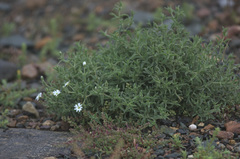 Mesostemma dichotomum
 Origanum majorana
 Triticum aestivum
 Medicago sativa