View: List Claim type Research area Organism Taxon as written Decade Paper Association observed original result negative measured Claim · model-written summary
Exotic cytoplasms in upland cotton backgrounds tended to decrease lint yield .
upland cotton backgrounds e1 exotic cytoplasms e1 Verbatim
t0 “UPLAND COTTON ”
✓ located verbatim in the source · title, characters 71–84 e1 “When transferred into upland cotton backgrounds, the exotic cytoplasms in general tended to decrease lint yield ”
✓ located verbatim in the source · abstract, characters 379–490 Other claims from this paper (5) Intervention effect observed original result negative measured Claim · model-written summary
Later spring seeding tended to decrease alfalfa dry matter yield .
Seeding alfalfa later e0 alfalfa dry matter (DM) yield e0 Verbatim
e0 “Seeding alfalfa later, compared with earlier, in the spring tended to increase weed and decrease alfalfa dry matter (DM) yield ”
✓ located verbatim in the source · abstract, characters 1037–1163 Other claims from this paper (14) Association author interpretation original result negative measured Claim · model-written summary
The authors conclude thermal time has a greater influence on yield decrease across harvest cycles.
different harvest cycles e0 Verbatim
e0 “thermal time has greater influence on yield decrease of sugarcane with different harvest cycles ”
✓ located verbatim in the source · abstract, characters 1254–1349 Other claims from this paper (13) Observation observed original result negative measured Claim · model-written summary
Navy beans showed a slight decrease in genetic yield trend.
slight decrease e0 Verbatim
e0 “navy beans and small red beans show a slight decrease ”
✓ located verbatim in the source · abstract, characters 1498–1551 e1 “positive trend in yield for black beans ”
✓ located verbatim in the source · abstract, characters 1451–1490 Other claims from this paper (5) Intervention effect observed original result negative measured Claim · model-written summary
The imazamox fomesafen mixture tended to decrease lima bean height and yield .
imazamox fomesafen mixture e0 height and yield e0 Not reported Comparator
Verbatim
e0 “The imazamox fomesafen mixture caused significant visual injury and tended to decrease lima bean height and yield . ”
✓ located verbatim in the source · abstract, characters 600–714 Other claims from this paper (7) Intervention effect observed original result negative measured Claim · model-written summary
At 60 kg zinc sulphate, yield tended to decrease .
60 kg ZnSO 4 .7H 2 O/ha e0 Not reported Comparator
Verbatim
e0 “at higher zinc level (60 kg ZnSO 4 .7H 2 O/ha) the yield tended to decrease ”
✓ located verbatim in the source · abstract, characters 352–427 t0 “carrot (Daucus caroto L.) ”
✓ located verbatim in the source · abstract, characters 112–137 Other claims from this paper (11) Association observed review summary negative basis n/a Claim · model-written summary
Prior studies associate a 1°C temperature rise with a 5–10% rice yield decrease .
temperature increases of merely 1°C e0 Not reported Taxon
Verbatim
e0 “temperature increases of merely 1°C result in a 5–10% decrease in yield ”
✓ located verbatim in the source · abstract, characters 509–580 t0 “rice breeding ”
✓ located verbatim in the source · title, characters 25–38 Other claims from this paper (2) Intervention effect observed original result negative measured Claim · model-written summary
Lower-third defoliation caused the smallest seed yield decrease relative to control.
lower 1/3 defoliation e0 lowest decrease e0 Not reported Comparator
Verbatim
e0 “the lowest decrease was observed in the lower 1/3 defoliation level ”
✓ located verbatim in the source · abstract, characters 1238–1305 t0 “Safflower ”
✓ located verbatim in the source · title, characters 119–128 Other claims from this paper (16) Intervention effect observed original result negative measured Claim · model-written summary
Intercropping caused a 2–7% yield decrease in egusi melon.
Not reported Comparator
Verbatim
e2 “Intercropping did not significantly influence bunch yield of plantain but it caused a 2–7 and 20% yield decrease in egusi melon and water melon respectively ”
✓ located verbatim in the source · abstract, characters 472–628 Other claims from this paper (6) Intervention effect author interpretation original result negative measured Claim · model-written summary
Reducing plant density to save water may decrease rather than increase wheat yield under water-limited conditions.
reducing the density e1 Not reported Comparator
Verbatim
e1 “reducing the density of palnts to reduce water use may decrease rather than increase wheat yield under water limited conditions ”
✓ located verbatim in the source · abstract, characters 1397–1524 Other claims from this paper (8) Lexical search (BM25). All words must match; if nothing does, any word. Organism names also match every spelling of the same organism. No semantic search yet.
 Medicago sativa
 Phaseolus lunatus
 Daucus carota
 Carthamus tinctorius
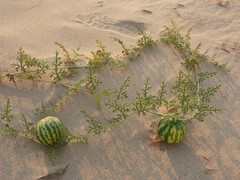 Citrullus mucosospermus
 Triticum aestivum