View: List Claim type Research area Organism Taxon as written Decade Paper Association observed original result measured Claim · model-written summary
A delay in inoculation after the 25-day stage was negatively correlated with yield losses.
Delay in inoculation after the 25 day stage e4 decrease inferred e4 Verbatim
e1 “Soybean crop inoculated with Myrothecium roridum at different days after sowing ”
✓ located verbatim in the source · abstract, characters 0–79 e4 “Delay in inoculation after the 25 day stage had a negative correlation with yield losses and a further delay of each day is likely to reduce the losses by 0.18 q/ha ”
✓ located verbatim in the source · abstract, characters 544–708 Other claims from this paper (8) Intervention effect observed original result no effect measured Claim · model-written summary
Irrigating grapevine by the crop criterion did not affect yield compared with growers criteria.
crop criterion (CC) to irrigate e2 did not affect e1 growers criteria e1 Verbatim
t0 “Crop Coefficient Use as a Criterion to Irrigate to Save Water on Grapevines ”
✓ located verbatim in the source · title, characters 0–75 e2 “the crop criterion (CC) to irrigate is adequate to decrease the water-use efficient ”
✓ located verbatim in the source · abstract, characters 338–421 e1 “Our results indicate that water consumption using CC is 90 cm/year vs. 147–187 cm/year with growers criteria, the use of which did not affect yield ”
✓ located verbatim in the source · abstract, characters 852–999 Other claims from this paper (1) Intervention effect observed original result negative measured Claim · model-written summary
Water stress slightly reduced the in vivo quantum yield of PS2 photochemistry (ΦPS2) and the photochemical quenching coefficient (qP) in sorghum.
quantum yield of PS2 photochemistry (ΦPS2) and the photochemical quenching coefficient (qP) e2 slightly reduced e2 Not reported Comparator
Verbatim
t0 “Two Hybrids of Sorghum ”
✓ located verbatim in the source · title, characters 47–69 e1 “Water stress caused a slight decrease in the efficiency of excitation capture by open PS2 reaction centres (Fv/Fm) ”
✓ located verbatim in the source · abstract, characters 865–979 e2 “The in vivo quantum yield of PS2 photochemistry (ΦPS2) and the photochemical quenching coefficient (qP) were slightly reduced ”
✓ located verbatim in the source · abstract, characters 981–1106 Other claims from this paper (11) Intervention effect observed original result negative measured Claim · model-written summary
'Fairway' crested wheatgrass was the least susceptible species to glyphosate plus 2,4-D, with average yield at 97% of untreated controls.
glyphosate plus 2,4-D e3 decrease inferred e3 untreated controls of each species e3 Verbatim
e3 “intermediate wheatgrass was the most and ‘Fairway’ crested wheatgrass the least susceptible to glyphosate plus 2,4-D with average yield s of 57 and 97% compared with untreated controls of each species, respectively ”
✓ located verbatim in the source · abstract, characters 501–714 Other claims from this paper (7) Intervention effect Fall glyphosate at 0.2 kg ae/ha, alone or with 2,4-D, left average grass yield at 98% of untreated controls. Intervention effect Fall glyphosate at 0.4 kg ae/ha, alone or with 2,4-D, left average grass yield at 87% of untreated controls. Intervention effect In a native rangeland site, Western wheatgrass production decreased more than any other species after spring or fall glyphosate application. Intervention effect Intermediate wheatgrass was the most susceptible species to glyphosate plus 2,4-D, with average yield at 57% of untreated controls. Intervention effect Glyphosate reduced the yield of 'Nordan' standard crested wheatgrass more than that of Fairway or other diploid cultivars. Association The greater the spring precipitation after a fall glyphosate application, the less glyphosate affected forage yield. Recommendation Glyphosate plus 2,4-D can be used for weed control in pasture and rangeland if some yield reduction is acceptable. Intervention effect observed original result negative measured Claim · model-written summary
In 1985 WS1 lowered grain weight of second category shoots.
grain weight of the second category shoots e0 Not reported Treatment Comparator
Verbatim
e0 “In the second year (1985) additionally a lower grain weight of the second category shoots caused by a reduction of the number of kernels per ear contributed to the decrease of the single plant yield . ”
✓ located verbatim in the source · abstract, characters 1285–1484 t0 “Spring Wheat ”
✓ located verbatim in the source · title, characters 123–135 Other claims from this paper (7) Intervention effect observed original result negative measured Claim · model-written summary
Ratoon stunting disease reduced sugarcane yield , with average 3-year losses of 29 to 60 t/ha across seven cultivars.
ratoon stunting disease e1 decrease inferred e1 Not reported Comparator
Verbatim
t0 “Effect of Ratoon Stunting Disease on Yield of Sugarcane Grown in Multiple Three-Year Plantings ”
✓ located verbatim in the source · title, characters 0–94 e1 “Yield losses in sugarcane caused by ratoon stunting disease were observed for seven of eight cultivars tested in four to six crop cycles of 3-yr plantings ”
✓ located verbatim in the source · abstract, characters 0–154 e2 “In the seven cultivars, average 3-yr losses ranged from 29 to 60 t/ha ”
✓ located verbatim in the source · abstract, characters 156–225 Other claims from this paper (6) Intervention effect observed original result positive measured Claim · model-written summary
Increasing N increased the size of pepper fruit in Trial 1.
Not reported Comparator
Verbatim
t0 “PEPPERS GROWN IN ROCKWOOL ”
✓ located verbatim in the source · title, characters 69–94 e1 “In Trial 1, increasing N did not affect the number of marketable fruit produced, but increased fruit size. ”
✓ located verbatim in the source · abstract, characters 574–680 Other claims from this paper (6) Observation observed original result measured Claim · model-written summary
Soil Ca, Mg and Fe availability decrease d to day 30, increased to day 40, then decrease d with higher N application.
Availability of Ca, Mg, Fe e0 increased up to 40 days followed by a decrease thereafter with the increase in rate of N application e0 Verbatim
t0 “Rice ”
✓ located verbatim in the source · title, characters 103–107 e0 “Availability of Ca, Mg, Fe, Mn, Zn and Cu in soil decrease d up to 30 days after transplanting, increased up to 40 days followed by a decrease thereafter with the increase in rate of N application. ”
✓ located verbatim in the source · abstract, characters 402–598 Other claims from this paper (11) Mechanism author interpretation original result negative measured Claim · model-written summary
Laboratory gas exchange curves suggested reduced Rubisco amount or activity caused the photosynthetic decline.
decline in photosynthetic capacity e0 Verbatim
e0 “the likely cause of the decline in photosynthetic capacity was (1) a decrease in the amount and/or activity of Rubisco ”
✓ located verbatim in the source · abstract, characters 2072–2190 t0 “watermelon yield and physiology at a rural site in Eastern Spain ”
✓ located verbatim in the source · title, characters 36–100 Other claims from this paper (16) Association observed original result significant (as stated) measured Claim · model-written summary
Seed size was associated with lower stand density (r = -0.33).
decrease inferred e4 Verbatim
e0 “growth and yield of 97 seedlots of Gungurm narrow-leafed lupins (Lupinus angustifolius L.) from Western Australia ”
✓ located verbatim in the source · abstract, characters 4–117 e4 “Seed size influenced (P<0.001) stand density (r = -0.33) and shoot dry weight (r = 0.58) but not grain yield (r = 0.09, n.s.) ”
✓ located verbatim in the source · abstract, characters 944–1069 Other claims from this paper (8) Lexical search (BM25). All words must match; if nothing does, any word. Organism names also match every spelling of the same organism. No semantic search yet.
 Glycine maxe1
 Vitis
 Sorghum
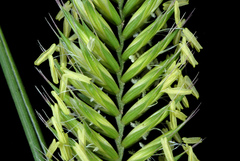 Agropyron cristatum
 Triticum aestivum
 Capsicum
 Oryza sativa
 Citrullus lanatus
 Lupinus angustifolius