View: List Claim type Research area Organism Taxon as written Decade Paper Intervention effect observed original result negative measured Claim · model-written summary
At high light, mixed nitrogen reduced nutrient uptake compared with all nitrate.
both N forms (80:20) e0 high light conditions e0 all NO3 treated plants e0 Verbatim
e0 “Plants supplied with both N forms (80:20) under high light conditions showed a decrease of nutrient uptake and produced low plant weight and yield compared to the all NO3 treated plants. ”
✓ located verbatim in the source · abstract, characters 166–352 Other claims from this paper (4) Association observed original result measured Claim · model-written summary
In test I, spider mites were negatively correlated with yield (r = −0.55*).
decrease inferred e3 Verbatim
t0 “Cotton, Gossypium hirsutum L. ”
✓ located verbatim in the source · title, characters 14–43 e3 “Correlation analyses of interest in test I were: spider mites with yield , percent first harvest, and yield first harvest, r = −0.55*,0.58*, and 0.25, respectively ”
✓ located verbatim in the source · abstract, characters 772–934 Other claims from this paper (9) Observation There were significant differences in spider mite numbers between cotton genotypes. Association Genotypes developed in the Mississippi delta had the lowest populations of spider mites. Association Okra-leaf cotton had significantly fewer spider mites than frego bract, smoothleaf, nectariless, glandless and normal isolines. Observation Cotton cultivars Camd-E, Coker 76-118, MO 311, MO 73-1203, UGA 220, TH 149, Delcot and Coker 201 tended to have high spider mite population numbers. Association In test I, spider mites were positively correlated with percent first harvest (r = 0.58*). Association In test I, spider mites were positively correlated with yield first harvest (r = 0.25). Association In test II, spider mites were negatively correlated with yield (r = −0.47*). Association In test II, spider mites were positively correlated with percent first harvest (r = 0.66**). Association In test II, spider mites were negatively correlated with yield first harvest (r = −0.07). Intervention effect observed original result positive measured Claim · model-written summary
On average, the yield advantage of mixtures over pure stands was small.
field experiments e0 Verbatim
e0 “The potential of selected cultivar mixtures to decrease lodging and consequently improve yield s in winter barley was examined in field experiments at two locations over 2 years ”
✓ located verbatim in the source · abstract, characters 8–184 e3 “On average, the yield advantage of mixtures compared with pure stands was small ”
✓ located verbatim in the source · abstract, characters 658–737 Other claims from this paper (8) Intervention effect observed original result positive measured Claim · model-written summary
Yield of fruit above 55 mm increased by about 3 t ha−1.
yield of fruits >55 mm e0 about 3 and 2 t ha−1 e0 Not reported Taxon Treatment Comparator
Verbatim
e0 “The increase in the yield of fruits >55 mm and decrease of unsaleable <45 mm fruits was equivalent to about 3 and 2 t ha−1 respectively ”
✓ located verbatim in the source · abstract, characters 932–1067 Other claims from this paper (19) Observation observed original result negative measured Claim · model-written summary
Meloidogyne attack reduced top growth and yield .
general top growth with or without chlorosis and yield e0 Verbatim
e0 “Symptoms of Meloidogyne attack include root galls (mostly terminal) consecutive with stopped longitudinal growth (characteristic roo ts), reduced stand, reduced tillering and panicle numbers as well as reduced general top growth with or without chlorosis and yield decrease . ”
✓ located verbatim in the source · abstract, characters 1217–1491 t0 “upland rice cultivars ”
✓ located verbatim in the source · title, characters 12–33 Other claims from this paper (13) Recommendation author interpretation original result basis n/a Claim · model-written summary
Selecting higher mineral concentrations was predicted to reduce yield , possibly except potassium.
selection for higher concentrations of any of these minerals e0 With the possible exception of potassium e0 Verbatim
e0 “With the possible exception of potassium, selection for higher concentrations of any of these minerals would result in a decrease in yield ”
✓ located verbatim in the source · abstract, characters 1504–1642 t0 “Setaria sphacelata
✓ located verbatim in the source · title, characters 38–56 Other claims from this paper (15) Observation Nitrogen, phosphorus, magnesium and calcium concentrations tended to be low in summer. Observation Potassium concentration fell over the two years. Observation Magnesium, calcium and sodium increased. Observation Genetic variance for digestibility occurred at only two of 14 harvests. Observation Additive genetic variance was significant and generally consistent for five elements. Observation Family interactions with season and year were small. Observation Additive variance effects for nine elements were erratic. Recommendation Higher or lower concentrations of those elements were unlikely to be selected successfully. Association Nitrogen, potassium, calcium, magnesium and sodium each correlated negatively with dry matter yield. Association Sodium was genetically negatively correlated with nitrogen, potassium, calcium and magnesium. Association Nitrogen, potassium, calcium and magnesium were mutually positively correlated. Recommendation Selecting any of four minerals at high concentration would increase the others and decrease sodium. Observation Genetic variation was detected in two mineral ratios. Recommendation Breeding manipulation of the ratios was not warranted. Recommendation The examples indicated potential to breed tropical forages for mineral ratios. Intervention effect author interpretation original result positive measured Claim · model-written summary
Reducing tapping frequency tended to increase total yield in clone PB 235.
reduction of tapping frequency e0 Not reported Comparator
Verbatim
t0 “Hevea brasiliensis
✓ located verbatim in the source · title, characters 61–79 e0 “In clone PB 235 which exhibited low latex sucrose, a reduction of tapping frequency resulted in an increase in sucrose level and in a decrease of bark “dryness” tending to an increase in total yield . ”
✓ located verbatim in the source · abstract, characters 756–955 Other claims from this paper (9) Intervention effect observed original result positive measured Claim · model-written summary
6-BA sprays compensated carrot yield losses on nitrogen and phosphate depleted soil.
yield productivity e0 nitrogen and phosphate depleted soil e0 Not reported Comparator
Verbatim
e0 “The decrease in yield productivity of carrots on nitrogen and phosphate depleted soil could be compensated by 6‐BA sprays. ”
✓ located verbatim in the source · abstract, characters 9–131 Other claims from this paper (4) Intervention effect observed original result negative significant (as stated) measured Claim · model-written summary
Ozone caused a significant yield loss of cotton in well-watered plots.
decrease inferred e1 open‐top field chambers e7 Not reported Comparator
Verbatim
t0 “Injury and Yield Response of Cotton to Chronic Doses of Ozone and Soil Moisture Deficit ”
✓ located verbatim in the source · title, characters 0–87 e1 “Ozone caused significant yield loss in WW plots but not in WS plots ”
✓ located verbatim in the source · abstract, characters 699–766 e6 “Gossypium hirsutum L. ‘McNair 235’
✓ located verbatim in the source · abstract, characters 194–228 e7 “in open‐top field chambers ”
✓ located verbatim in the source · abstract, characters 353–379 Other claims from this paper (4) Association observed original result negative measured Claim · model-written summary
Sunflower yield decrease d as the number of Homoeosoma electellum larvae initially placed on the plant increased
number of larvae initially placed on the plant e1 decrease inferred e1 Verbatim
e0 “Second- and third-instar Homoeosoma electellum (Hulst) were collected and caged on newly blossomed sunflowers during 1981 and 1982 ”
✓ located verbatim in the source · abstract, characters 0–130 e1 “Yield was inversely related to the number of larvae initially placed on the plant ”
✓ located verbatim in the source · abstract, characters 183–264 Other claims from this paper (6) Lexical search (BM25). All words must match; if nothing does, any word. Organism names also match every spelling of the same organism. No semantic search yet.
 Gossypium hirsutum
 Hordeum vulgare
 Oryza sativa
 Meloidogyne
 Setaria sphacelata
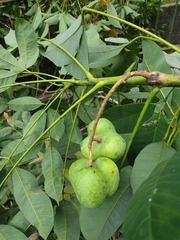 Hevea brasiliensis
 Daucus carota
 Helianthus
 Homoeosoma electellum