View: List Claim type Research area Organism Taxon as written Decade Paper Intervention effect observed original result positive measured Claim · model-written summary
Bleaching powder decrease d late wilt incidence by 49.7%.
Application of bleaching powder at 1000 ppm thrice at 45, 55 and 65 days after sowing e3 late wilt incidence e7 Not reported Comparator
Verbatim
t0 “Grain Yield in Maize ”
✓ located verbatim in the source · title, characters 63–83 e3 “Application of bleaching powder at 1000 ppm thrice at 45, 55 and 65 days after sowing was most effective ”
✓ located verbatim in the source · abstract, characters 526–630 e7 “corresponding decrease of the late wilt incidence by 45.9, 53, 46 and 49.7% ”
✓ located verbatim in the source · abstract, characters 734–809 e0 “effective control of late wilt (Cephalosporium maydis ) ”
✓ located verbatim in the source · abstract, characters 146–200 Other claims from this paper (10) Association observed original result negative measured Claim · model-written summary
The earlier main-stem leaves were removed, the more drastically cotton growth and yield decrease d
The earlier the main‐stem leaf removal e7 plant growth and yield e7 decrease inferred e7 the more drastic the resulting effect e7 Verbatim
e0 “management of cotton ( Gossypium hirsutum L.) crops ”
✓ located verbatim in the source · abstract, characters 140–191 e7 “The earlier the main‐stem leaf removal, the more drastic the resulting effect on plant growth and yield ”
✓ located verbatim in the source · abstract, characters 1112–1215 Other claims from this paper (7) Association hypothesis original result negative measured Claim · model-written summary
Early defoliation incited by Septoria brown spot might result in a significant yield reduction in soybean.
Septoria brown spote0 pathogen decrease inferred e0 might result in significant e0 Verbatim
e0 “Various yield composing characters were negatively correlated to the leaf defoliation, suggesting that early defoliation incited by Septoria brown spot might result in significant yield reduction in soybean ”
✓ located verbatim in the source · abstract, characters 531–737 Other claims from this paper (5) Intervention effect observed original result positive significant (as stated) measured Claim · model-written summary
Gypsum significantly increased first-cut dry matter yield .
gypsum application e0 dry matter yield of the first cuts e0 Not reported Comparator
Verbatim
e0 “dry matter yield of the first cuts of forage sorghum increased significantly with increase in N‐level, with decrease in irrigation interval, and with gypsum application ”
✓ located verbatim in the source · abstract, characters 721–889 Other claims from this paper (17) Intervention effect observed original result negative measured Claim · model-written summary
Soybeans planted in November through January yield 25 to 50 percent of those planted through June in Hawaii.
planted in November through January e0 decrease inferred e0 planted through June e0 Verbatim
e0 “In Hawaii, soybeans planted in November through January will produce yield s of 25 to 50 percent compared with those planted through June ”
✓ located verbatim in the source · abstract, characters 9–145 Other claims from this paper (11) Intervention effect planting gave significant differences in number of plants, pods per plant, seeds per pod. Intervention effect planting gave significant differences in seed weight, yield of seed, plant height. Intervention effect planting gave significant differences in oil content of the seed. Intervention effect cultivar gave significant differences in number of plants, pods per plant, seeds per pod. Intervention effect cultivar gave significant differences in seed weight, yield of seed, plant height. Intervention effect cultivar gave significant differences in oil content of the seed. Intervention effect date × cultivar interaction gave significant differences in number of plants, pods per plant, seeds per pod. Intervention effect date × cultivar interaction gave significant differences in seed weight, yield of seed, plant height. Intervention effect date × cultivar interaction gave significant differences in oil content of the seed. Association Pods per plant had a closer relationship with yield under stress conditions (November through January plantings). Association Seeds per pod were more closely associated with yield in non-stress environments (April through June plantings). Mechanism observed original result negative measured Claim · model-written summary
Compaction reduced crop growth primarily through mechanical impedance that slows root system development.
mechanical impedance e0 Verbatim
e0 “The decrease in crop growth by compaction is primarily due to mechanical impedance, which slows down development of the root system. ”
✓ located verbatim in the source · abstract, characters 921–1053 e1 “The grain yield of wheat was significantly reduced when the volume of large pores was reduced to about 10 % or less. ”
✓ located verbatim in the source · abstract, characters 476–592 Other claims from this paper (1) Mechanism hypothesis original result positive basis n/a Claim · model-written summary
Authors postulated that the dwarf mutant's short thick leaves explain its smaller photosynthetic decline under drought.
short and thicker leaves e0 lowest decrease of the photosynthetic rate e0 Verbatim
e0 “the lowest decrease of the photosynthetic rate under drought condition in the dwarf mutant was associated with the presence of short and thicker leaves ”
✓ located verbatim in the source · abstract, characters 1996–2147 t0 “rice ”
✓ located verbatim in the source · title, characters 116–120 e1 “Effect of defoliation ”
✓ located verbatim in the source · title, characters 0–21 Other claims from this paper (12) Mechanism author interpretation original result measured Claim · model-written summary
Low temperature increases inhibition of electron transfer from PSII to the plastoquinone pool.
quantum yield of oxygen evolution e0 drastic decrease e0 greater inhibition of electron transfer from primary electron accepting plastoquinone of PSII to the plastoquinone pool e0 Verbatim
e0 “at low temperature there is greater inhibition of electron transfer from primary electron accepting plastoquinone of PSII to the plastoquinone pool, which leads to a drastic decrease in the quantum yield of oxygen evolution in the chilling-sensitive pumpkin. ”
✓ located verbatim in the source · abstract, characters 1097–1355 Other claims from this paper (8) Observation observed original result measured Claim · model-written summary
Extractable leaf protein yield showed a quadratic response with age.
extractable leaf protein yield e0 Not reported Direction
Verbatim
e0 “A linear decrease with age was noted for the total and protein nitrogen extractability of this crop whereas the nitrogen percentage in dry matter of leaves and the extractable leaf protein yield gave a quadratic response. ”
✓ located verbatim in the source · abstract, characters 308–529 t0 “winged bean ”
✓ located verbatim in the source · title, characters 70–81 Other claims from this paper (10) Intervention effect author interpretation original result positive measured Claim · model-written summary
Varietal mixtures stabilized spring barley crop yield s through reduced mildew-related yield variability.
varietal mixtures e0 mildew e0 pathogen Not reported Comparator
Verbatim
e0 “By using varietal mixtures, stabilization of crop yield s is obtained due to the decrease of mildew‐related variability range of spring barley yield s ”
✓ located verbatim in the source · abstract, characters 401–549 Other claims from this paper (2) Lexical search (BM25). All words must match; if nothing does, any word. Organism names also match every spelling of the same organism. No semantic search yet.
 Zea mays
 Gossypium hirsutum
 Glycine max
 Triticum aestivum
 Oryza sativa
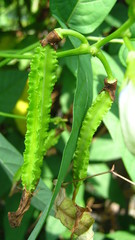 Psophocarpus tetragonolobus
 Hordeum vulgare