View: List Claim type Research area Organism Taxon as written Decade Paper Association observed original result negative simulated Claim · model-written summary
Models predicted above average July heat units would decrease corn yield .
above average heat units e0 Not reported Taxon
Verbatim
e0 “above average heat units would decrease yield ”
✓ located verbatim in the source · abstract, characters 1433–1478 Other claims from this paper (12) Association observed review summary negative measured Claim · model-written summary
Weed competition can decrease alfalfa yield .
Verbatim
e0 “Weeds compete with alfalfa for water, nutrients, light, and space. This competition can decrease yield s ”
✓ located verbatim in the source · abstract, characters 0–103 Other claims from this paper (4) Association author interpretation review summary negative basis n/a Claim · model-written summary
Salinity above 8 dS /m may decrease alfalfa yield by 50 %.
Verbatim
e0 “8 dS /m (4091 ppm, 70 mM), levels that may decrease alfalfa yield by 50 % ”
✓ located verbatim in the source · abstract, characters 526–599 Other claims from this paper (3) Association observed original result no effect not significant (as stated) measured Claim · model-written summary
There was no evidence for a decrease in yield caused by root-zone warming.
Verbatim
e0 “Rose cvs Ilona, Mercedes and Sonia ”
✓ located verbatim in the source · abstract, characters 7–41 e1 “There was no evidence for a decrease in yield caused by RZW ”
✓ located verbatim in the source · abstract, characters 1540–1599 Other claims from this paper (19) Association observed original result negative measured Claim · model-written summary
The decrease in sugarcane yield was much greater in some varieties than in others.
decrease in yield e5 Verbatim
t0 “Residual effect of glyphosate as a ripener on sugarcane ”
✓ located verbatim in the source · title, characters 0–55 e5 “The decrease in yield in some varieties was much greater than in others ”
✓ located verbatim in the source · abstract, characters 753–824 Other claims from this paper (5) Association observed review summary negative measured Claim · model-written summary
Mite damage was shown to decrease cassava root yield by up to 87%.
root and stake yield e1 Verbatim
t0 “The cassava mites ”
✓ located verbatim in the source · title, characters 0–17 e1 “These arthropods cause three patterns of damage and have been shown to cause a decrease in root and stake yield of up to 87% and 82% respectively ”
✓ located verbatim in the source · abstract, characters 188–333 Other claims from this paper (4) Association observed review summary negative measured Claim · model-written summary
Mite damage was shown to decrease cassava stake yield by up to 82%.
root and stake yield e1 Verbatim
t0 “The cassava mites ”
✓ located verbatim in the source · title, characters 0–17 e1 “These arthropods cause three patterns of damage and have been shown to cause a decrease in root and stake yield of up to 87% and 82% respectively ”
✓ located verbatim in the source · abstract, characters 188–333 Other claims from this paper (4) Association observed original result negative measured Claim · model-written summary
P christiei populations were associated with 16% yield decrease in Bragg.
P christiei e1 pest Verbatim
e0 “were associated with 16%, 10% and 6% yield decrease of 'Bragg', 'Santa Rosa' and 'Hernon 147', respectively. ”
✓ located verbatim in the source · abstract, characters 874–982 t0 “Plant-Parasitic Nematodes and Neocosmospora vasinfectca Var. Africana Associated with Soybeans ”
✓ located verbatim in the source · title, characters 0–94 e1 “P christiei were recovered from fumigated plots ”
✓ located verbatim in the source · abstract, characters 822–869 Other claims from this paper (5) Association observed original result mixed measured Claim · model-written summary
Compaction from light axle loads can both increase and decrease crop yield , depending on soil texture and growing season precipitation.
increase and decrease e1 depending on soil texture and growing season precipitation e1 Verbatim
t1 “The Effect of Soil Compaction on Crop Yield ”
✓ located verbatim in the source · title, characters 0–43 e1 “This compaction can both increase and decrease crop yield depending on soil texture and growing season precipitation ”
✓ located verbatim in the source · abstract, characters 308–424 Other claims from this paper (5) Association observed original result negative measured Claim · model-written summary
P christiei populations were associated with 10% yield decrease in Santa Rosa.
P christiei e1 pest Verbatim
e0 “were associated with 16%, 10% and 6% yield decrease of 'Bragg', 'Santa Rosa' and 'Hernon 147', respectively. ”
✓ located verbatim in the source · abstract, characters 874–982 t0 “Plant-Parasitic Nematodes and Neocosmospora vasinfectca Var. Africana Associated with Soybeans ”
✓ located verbatim in the source · title, characters 0–94 e1 “P christiei were recovered from fumigated plots ”
✓ located verbatim in the source · abstract, characters 822–869 Other claims from this paper (5) Lexical search (BM25). All words must match; if nothing does, any word. Organism names also match every spelling of the same organism. No semantic search yet.
 Medicago sativa
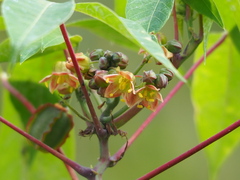 Manihot esculenta
 Glycine max