View: List Claim type Research area Organism Taxon as written Decade Paper Association observed original result positive measured Claim · model-written summary
Wider sorghum row spacing decrease d crop yield penalties caused by weeds.
crop yield penalties due to weeds e0 Verbatim
e0 “In sorghum, as row spacing widens weed growth and seed production increases; however, crop yield penalties due to weeds decrease ”
✓ located verbatim in the source · abstract, characters 472–600 Other claims from this paper (6) Intervention effect observed original result negative measured Claim · model-written summary
Season-long weed competition decrease d grain yield by 29%.
season-long weed-crop competition e0 Not reported Comparator
Verbatim
e0 “An average decrease in grain yield by 29% was observed due to season-long weed-crop competition ”
✓ located verbatim in the source · abstract, characters 152–247 t0 “wheat (Triticum aestivum ) ”
✓ located verbatim in the source · title, characters 73–98 Other claims from this paper (9) Association observed original result negative measured Claim · model-written summary
Apple yield decrease d as preplant nematode density increased.
before apple seedlings were planted e0 Verbatim
e0 “there was good evidence of a decrease in yield with increased nematode density before apple seedlings were planted ”
✓ located verbatim in the source · abstract, characters 128–242 t0 “Pratylenchus penetrans
✓ located verbatim in the source · title, characters 43–65 Other claims from this paper (5) Observation observed original result negative significant (as stated) measured Claim · model-written summary
Infected grapevines had significantly lower yield .
Verbatim
e0 “Infected plants showed a significant decrease in yield ”
✓ located verbatim in the source · abstract, characters 1899–1953 t0 “grapevine ”
✓ located verbatim in the source · title, characters 92–101 Other claims from this paper (14) Observation Leafroll infection reduced grapevine gas exchange. Observation At ripeness, stomatal conductance fell more than net assimilation. Observation Infected leaves had higher intrinsic water-use efficiency. Mechanism The declines in conductance and assimilation were not attributed to lower bulk water potential. Observation Maximum photosystem II quantum efficiency was unaffected by infection. Observation Effective PSII efficiency, electron transport and photochemical quenching decreased significantly. Observation Non-photochemical quenching increased significantly. Observation Virus infection reduced light-saturated CO2 fixation and carboxylation efficiency. Observation Apparent quantum yield of CO2 fixation was significantly higher. Observation Infection markedly reduced photosynthetic pigments, soluble sugars and proteins. Observation Starch and anthocyanins increased significantly under infection. Observation Leaf N, P, Ca, S and Fe concentrations significantly decreased. Observation Leaf K, Mg, B, Cu, Zn and Mn concentrations were unaffected. Observation Lower cluster weight contributed to yield loss. Association observed original result no effect measured Claim · model-written summary
Grain weight did not decrease as common root rot severity increased.
Verbatim
t0 “wheat ”
✓ located verbatim in the source · title, characters 54–59 e1 “Grain yield , tiller and grain number, but not grain weight decrease d as disease severity increased ”
✓ located verbatim in the source · abstract, characters 543–641 e3 “common root rot (CRR) caused by Bipolaris sorokiniana ”
✓ located verbatim in the source · abstract, characters 15–68 Other claims from this paper (9) Intervention effect observed original result no effect measured Claim · model-written summary
Blending pure lines did not decrease charcoal rot infection.
blending pure lines e0 charcoal rot infection e0 Not reported Comparator
Verbatim
e0 “There was no benefit in blending pure lines either in increased yield or decrease d charcoal rot infection ”
✓ located verbatim in the source · abstract, characters 1508–1613 e1 “of soybean [ Glycine max (L.) Merr.] ”
✓ located verbatim in the source · abstract, characters 53–89 Other claims from this paper (9) Association observed original result negative measured Claim · model-written summary
Each additional whitefly per leaf was associated with a 40.044 kg/ha decrease in chili yield .
yield of chili plants e0 one whitefly/leaf e0 Verbatim
e0 “Each addition of one whitefly/leaf will increase the incidence of disease by 25.981%, the severity by 15.269%, and reduce the yield of chili plants by 40.044 kg/ha. ”
✓ located verbatim in the source · abstract, characters 814–978 Other claims from this paper (3) Intervention effect observed original result negative measured Claim · model-written summary
Weed infestation decrease d maize grain yield by up to 32%.
weed‐infested conditions e0 maize grain yield e0 Not reported Comparator
Verbatim
e0 “under weed‐infested conditions, there was a large decrease in maize grain yield (up to 32%) ”
✓ located verbatim in the source · abstract, characters 873–964 Other claims from this paper (9) Observation observed original result negative measured Claim · model-written summary
Weeds decrease d barley and wheat grain yield by an estimated 200 kg ha−1.
Verbatim
e0 “weeds decrease the yield of spring barley and spring wheat for 200 kg ha−1 ”
✓ located verbatim in the source · abstract, characters 596–670 Other claims from this paper (11) Intervention effect observed original result negative measured Claim · model-written summary
Sunwoobori grain yield decrease d by more than 60.0%.
virus infected cultivars e1 Not reported Comparator
Verbatim
e0 “Sunwoobori (S) was severely decrease more than 60.0%. ”
✓ located verbatim in the source · abstract, characters 2353–2406 e1 “The grain yield was also significantly reduced in virus infected cultivars. ”
✓ located verbatim in the source · abstract, characters 2277–2352 t0 “Barley ”
✓ located verbatim in the source · title, characters 39–45 Other claims from this paper (13) Lexical search (BM25). All words must match; if nothing does, any word. Organism names also match every spelling of the same organism. No semantic search yet.
 Sorghum
 Triticum aestivum
 Malus domestica
 Pratylenchus penetrans
 Vitis
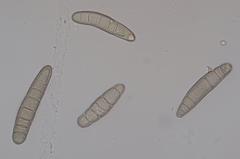 Bipolaris sorokiniana
 Glycine max
 Macrophomina phaseolina
 Zea mays
 Hordeum vulgare