Abstract
Nuclear polyhedrosis virus, introduced into virus-free population of the Babul defoliator, Taragama siva (Streblote siva) larvae (Lasiocampidae: Lepidoptera), in 1996, was carried over into 1997 host generation and was spread into the surrounding areas from the points of introduction at Jodhpur, Rajasthan (India). The extent of spread in 1997 appeared to be influenced by the size of the area treated in 1996. During 1998-99, the NPV infection was spread ahnd found fully developed in the virus free zone of T. siva population. In 1997 the epizooties developed slowly during the early instars and reached the highest levels late in the last instars larvae of T. siva. The pattern of mortality in the first and second generation in both the year remained similar where highest percentage larval mortality were recorded during the months of August and September. Many infected larvae crawled to the tops of the Prosopis juliflora trees and died while eggs were being laid by adult moths, thus, some eggs masses where contaminated with NPV infection. This is one of the ways by which the virus may spread from one generation to the next, but eggs transmission by adult appears to be the main factor of the spread over wide areas of Jodhpur and adjacent localities. Adults of a dipterous larval parasite, Carcelia sp. was also found to the most important dispersal agent of virus-disease in localized areas because they feed and develop on virus-diseased larvae and remain in the larval body from the time when larval enter the third instars until the emergence of adult moth. Of the important natural enemy complex, nineteen species of parasites, thirteen species of predators and three species of entomopathogens were found associated with the potential pests of Prosopis species. The key predators and parasites of neem weevil Myllocerus tenuicornis Faust are Eumenes dimidiatipennis, E. esuriens (Euminidae” Hymenoptera), Bracon greeni, Iphiaulax sp. (Brachonidae: Hymenoptera) and pathogens Beauveria bassiana.
Abstract from the paper’s OpenAlex record, shown for indexing and research. Copyright remains with the authors or the publisher. Read at the source ↗
The text the model read, with the source record’s inline markup (italics, sub- and superscripts) rendered and its character entities decoded; quote offsets refer to the raw text.
Claims 9
Claim · model-written summary
NPV introduced in 1996 was carried over into 1997 and spread into the surrounding areas, affecting Streblote siva
- Taxon
- Prosopis cineraria
 Prosopis cinerariat0
- Treatment
- introduced into virus-free populatione1
- Interactor
- Streblote sivae1pest
- Second interactor
- Nuclear polyhedrosis virusunidentified nuclear polyhedrosis virusese1biocontrol_agent
- Outcome
- spread into the surrounding arease1
Organisms pictured · Representative pictures of the matched species, not figures from the paper.

Verbatim
t0“Prosopis cineraria”
e1“Nuclear polyhedrosis virus, introduced into virus-free population of the Babul defoliator, Taragama siva (Streblote siva) larvae (Lasiocampidae: Lepidoptera), in 1996, was carried over into 1997 host generation and was spread into the surrounding areas”
Claim · model-written summary
NPV epizootics in Streblote siva developed slowly in early instars and reached their highest levels late in the last instars
- Taxon
- Prosopis cinerariaProsopis cinerariat0
- Interactor
- T. sivae2pest
- Outcome
- epizootiese2
Organisms pictured · Representative pictures of the matched species, not figures from the paper.
Verbatim
t0“Prosopis cineraria”
e2“In 1997 the epizooties developed slowly during the early instars and reached the highest levels late in the last instars larvae of T. siva”
Claim · model-written summary
Larval mortality of Streblote siva was highest in August and September
- Taxon
- Prosopis cinerariaProsopis cinerariat0
- Outcome
- larval mortalitye3
- Direction
- higheste3
- Qualifier
- during the months of August and Septembere3
Organisms pictured · Representative pictures of the matched species, not figures from the paper.
Verbatim
t0“Prosopis cineraria”
e3“highest percentage larval mortality were recorded during the months of August and September”
Claim · model-written summary
Egg transmission by adult moths appears to be the main factor of the spread of NPV over wide areas
- Taxon
- Prosopis cinerariaProsopis cinerariat0
- Outcome
- spread over wide arease4
- Qualifier
- eggs transmission by adulte4
Organisms pictured · Representative pictures of the matched species, not figures from the paper.
Verbatim
t0“Prosopis cineraria”
e4“but eggs transmission by adult appears to be the main factor of the spread over wide areas of Jodhpur and adjacent localities”
Claim · model-written summary
Nineteen species of parasites were found associated with the potential pests of Prosopis
- Taxon
- Prosopis cinerariaProsopis cinerariat0
- Outcome
- species of parasitese5
- Value
- nineteen speciese5
Organisms pictured · Representative pictures of the matched species, not figures from the paper.
Verbatim
t0“Prosopis cineraria”
e5“Of the important natural enemy complex, nineteen species of parasites, thirteen species of predators and three species of entomopathogens were found associated with the potential pests of Prosopis species”
Claim · model-written summary
Thirteen species of predators were found associated with the potential pests of Prosopis
- Taxon
- Prosopis cinerariaProsopis cinerariat0
- Outcome
- species of predatorse5
- Value
- thirteen speciese5
Organisms pictured · Representative pictures of the matched species, not figures from the paper.
Verbatim
t0“Prosopis cineraria”
e5“Of the important natural enemy complex, nineteen species of parasites, thirteen species of predators and three species of entomopathogens were found associated with the potential pests of Prosopis species”
Claim · model-written summary
Three species of entomopathogens were found associated with the potential pests of Prosopis
- Taxon
- Prosopis cinerariaProsopis cinerariat0
- Outcome
- species of entomopathogense5
- Value
- three speciese5
Organisms pictured · Representative pictures of the matched species, not figures from the paper.
Verbatim
t0“Prosopis cineraria”
e5“Of the important natural enemy complex, nineteen species of parasites, thirteen species of predators and three species of entomopathogens were found associated with the potential pests of Prosopis species”
Claim · model-written summary
The key predators and parasites of the neem weevil Myllocerus tenuicornis include Eumenes dimidiatipennis
- Taxon
- Prosopis cinerariaProsopis cinerariat0
- Interactor
- Myllocerus tenuicornise6pest
- Outcome
- key predators and parasitese6
Organisms pictured · Representative pictures of the matched species, not figures from the paper.
Verbatim
t0“Prosopis cineraria”
e6“The key predators and parasites of neem weevil Myllocerus tenuicornis Faust are Eumenes dimidiatipennis”
Claim · model-written summary
The dipterous larval parasite Carcelia sp. was found to be the most important dispersal agent of the virus disease in localized areas
- Taxon
- Prosopis cinerariaProsopis cinerariat0
- Outcome
- dispersal agent of virus-diseasee7
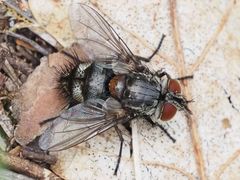 Carcelia
Organisms pictured · Representative pictures of the matched species, not figures from the paper.

Verbatim
t0“Prosopis cineraria”
e7“Carcelia sp. was also found to the most important dispersal agent of virus-disease in localized areas”