Abstract
The current work aimed to examine population abundance of some piercing-sucking-insects infesting different barely plant cultivars at Sharkia Governorate during 2022/23 and 2023/24 seasons. The insects were obtained by methods ofplant samples and sweeping net. These insects were: a)Aphids: Rhopalosiphum padi (Linnaeus),Rhaplosiphium maidis (Fitch), Schizaphis graminum (Rond.) and Sitobion avenae (Fabr); b) leafhoppers: Empoasca decedens (Paoli), E. decipiens (Paoli), Balclutha hortensis (Landb.) and Cicadulina chinai (Ghaui) and planthoppers: Sogatella vibix (Haupt) and S. furcifera (Horv.).Peak of R.padi, R.maidis, and S. graminum population occurred at the first week of March, while, S. avenaepeaked on the third week of March in barely fields. Population abundance of leafhoppers,E. decipiens , E.decedens, B. hortensiss and C.chinai showed a single peak at the end of February, whereas that of planthoppers,S. vibix and S. furcifera exhibited one peak during the third week of February.Barely varieties significantly affected the population abundance ofthe previously mentioned insects, with Giza 138 variety hosted the lowest mean number of insects, while the highest mean number of insects were found with Giza 123 variety. Chemical analysis revealed a positive relationship between protein and carbohydrate contents and insects attack, whereas an inverse relationship was obtained between pH values and insects attack.
Abstract from the paper’s OpenAlex record; open copy licensed cc-by. Read at the source ↗
The text the model read, with the source record’s inline markup (italics, sub- and superscripts) rendered and its character entities decoded; quote offsets refer to the raw text.
Claims 16
Claim · model-written summary
Rhopalosiphum padi population peaked in the first week of March in barley fields.
- Taxon
- Barley
 Hordeum vulgaret0
- Interactor
- R.padi
 Rhopalosiphum padie1pest
- Outcome
- populatione1
- Qualifier
- first week of Marche1
- Setting
- Sharkia Governoratee0
Organisms pictured · Representative pictures of the matched species, not figures from the paper.


Verbatim
t0“Effect of Certain Barley Plant Varieties”
e0“at Sharkia Governorate during 2022/23 and 2023/24 seasons”
e1“Peak of R.padi, R.maidis, and S. graminum population occurred at the first week of March, while, S. avenaepeaked on the third week of March in barely fields”
Claim · model-written summary
Rhopalosiphum maidis population peaked in the first week of March in barley fields.
- Taxon
- BarleyHordeum vulgaret0
- Interactor
- R.maidis
 Rhopalosiphum maidise1pest
- Outcome
- populatione1
- Qualifier
- first week of Marche1
Organisms pictured · Representative pictures of the matched species, not figures from the paper.
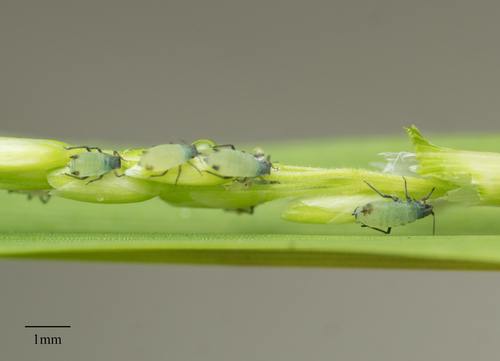
Verbatim
t0“Effect of Certain Barley Plant Varieties”
e1“Peak of R.padi, R.maidis, and S. graminum population occurred at the first week of March, while, S. avenaepeaked on the third week of March in barely fields”
Claim · model-written summary
Schizaphis graminum population peaked in the first week of March in barley fields.
- Taxon
- BarleyHordeum vulgaret0
- Interactor
- S. graminum
 Schizaphis graminume1pest
- Outcome
- populatione1
- Qualifier
- first week of Marche1
Organisms pictured · Representative pictures of the matched species, not figures from the paper.

Verbatim
t0“Effect of Certain Barley Plant Varieties”
e1“Peak of R.padi, R.maidis, and S. graminum population occurred at the first week of March, while, S. avenaepeaked on the third week of March in barely fields”
Claim · model-written summary
Sitobion avenae population peaked in the third week of March in barley fields.
- Taxon
- BarleyHordeum vulgaret0
- Interactor
- S. avenae
 Sitobion avenaee1pest
- Outcome
- populatione1
- Qualifier
- third week of Marche1
Organisms pictured · Representative pictures of the matched species, not figures from the paper.

Verbatim
t0“Effect of Certain Barley Plant Varieties”
e1“Peak of R.padi, R.maidis, and S. graminum population occurred at the first week of March, while, S. avenaepeaked on the third week of March in barely fields”
Claim · model-written summary
Empoasca decipiens population abundance showed a single peak at the end of February.
- Taxon
- BarleyHordeum vulgaret0
- Interactor
- E. decipiensHebata decipiense2pest
- Outcome
- Population abundancee2
- Qualifier
- end of Februarye2
Organisms pictured · Representative pictures of the matched species, not figures from the paper.
Verbatim
t0“Effect of Certain Barley Plant Varieties”
e2“Population abundance of leafhoppers,E. decipiens , E.decedens, B. hortensiss and C.chinai showed a single peak at the end of February, whereas that of planthoppers,S. vibix and S. furcifera exhibited one peak during the third week of February”
Claim · model-written summary
Empoasca decedens population abundance showed a single peak at the end of February.
- Taxon
- BarleyHordeum vulgaret0
- Interactor
- E.decedens
 Asymmetrasca decedense2pest
- Outcome
- Population abundancee2
- Qualifier
- end of Februarye2
Organisms pictured · Representative pictures of the matched species, not figures from the paper.

Verbatim
t0“Effect of Certain Barley Plant Varieties”
e2“Population abundance of leafhoppers,E. decipiens , E.decedens, B. hortensiss and C.chinai showed a single peak at the end of February, whereas that of planthoppers,S. vibix and S. furcifera exhibited one peak during the third week of February”
Claim · model-written summary
Balclutha hortensis population abundance showed a single peak at the end of February.
- Taxon
- BarleyHordeum vulgaret0
- Interactor
- B. hortensisse2pest
- Outcome
- Population abundancee2
- Qualifier
- end of Februarye2
Organisms pictured · Representative pictures of the matched species, not figures from the paper.
Verbatim
t0“Effect of Certain Barley Plant Varieties”
e2“Population abundance of leafhoppers,E. decipiens , E.decedens, B. hortensiss and C.chinai showed a single peak at the end of February, whereas that of planthoppers,S. vibix and S. furcifera exhibited one peak during the third week of February”
Claim · model-written summary
Cicadulina chinai population abundance showed a single peak at the end of February.
- Taxon
- BarleyHordeum vulgaret0
- Interactor
- C.chinaie2pest
- Outcome
- Population abundancee2
- Qualifier
- end of Februarye2
Organisms pictured · Representative pictures of the matched species, not figures from the paper.
Verbatim
t0“Effect of Certain Barley Plant Varieties”
e2“Population abundance of leafhoppers,E. decipiens , E.decedens, B. hortensiss and C.chinai showed a single peak at the end of February, whereas that of planthoppers,S. vibix and S. furcifera exhibited one peak during the third week of February”
Claim · model-written summary
Sogatella vibix population abundance showed one peak in the third week of February.
- Taxon
- BarleyHordeum vulgaret0
- Interactor
- S. vibixSogatella vibixe2pest
- Outcome
- Population abundancee2
- Qualifier
- third week of Februarye2
Organisms pictured · Representative pictures of the matched species, not figures from the paper.
Verbatim
t0“Effect of Certain Barley Plant Varieties”
e2“Population abundance of leafhoppers,E. decipiens , E.decedens, B. hortensiss and C.chinai showed a single peak at the end of February, whereas that of planthoppers,S. vibix and S. furcifera exhibited one peak during the third week of February”
Claim · model-written summary
Sogatella furcifera population abundance showed one peak in the third week of February.
- Taxon
- BarleyHordeum vulgaret0
- Interactor
- S. furciferaSogatella furciferae2pest
- Outcome
- Population abundancee2
- Qualifier
- third week of Februarye2
Organisms pictured · Representative pictures of the matched species, not figures from the paper.
Verbatim
t0“Effect of Certain Barley Plant Varieties”
e2“Population abundance of leafhoppers,E. decipiens , E.decedens, B. hortensiss and C.chinai showed a single peak at the end of February, whereas that of planthoppers,S. vibix and S. furcifera exhibited one peak during the third week of February”
Claim · model-written summary
Barley varieties significantly affected the population abundance of the piercing-sucking insects.
- Taxon
- BarleyHordeum vulgaret0
- Treatment
- varietiese3
- Outcome
- population abundancee3
Not reportedDirection
Organisms pictured · Representative pictures of the matched species, not figures from the paper.
Verbatim
t0“Effect of Certain Barley Plant Varieties”
e3“Barely varieties significantly affected the population abundance ofthe previously mentioned insects, with Giza 138 variety hosted the lowest mean number of insects”
Claim · model-written summary
Giza 138 hosted the lowest mean number of insects among barley varieties.
- Taxon
- BarleyHordeum vulgaret0
- Material
- Giza 138e4
- Outcome
- mean number of insectse4
- Direction
- loweste4
Organisms pictured · Representative pictures of the matched species, not figures from the paper.
Verbatim
t0“Effect of Certain Barley Plant Varieties”
e4“with Giza 138 variety hosted the lowest mean number of insects, while the highest mean number of insects were found with Giza 123 variety”
Claim · model-written summary
Giza 123 hosted the highest mean number of insects among barley varieties.
- Taxon
- BarleyHordeum vulgaret0
- Material
- Giza 123e4
- Outcome
- mean number of insectse4
- Direction
- higheste4
Organisms pictured · Representative pictures of the matched species, not figures from the paper.
Verbatim
t0“Effect of Certain Barley Plant Varieties”
e4“with Giza 138 variety hosted the lowest mean number of insects, while the highest mean number of insects were found with Giza 123 variety”
Claim · model-written summary
Protein content showed a positive relationship with insect attack on barley.
- Taxon
- BarleyHordeum vulgaret0
- Compound
- proteine5
- Outcome
- insects attacke5
- Direction
- positivee5
Organisms pictured · Representative pictures of the matched species, not figures from the paper.
Verbatim
t0“Effect of Certain Barley Plant Varieties”
e5“Chemical analysis revealed a positive relationship between protein and carbohydrate contents and insects attack, whereas an inverse relationship was obtained between pH values and insects attack”
Claim · model-written summary
Carbohydrate content showed a positive relationship with insect attack on barley.
- Taxon
- BarleyHordeum vulgaret0
- Compound
- carbohydrate contentse5
- Outcome
- insects attacke5
- Direction
- positivee5
Organisms pictured · Representative pictures of the matched species, not figures from the paper.
Verbatim
t0“Effect of Certain Barley Plant Varieties”
e5“Chemical analysis revealed a positive relationship between protein and carbohydrate contents and insects attack, whereas an inverse relationship was obtained between pH values and insects attack”
Claim · model-written summary
pH values showed an inverse relationship with insect attack on barley.
- Taxon
- BarleyHordeum vulgaret0
- Compound
- pH valuese5
- Outcome
- insects attacke5
- Direction
- inversee5
Organisms pictured · Representative pictures of the matched species, not figures from the paper.
Verbatim
t0“Effect of Certain Barley Plant Varieties”
e5“Chemical analysis revealed a positive relationship between protein and carbohydrate contents and insects attack, whereas an inverse relationship was obtained between pH values and insects attack”