Abstract
Sowing density is a key management practice influencing productivity and quality of leafy greens and culinary herbs grown in controlled environments. However, research-based information on optimal density is limited for many culinary herbs. This greenhouse study aimed to quantify sowing density impacts on biomass output, individual plant growth, and morphological traits in hydroponically produced ‘Giant of Italy’ parsley ( Petroselinum crispum ), ‘Santo’ cilantro ( Coriandrum sativum ), and sage ( Salvia officinalis ). Seedlings were grown in phenolic foam cubes with 1, 5, 10, 15, or 20 seeds per cell, transplanted into an ebb-and-flow hydroponic system in a glass-glazed greenhouse with 23 °C target average daily temperature, 16-hour photoperiod, a target daily light integral of 13 mol·m −2 ·d −1 , and harvested at 16 to 28 d after transplanting depending on species. ‘Giant of Italy’ parsley and ‘Santo’ cilantro fresh weight per cell increased quadratically by 274% (57.3 g) and 305% (19 g), respectively, as sowing density increased from 1 to 15 seeds per cell, then plateaued as density further increased. Sage fresh weight plateaued at 10 seeds per cell with an increase of 225% (29.2 g) compared with 1 seed per cell. Cilantro and sage dry weight per cell plateaued at 14 and 8 seeds per cell, respectively, and parsley dry weight quadratically increased as sowing density rose up to 20 seeds per cell. Although fresh and dry weight increased, individual plant height, stem diameter, and individual plant dry weight exhibited linear or quadratic declines as sowing density increased, indicating higher sowing densities restricted individual plant growth. In summary, as sowing density increased, fresh and dry weight per cell generally increased but individual plant quality decreased. For the greatest fresh and dry weight, 20, 18, and 10 seeds per cell should be sown for parsley, cilantro, and sage, respectively. However, to balance fresh weight and crop quality, our results suggest sowing density (seeds per cell) targets of 16 seeds for parsley, 18 seeds for cilantro, and 10 seeds for sage.
Abstract from the paper’s OpenAlex record; open copy licensed cc-by-nc-nd. Read at the source ↗
The text the model read, with the source record’s inline markup (italics, sub- and superscripts) rendered and its character entities decoded; quote offsets refer to the raw text.
Claims 10
Claim · model-written summary
Parsley fresh weight per cell increased quadratically by 274% (57.3 g) as sowing density rose from 1 to 15 seeds per cell, then plateaued.
- Taxon
- parsley
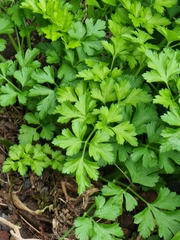 Petroselinum crispume1
- Treatment
- sowing densitye1
- Outcome
- fresh weight per celle1
- Direction
- increasede1
- Value
- 274% (57.3 g)e1
- Qualifier
- quadraticallye1
Not reportedComparator
Organisms pictured · Representative pictures of the matched species, not figures from the paper.
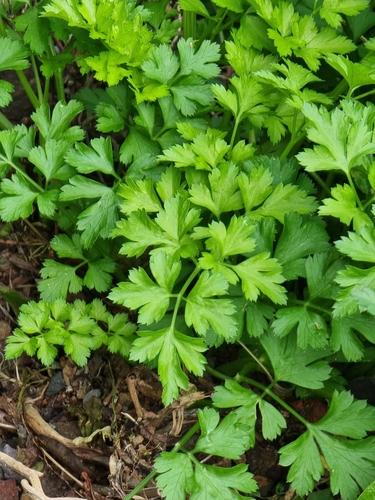
Verbatim
e1“‘Giant of Italy’ parsley and ‘Santo’ cilantro fresh weight per cell increased quadratically by 274% (57.3 g) and 305% (19 g), respectively, as sowing density increased from 1 to 15 seeds per cell, then plateaued as density further increased”
Claim · model-written summary
Cilantro fresh weight per cell increased quadratically by 305% (19 g) as sowing density rose from 1 to 15 seeds per cell, then plateaued.
- Taxon
- cilantro
 Coriandrum sativume1
- Treatment
- sowing densitye1
- Outcome
- fresh weight per celle1
- Direction
- increasede1
- Value
- 305% (19 g)e1
- Qualifier
- quadraticallye1
Not reportedComparator
Organisms pictured · Representative pictures of the matched species, not figures from the paper.

Verbatim
e1“‘Giant of Italy’ parsley and ‘Santo’ cilantro fresh weight per cell increased quadratically by 274% (57.3 g) and 305% (19 g), respectively, as sowing density increased from 1 to 15 seeds per cell, then plateaued as density further increased”
Claim · model-written summary
Sage fresh weight plateaued at 10 seeds per cell, an increase of 225% (29.2 g) over 1 seed per cell.
Verbatim
e2“Sage fresh weight plateaued at 10 seeds per cell with an increase of 225% (29.2 g) compared with 1 seed per cell”
Claim · model-written summary
Cilantro dry weight per cell plateaued at 14 seeds per cell.
- Taxon
- cilantroCoriandrum sativume3
- Outcome
- dry weight per celle3
- Value
- 14e3
- Qualifier
- plateauede3
Organisms pictured · Representative pictures of the matched species, not figures from the paper.
Verbatim
e3“Cilantro and sage dry weight per cell plateaued at 14 and 8 seeds per cell, respectively, and parsley dry weight quadratically increased as sowing density rose up to 20 seeds per cell”
Claim · model-written summary
Sage dry weight per cell plateaued at 8 seeds per cell.
Verbatim
e3“Cilantro and sage dry weight per cell plateaued at 14 and 8 seeds per cell, respectively, and parsley dry weight quadratically increased as sowing density rose up to 20 seeds per cell”
Claim · model-written summary
Parsley dry weight per cell increased quadratically as sowing density rose up to 20 seeds per cell.
- Taxon
- parsleyPetroselinum crispume3
- Treatment
- sowing densitye3
- Outcome
- dry weighte3
- Direction
- increasede3
- Value
- 20 seeds per celle3
- Qualifier
- quadraticallye3
Not reportedComparator
Organisms pictured · Representative pictures of the matched species, not figures from the paper.
Verbatim
e3“Cilantro and sage dry weight per cell plateaued at 14 and 8 seeds per cell, respectively, and parsley dry weight quadratically increased as sowing density rose up to 20 seeds per cell”
Claim · model-written summary
Individual plant height, stem diameter and individual plant dry weight declined as sowing density increased in culinary herbs.
- Taxon
- culinary herbse0
- Treatment
- sowing densitye4
- Outcome
- individual plant height, stem diameter, and individual plant dry weighte4
- Direction
- declinese4
Not reportedComparator
Verbatim
e0“leafy greens and culinary herbs grown in controlled environments”
e4“individual plant height, stem diameter, and individual plant dry weight exhibited linear or quadratic declines as sowing density increased”
Claim · model-written summary
A sowing density target of 16 seeds per cell is suggested for parsley.
- Taxon
- parsleyPetroselinum crispume5
- Outcome
- sowing density (seeds per cell) targetse5
- Value
- 16 seedse5
Organisms pictured · Representative pictures of the matched species, not figures from the paper.
Verbatim
e5“to balance fresh weight and crop quality, our results suggest sowing density (seeds per cell) targets of 16 seeds for parsley, 18 seeds for cilantro, and 10 seeds for sage”
Claim · model-written summary
A sowing density target of 18 seeds per cell is suggested for cilantro.
- Taxon
- cilantroCoriandrum sativume5
- Outcome
- sowing density (seeds per cell) targetse5
- Value
- 18 seedse5
Organisms pictured · Representative pictures of the matched species, not figures from the paper.
Verbatim
e5“to balance fresh weight and crop quality, our results suggest sowing density (seeds per cell) targets of 16 seeds for parsley, 18 seeds for cilantro, and 10 seeds for sage”
Claim · model-written summary
A sowing density target of 10 seeds per cell is suggested for sage.
Verbatim
e5“to balance fresh weight and crop quality, our results suggest sowing density (seeds per cell) targets of 16 seeds for parsley, 18 seeds for cilantro, and 10 seeds for sage”
The same questions in other papers
density · growth · Coriandrum sativum (coriander)Results agree
3 papers in the same direction as this paper
- positive
- positive
- positive
Claims are grouped by organism, treatment and what was measured or targeted. A paper counts as positive when any of its claims in the group is positive.