Abstract
Onion purple blotch is the most indispensable foliar disease of crop and has become a major concern for farmers and research fraternity. An attempt to investigate the role of injury in parasitism by Alternaria porri indicated that disease incidence and severity enhance considerably with injury. Thrips injured plants inoculated with A. porri presented 100% incidence and 52–72% severity while mechanically injured plants inoculated with A. porri showed 60–70% incidence and 28–34% severity. The uninjured plants showed considerably less disease incidence (30–40%) and severity (10–16%). Injured inoculated plants presented reduced leaf length and leaf area while the leaf diameter remained unaffected. The lesion number, lesion length and size was substantially enhanced with concomitant infestation of pest and pathogen. Thrips tabaci injury led to more pronounced symptoms of purple blotch compared to Thrips parvispinus injury. There was substantial decrease in photosynthetic rate and chlorophyll content with stress imposed on plant whilst the relative stress injury was enhanced. The induction of injury and inoculation of A. porri had an impact on the concentration of total phenolics, total soluble sugars, total proteins and hydrogen peroxide in onion leaves. A. porri combined with injury caused a more pronounced decrease in total soluble sugars and total protein content while enhancement in total phenolics and hydrogen peroxide content compared to uninjured plants. The dynamic nature of morpho-physiological and biochemical changes owing to stress conditions imposed on onion plant adds an extra layer of complexity in understanding the onion plant physiology and their ability to work out in response to challenging environment conditions.
Abstract from the paper’s OpenAlex record; open copy licensed cc-by. Read at the source ↗
The text the model read, with the source record’s inline markup (italics, sub- and superscripts) rendered and its character entities decoded; quote offsets refer to the raw text.
Claims 14
Claim · model-written summary
Thrips-injured inoculated onion plants had 100% purple blotch incidence.
- Taxon
- onion
 Allium cepat0
- Treatment
- Thrips injured plants inoculated with A. porrie0
- Interactor
- A. porri
 Alternaria porrie0pathogen
- Outcome
- incidencee0
- Value
- 100%e0
Not reportedComparatorDirection
Organisms pictured · Representative pictures of the matched species, not figures from the paper.


Verbatim
e0“Thrips injured plants inoculated with A. porri presented 100% incidence”
t0“onion purple blotch”
Claim · model-written summary
Thrips-injured inoculated onion plants had 52–72% disease severity.
- Taxon
- onionAllium cepat0
- Treatment
- Thrips injured plants inoculated with A. porrie0
- Interactor
- A. porriAlternaria porrie0pathogen
- Outcome
- severitye0
- Value
- 52–72%e0
Not reportedComparatorDirection
Organisms pictured · Representative pictures of the matched species, not figures from the paper.
Verbatim
e0“Thrips injured plants inoculated with A. porri presented 100% incidence and 52–72% severity”
t0“onion purple blotch”
Claim · model-written summary
Mechanically injured, inoculated onion plants had 60–70% disease incidence.
- Taxon
- onionAllium cepat0
- Treatment
- mechanically injured plants inoculated with A. porrie0
- Interactor
- A. porriAlternaria porrie0pathogen
- Outcome
- incidencee0
- Value
- 60–70%e0
Not reportedComparatorDirection
Organisms pictured · Representative pictures of the matched species, not figures from the paper.
Verbatim
e0“mechanically injured plants inoculated with A. porri showed 60–70% incidence”
t0“onion purple blotch”
Claim · model-written summary
Mechanically injured, inoculated onion plants had 28–34% disease severity.
- Taxon
- onionAllium cepat0
- Treatment
- mechanically injured plants inoculated with A. porrie0
- Interactor
- A. porriAlternaria porrie0pathogen
- Outcome
- severitye0
- Value
- 28–34%e0
Not reportedComparatorDirection
Organisms pictured · Representative pictures of the matched species, not figures from the paper.
Verbatim
e0“mechanically injured plants inoculated with A. porri showed 60–70% incidence and 28–34% severity”
t0“onion purple blotch”
Claim · model-written summary
Uninjured onion plants had 30–40% disease incidence.
- Taxon
- onionAllium cepat0
- Outcome
- disease incidencee0
- Direction
- lesse0
- Value
- 30–40%e0
Organisms pictured · Representative pictures of the matched species, not figures from the paper.
Verbatim
e0“The uninjured plants showed considerably less disease incidence (30–40%)”
t0“onion purple blotch”
Claim · model-written summary
Uninjured onion plants had 10–16% disease severity.
- Taxon
- onionAllium cepat0
- Outcome
- severitye0
- Direction
- lesse0
- Value
- 10–16%e0
Organisms pictured · Representative pictures of the matched species, not figures from the paper.
Verbatim
e0“The uninjured plants showed considerably less disease incidence (30–40%) and severity (10–16%)”
t0“onion purple blotch”
Claim · model-written summary
Injured inoculated plants had reduced leaf length and area.
- Taxon
- onionAllium cepat0
- Treatment
- Injured inoculatede0
- Outcome
- leaf length and leaf areae0
- Direction
- reducede0
Not reportedComparator
Organisms pictured · Representative pictures of the matched species, not figures from the paper.
Verbatim
e0“Injured inoculated plants presented reduced leaf length and leaf area”
t0“onion purple blotch”
Claim · model-written summary
Injured inoculated plants had unchanged leaf diameter.
- Taxon
- onionAllium cepat0
- Treatment
- Injured inoculatede0
- Outcome
- leaf diametere0
- Direction
- unaffectede0
Not reportedComparator
Organisms pictured · Representative pictures of the matched species, not figures from the paper.
Verbatim
e0“Injured inoculated plants presented reduced leaf length and leaf area while the leaf diameter remained unaffected”
t0“onion purple blotch”
Claim · model-written summary
Concomitant pest and pathogen infestation increased lesion number, length, and size.
- Taxon
- onionAllium cepat0
- Treatment
- concomitant infestation of pest and pathogene0
- Outcome
- lesion number, lesion length and sizee0
- Direction
- enhancede0
Not reportedComparator
Organisms pictured · Representative pictures of the matched species, not figures from the paper.
Verbatim
e0“The lesion number, lesion length and size was substantially enhanced with concomitant infestation of pest and pathogen”
t0“onion purple blotch”
Claim · model-written summary
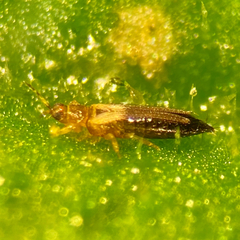
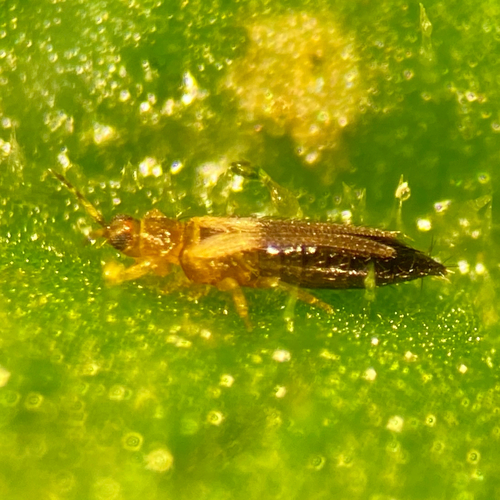
Thrips tabaci injury led to more pronounced purple blotch symptoms than Thrips parvispinus injury.
- Taxon
- onionAllium cepat0
- Treatment
- Thrips tabaci injurye0
- Interactor
- Thrips tabaci
 Thrips tabacie0pest
- Second interactor
- Thrips parvispinus
 Thrips parvispinuse0pest
- Outcome
- symptoms of purple blotche0
- Direction
- more pronouncede0
- Comparator
- Thrips parvispinus injurye0
Organisms pictured · Representative pictures of the matched species, not figures from the paper.
Verbatim
e0“Thrips tabaci injury led to more pronounced symptoms of purple blotch compared to Thrips parvispinus injury”
t0“onion purple blotch”
Claim · model-written summary
Plant stress decreased photosynthetic rate and chlorophyll content.
- Taxon
- onionAllium cepat0
- Outcome
- photosynthetic rate and chlorophyll contente0
- Direction
- decreasee0
Organisms pictured · Representative pictures of the matched species, not figures from the paper.
Verbatim
e0“There was substantial decrease in photosynthetic rate and chlorophyll content with stress imposed on plant”
t0“onion purple blotch”
Claim · model-written summary
Relative stress injury increased under imposed plant stress.
- Taxon
- onionAllium cepat0
- Outcome
- relative stress injurye0
- Direction
- enhancede0
Organisms pictured · Representative pictures of the matched species, not figures from the paper.
Verbatim
e0“the relative stress injury was enhanced”
t0“onion purple blotch”
Claim · model-written summary
Alternaria inoculation combined with injury decreased total soluble sugars and protein content more than in uninjured plants.
- Taxon
- onionAllium cepat0
- Treatment
- A. porri combined with injurye0
- Interactor
- A. porriAlternaria porrie0pathogen
- Outcome
- total soluble sugars and total protein contente0
- Direction
- decreasee0
Not reportedComparator
Organisms pictured · Representative pictures of the matched species, not figures from the paper.
Verbatim
e0“A. porri combined with injury caused a more pronounced decrease in total soluble sugars and total protein content”
t0“onion purple blotch”
Claim · model-written summary
Alternaria inoculation combined with injury increased total phenolics and hydrogen peroxide content over uninjured plants.
- Taxon
- onionAllium cepat0
- Treatment
- A. porri combined with injurye0
- Interactor
- A. porriAlternaria porrie0pathogen
- Outcome
- total phenolics and hydrogen peroxide contente0
- Direction
- enhancemente0
- Comparator
- uninjured plantse0
Organisms pictured · Representative pictures of the matched species, not figures from the paper.
Verbatim
e0“A. porri combined with injury caused a more pronounced decrease in total soluble sugars and total protein content while enhancement in total phenolics and hydrogen peroxide content compared to uninjured plants”
t0“onion purple blotch”
The same questions in other papers
Thrips · disease · Allium cepa (onion)Positive and negative results
1 paper in the same direction as this paper · 1 in the opposite direction
- positive
- negative
Alternaria porri · disease · Allium cepa (onion)Results agree
1 paper in the same direction as this paper
- negative
inoculation · growth · Allium cepa (onion)Results differ
9 papers in the same direction as this paper · 89 in the opposite direction
- positive
- positive
- positive
95 papers more in this group
See all 99 papers →inoculation · disease · Allium cepa (onion)Positive and negative results
26 papers in the same direction as this paper · 22 in the opposite direction
- negative
- negative
- positive
45 papers more in this group
See all 49 papers →infection · disease · Allium cepa (onion)Results agree
2 papers in the same direction as this paper
- negative
- negative
Claims are grouped by organism, treatment and what was measured or targeted. A paper counts as positive when any of its claims in the group is positive.