Abstract
The Cucurbita genus is home to a number of economically and culturally important species. We present the analysis of genotype data generated through genotyping-by-sequencing of the USDA germplasm collections of Cucurbita pepo , C. moschata , and C. maxima . These collections include a mixture of wild, landrace, and cultivated specimens from all over the world. Roughly 1,500 - 32,000 high-quality single nucleotide polymorphisms (SNPs) were called in each of the collections, which ranged in size from 314 to 829 accessions. Genomic analyses were conducted to characterize the diversity in each of the species. Analysis revealed extensive structure corresponding to a combination of geographical origin and morphotype/market class. Genome-wide associate studies (GWAS) were conducted using both historical and contemporary data. Signals were observed for several traits, but the strongest was for the bush ( Bu ) gene in C. pepo . Analysis of genomic heritability, together with population structure and GWAS results, was used to demonstrate a close alignment of seed size in C. pepo , maturity in C. moschata , and plant habit in C. maxima with genetic subgroups. These data represent a large, valuable collection of sequenced Cucurbita that can be used to direct the maintenance of genetic diversity, for developing breeding resources, and to help prioritize whole-genome re-sequencing.
Abstract from the paper’s OpenAlex record; open copy licensed cc-by. Read at the source ↗
The text the model read, with the source record’s inline markup (italics, sub- and superscripts) rendered and its character entities decoded; quote offsets refer to the raw text.
Claims 6
Claim · model-written summary
The Cucurbita collections had about 1,500 to 32,000 high-quality SNPs each.
 Cucurbita
Organisms pictured · Representative pictures of the matched species, not figures from the paper.

Verbatim
e0“Roughly 1,500 - 32,000 high-quality single nucleotide polymorphisms (SNPs) were called in each of the collections”
t0“Cucurbita pepo, C. moschata, and C. maxima”
Claim · model-written summary
Genetic structure corresponded to geography and morphotype or market class.
- Taxon
- Cucurbita pepo
 Cucurbita pepot0
- Outcome
- extensive structuree0
- Setting
- geographical origine0
Not reportedDirection
Organisms pictured · Representative pictures of the matched species, not figures from the paper.

Verbatim
e0“extensive structure corresponding to a combination of geographical origin and morphotype/market class”
t0“Cucurbita pepo, C. moschata, and C. maxima”
Claim · model-written summary
The strongest GWAS signal was for the bush gene in C. pepo.
- Taxon
- C. pepoCucurbita pepoe0
- Gene
- bush ( Bu ) genee0
- Outcome
- strongeste0
Not reportedDirection
Organisms pictured · Representative pictures of the matched species, not figures from the paper.
Verbatim
e0“the strongest was for the bush ( Bu ) gene in C. pepo”
Claim · model-written summary
Seed size in C. pepo aligned closely with genetic subgroups.
- Taxon
- C. pepoCucurbita pepoe0
- Outcome
- seed sizee0
- Comparator
- genetic subgroupse0
Not reportedDirection
Organisms pictured · Representative pictures of the matched species, not figures from the paper.
Verbatim
e0“close alignment of seed size in C. pepo , maturity in C. moschata , and plant habit in C. maxima with genetic subgroups”
Claim · model-written summary
Maturity in C. moschata aligned closely with genetic subgroups.
- Taxon
- C. moschata
 Cucurbita moschatae0
- Outcome
- maturitye0
- Comparator
- genetic subgroupse0
Not reportedDirection
Organisms pictured · Representative pictures of the matched species, not figures from the paper.

Verbatim
e0“close alignment of seed size in C. pepo , maturity in C. moschata , and plant habit in C. maxima with genetic subgroups”
Claim · model-written summary
Plant habit in C. maxima aligned closely with genetic subgroups.
- Taxon
- C. maxima
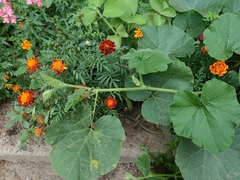 Cucurbita maximae0
- Outcome
- plant habite0
- Comparator
- genetic subgroupse0
Not reportedDirection
Organisms pictured · Representative pictures of the matched species, not figures from the paper.

Verbatim
e0“close alignment of seed size in C. pepo , maturity in C. moschata , and plant habit in C. maxima with genetic subgroups”