Abstract
A complex of thrips species infests seedling stage cotton, Gossypium hirsutum (L.), in the southern United States. Preventive control tactics are recommended to manage early season infestations, but foliar insecticides may be necessary to prevent injury for the duration of seedling development. The objective of this work was to compare efficacy of spinetoram to that of spinosad and current standard products, and to define the minimum effective spinetoram rate for satisfactory control of thrips. Foliar applied insecticides were applied with and without a surfactant against varying thrips infestation levels in field plots. Results demonstrated that infestations comprised primarily of tobacco thrip, Frankliniella fusca (Hinds), were more sensitive to spinetoram than spinosad at equivalent rates of active ingredient. Spinetoram applied at 13.0 to 26.0 g a.i./ha provided control comparable to commercial standards under moderate infestation levels. Consistency and numerical increases in efficacy were observed when applying spinetoram (13.0 g a.i./ha) with a surfactant. Efficacy of spinetoram at 13.0 g a.i./ha in combination with a surfactant was confirmed against onion thrips, Thrips tabaci (Lindeman), and in commercial scale plots. Spinetoram alone was not adequate for managing extremely high (>269 fold greater than a threshold of one thrip per plant) populations of tobacco thrips. These experiments demonstrate that spinetoram, applied at 13.0 to 26.0 g a.i./ha, has utility in the management of thrips infesting cotton seedlings.
Abstract from the paper’s OpenAlex record, shown for indexing and research. Copyright remains with the authors or the publisher. Read at the source ↗
The text the model read, with the source record’s inline markup (italics, sub- and superscripts) rendered and its character entities decoded; quote offsets refer to the raw text.
Claims 5
Claim · model-written summary
Tobacco thrips infestations were more sensitive to spinetoram than spinosad at equal active-ingredient rates.
- Taxon
- cotton
 Gossypium hirsutumt0
- Treatment
- spinetorame0
- Interactor
- Frankliniella fusca
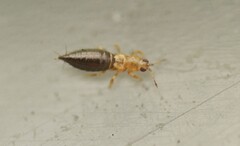 Frankliniella fuscae0pest
- Outcome
- infestations comprised primarily of tobacco thrip, Frankliniella fusca (Hinds)e0
- Direction
- more sensitivee0
- Comparator
- spinosade0
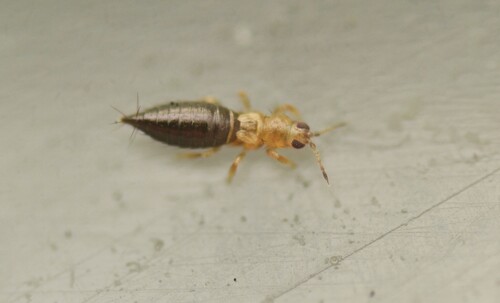
Organisms pictured · Representative pictures of the matched species, not figures from the paper.

Verbatim
e0“infestations comprised primarily of tobacco thrip, Frankliniella fusca (Hinds), were more sensitive to spinetoram than spinosad at equivalent rates of active ingredient”
t0“Seedling Cotton, Gossypium hirsutum L.”
Claim · model-written summary
Spinetoram at 13.0 to 26.0 g a.i./ha gave control comparable to commercial standards under moderate infestation.
- Taxon
- CottonGossypium hirsutumt0
- Treatment
- Spinetoram applied at 13.0 to 26.0 g a.i./hae0
- Outcome
- controle0
- Direction
- comparablee0
- Qualifier
- moderate infestation levelse0
- Comparator
- commercial standardse0
Organisms pictured · Representative pictures of the matched species, not figures from the paper.

Verbatim
e0“Spinetoram applied at 13.0 to 26.0 g a.i./ha provided control comparable to commercial standards under moderate infestation levels”
t0“Thrips (Thysanoptera: Thripidae) in Seedling Cotton”
Claim · model-written summary
A surfactant numerically increased consistency and efficacy of spinetoram.
- Taxon
- CottonGossypium hirsutumt0
- Treatment
- spinetoram (13.0 g a.i./ha) with a surfactante0
- Outcome
- efficacye0
- Direction
- increasese0
Not reportedComparator
Organisms pictured · Representative pictures of the matched species, not figures from the paper.
Verbatim
e0“Consistency and numerical increases in efficacy were observed when applying spinetoram (13.0 g a.i./ha) with a surfactant”
t0“Thrips (Thysanoptera: Thripidae) in Seedling Cotton”
Claim · model-written summary
Spinetoram with surfactant controlled onion thrips in commercial plots.
- Taxon
- CottonGossypium hirsutumt0
- Treatment
- spinetoram at 13.0 g a.i./ha in combination with a surfactante0
- Interactor
- Thrips tabaci
 Thrips tabacie0pest
- Outcome
- Efficacye0
- Setting
- commercial scale plotse0
Not reportedComparatorDirection
Organisms pictured · Representative pictures of the matched species, not figures from the paper.
Verbatim
e0“Efficacy of spinetoram at 13.0 g a.i./ha in combination with a surfactant was confirmed against onion thrips, Thrips tabaci (Lindeman), and in commercial scale plots”
t0“Thrips (Thysanoptera: Thripidae) in Seedling Cotton”
Claim · model-written summary
Spinetoram alone was inadequate for extremely high tobacco thrips populations.
- Taxon
- CottonGossypium hirsutumt0
- Treatment
- Spinetoram alonee0
- Interactor
- tobacco thripse0pest
- Outcome
- managing extremely high (>269 fold greater than a threshold of one thrip per plant) populations of tobacco thripse0
- Direction
- not adequatee0
Not reportedComparator
Organisms pictured · Representative pictures of the matched species, not figures from the paper.
Verbatim
e0“Spinetoram alone was not adequate for managing extremely high (>269 fold greater than a threshold of one thrip per plant) populations of tobacco thrips”
t0“Thrips (Thysanoptera: Thripidae) in Seedling Cotton”
The same questions in other papers
Spinetoram · pest · Gossypium hirsutum (cotton)Positive and negative results
5 in the opposite direction
- positive
- positive
- positive
2 papers more in this group
See all 6 papers →Spinetoram · Thrips tabaci · Gossypium hirsutum (cotton)Results agree
5 papers in the same direction as this paper
- positive
- positive
- positive
2 papers more in this group
See all 6 papers →Spinetoram · Thrips · Gossypium hirsutum (cotton)Results agree
6 papers in the same direction as this paper
- positive
- positive
- positive
3 papers more in this group
See all 7 papers →Claims are grouped by organism, treatment and what was measured or targeted. A paper counts as positive when any of its claims in the group is positive.